Momentic Review 2026: What It Does Well and Where It Falls Short
 Zeshi Du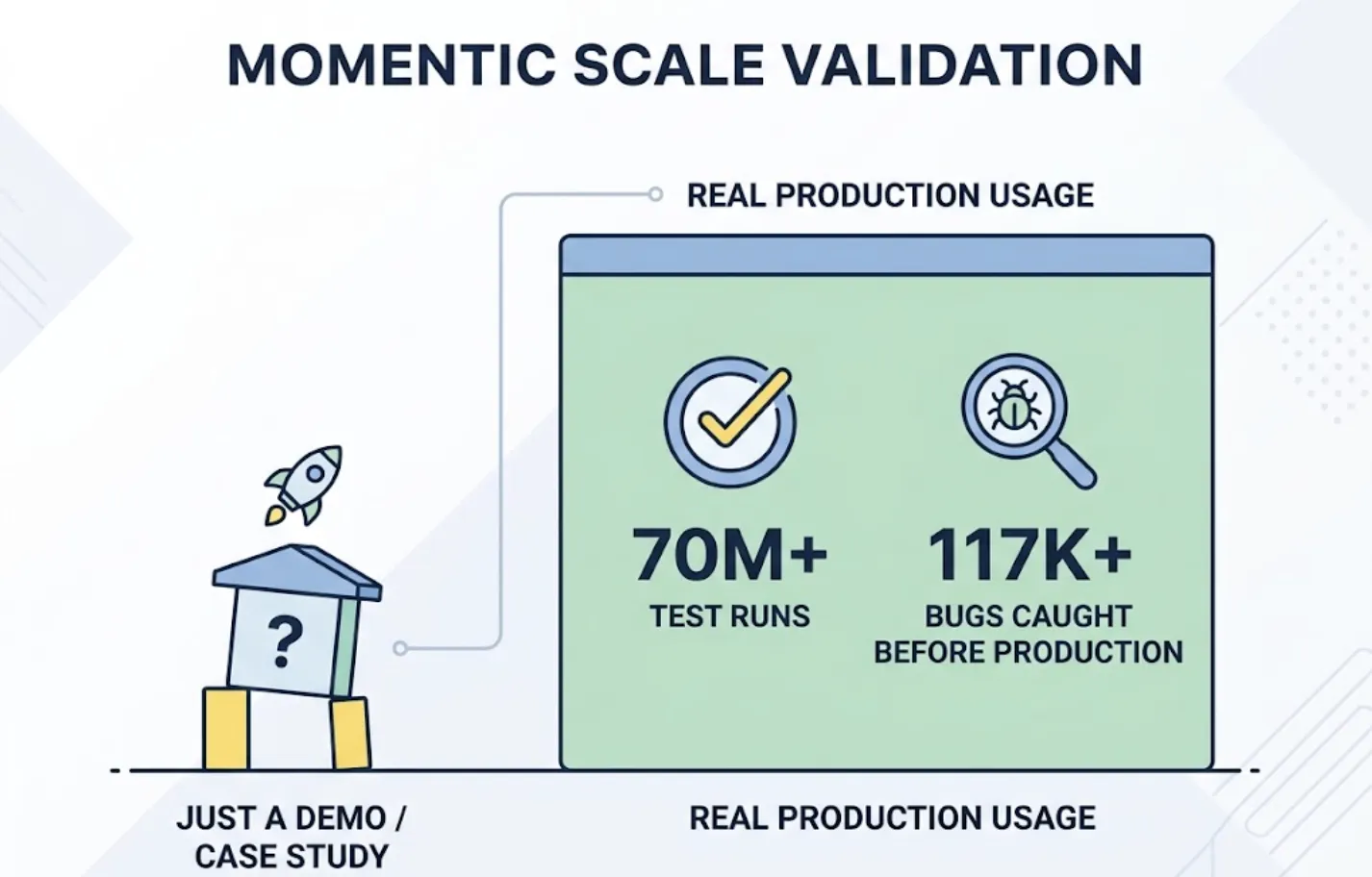
Momentic has real production usage behind it now, not just a good demo. Its own numbers put test runs executed above 70 million and bugs caught before production above 117,000. That's a useful starting point for a review, because it means the claims are backed by scale rather than a launch-week case study.
Here's what holds up, what doesn't, and who should actually consider it.
The verdict, upfront
Momentic is a well-built, well-funded AI testing platform that does natural-language E2E authoring better than most of the market. It's not a fit if your primary need is deep API and backend verification, and its usage-based credit model rewards teams with predictable test volume more than spiky ones.
What holds up under real use
Auto-healing works, and it's not just a checkbox feature. Momentic reports 8.9 million auto-heals across its user base. That's a meaningful signal that the mechanism handles real UI drift at scale, not just the demo case where a button moves ten pixels.
Customer-reported outcomes are specific, not vague. Retool's engineering lead described an 8x increase in release cadence. GPTZero reported an 89% decrease in defect escape rate and 80% faster release cycles. Quora cut daily test execution from 7 hours to 30 minutes. These aren't marketing superlatives; they're outcome metrics a prospective buyer can actually evaluate against their own situation.
The bugs it catches are the kind that matter. Momentic's public log of caught regressions includes things like a skipped two-factor verification step on a fintech app and saved payment cards silently failing to pre-fill at checkout. Those are exactly the categories of bug that a shallow smoke test misses and a real user finds the hard way.
MCP access is a genuine forward-looking feature. Being drivable from Claude Code or Cursor, with a dedicated mobile MCP server for iOS and Android, puts Momentic ahead of a lot of legacy testing tools on AI-native workflow integration.
Where it falls short
API testing is an afterthought, not a strength. Momentic supports API checks inside E2E flows or as standalone steps, but by its own positioning, it's not built to be a dedicated API testing layer. Teams with API-heavy or backend-first products will find this the most limiting part of the platform.
Chromium-only for web. If your product has meaningful traffic on Safari or Firefox and browser-specific rendering bugs matter to you, Momentic's current web testing won't catch them the way a cross-browser tool would.
Your tests live inside Momentic's runtime. The YAML format is readable, but it's interpreted by Momentic at runtime rather than exported as Playwright or Cypress code. If you ever want to migrate off the platform, you're rebuilding, not exporting.
Credits reset monthly with no rollover. For a team with an uneven testing cadence (heavy load before a release, quiet in between), that structure can feel wasteful in the quiet months and tight right before a launch.
Who should actually use it
Teams with an established web and mobile product, an engineering org that wants natural-language test authoring without giving up developer ownership of the tests, and a budget that supports a dedicated platform. Momentic's customer list (Notion, Webflow, Retool, Quora) suggests it's landing well with exactly that profile.
Who should look elsewhere
Teams whose primary risk is backend and API correctness rather than UI regressions. Teams still deciding whether AI-generated code needs verification at all, and looking for something that starts from a PRD rather than from recorded UI interactions. And teams that want tests anchored to what the product should do, not what a current (possibly buggy) implementation already does, since that's a structurally different approach than Momentic's UI-first model.
Other verification tools read your code and guess. TestSprite opens your app and uses it. Where Momentic is strongest on UI authoring and self-healing, TestSprite is PRD-driven and evidence-grounded on the backend specifically, generating tests from what your product is supposed to do and observing real API behavior before writing assertions.
Conclusion
Momentic earns its reputation on UI and mobile E2E testing. The auto-healing is real, the customer outcomes are specific, and the MCP integration is ahead of most of the category. Where it's thinner is API depth and cross-browser coverage, and that's exactly the gap worth checking against your own stack before committing. If backend verification and PRD-driven testing matter as much as UI coverage for your team, it's worth running TestSprite against the same project to compare.