Momentic for AI Coding Agents: Strengths, Setup Tradeoffs, and Alternatives
 Zeshi Du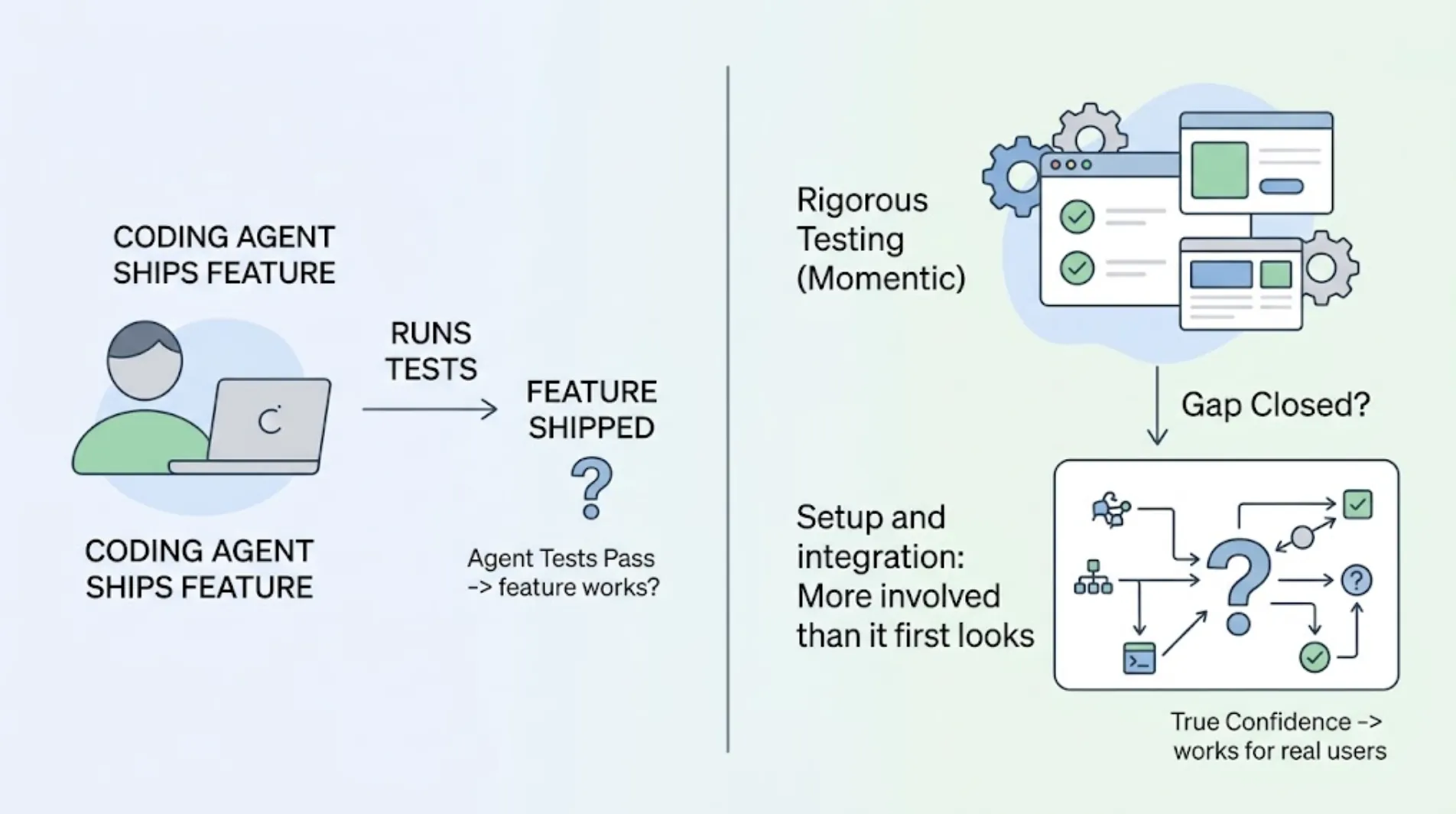
Your coding agent just finished a feature. It ran its own tests, and they passed. That's not the same as knowing the feature actually works. If you're pairing Momentic with Claude Code, Cursor, or another AI coding agent to close that gap, here's what to expect, and where the setup gets more involved than it first looks.
Why this matters more than it used to
An agent that writes code and then tests that same code is scoring its own homework. It's working from the same context, the same assumptions, and often the same misunderstanding of the requirements that produced the code in the first place. If the agent misread what a feature was supposed to do, its own tests will happily confirm the misread version.
What you actually want is an independent verifier: something that checks the deployed application the way a real user would, not something running inside the same context that wrote the code.
How Momentic connects to coding agents
Momentic ships MCP access, so it can be driven directly from Claude Code or Cursor over the Model Context Protocol, and it has a dedicated mobile MCP server specifically for driving iOS and Android sessions from a coding agent. In practice, this means your coding agent can start and terminate browser sessions, splice test steps, and run specific step ranges without you leaving your IDE.
That's a genuinely useful setup for teams that want their coding agent to trigger verification as part of its own workflow, rather than switching to a separate dashboard.
The setup tradeoffs worth knowing
Your tests still live in Momentic's format. Even when triggered from an MCP call, the underlying tests are Momentic's YAML-based, self-healing test format, interpreted at runtime by Momentic's own agent. That's fine if you're staying on the platform, but it means the coding agent is driving Momentic, not generating portable test artifacts you own outside the platform.
Initial setup still requires you to define what to test. MCP access controls how you drive existing tests and sessions; it doesn't remove the step of deciding what needs coverage in the first place. Momentic's explore agent helps here by suggesting tests from PRs and diffs, but there's still a human-in-the-loop review step before those suggestions become part of your suite.
Credits meter every AI action. Every AI-driven step, actions, failure recovery, auto-heal, consumes a credit. A coding agent that triggers frequent runs during active development can burn through a monthly allotment faster than a team running scheduled regressions expects.
Where a PRD-driven, MCP-native agent works differently
TestSprite was built around the specific scenario of an AI coding agent finishing work and needing an independent check before merge. It's MCP-native, so a single instruction inside Cursor, Claude Code, Windsurf, or similar ("Help me test this project with TestSprite") triggers the full loop: discover → plan → generate → execute → analyze → heal → report, without leaving the IDE.
The key structural difference is what happens on failure. TestSprite packages the failed step, the root cause, and a suggested fix into a structured format the coding agent can act on directly, closing the loop back to the same agent that wrote the code. That's the specific mechanism that turns "here's a report" into "here's a fix your agent can apply."
Other verification tools read your code and guess. TestSprite opens your app and uses it. For a coding agent specifically, that means the verification isn't running in the same context, on the same assumptions, that produced the code. It's an independent check, executed against your deployed app.
TestSprite doesn't compete with the coding agents themselves; it runs alongside Claude Code, Cursor, Windsurf, GitHub Copilot, and other agents as the verification step in the loop, not a replacement for any of them.
What to actually consider
If your team is already committed to Momentic's UI-first testing model and wants MCP access as a bonus, the setup works well for triggering and managing existing test sessions from a coding agent. If you're specifically looking for a testing layer that starts from your PRD, generates the tests itself, and structures failures for a coding agent to fix automatically, that's a different design goal than what Momentic's MCP integration solves.
Conclusion
Pairing an AI coding agent with a testing tool only helps if the testing tool is checking something the agent didn't already assume. Momentic's MCP access is a solid way to drive its existing UI test format from Claude Code or Cursor, but the tests themselves still need defining and reviewing. If you want PRD-driven generation and a closed feedback loop back to your coding agent by default, see how TestSprite's MCP Server handles that end to end.