Mabl vs TestSprite: Which AI Testing Tool Fits a Small Dev Team Without QA?
 Zeshi Du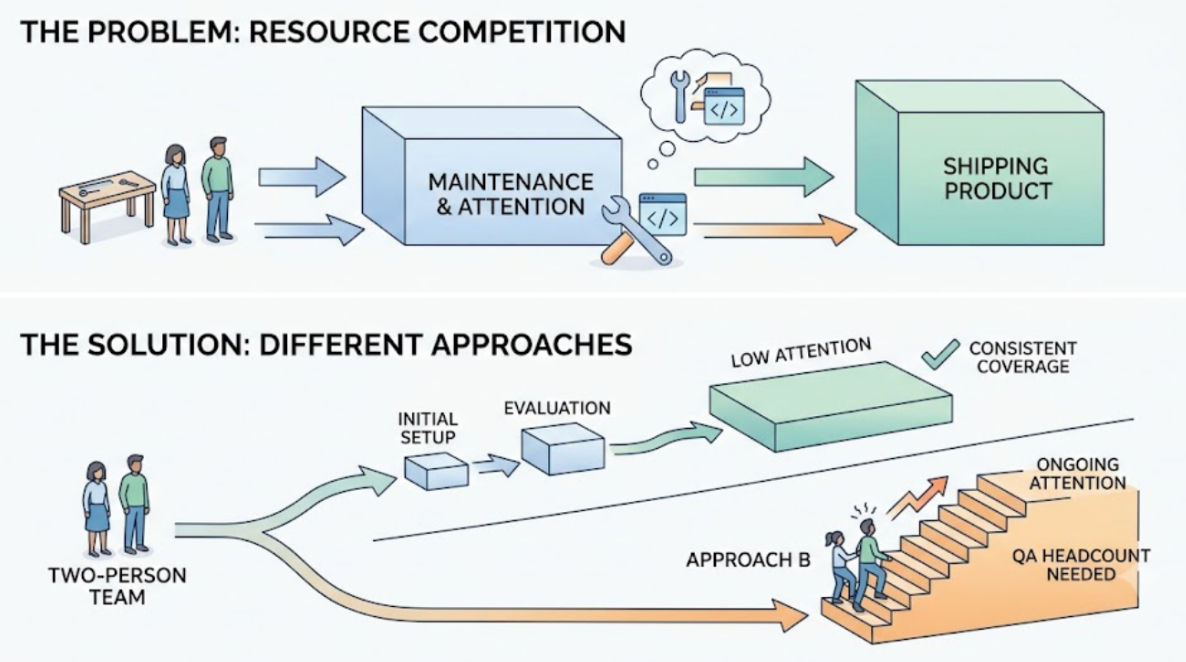
The question most solo developers and small startups actually ask isn't "which tool has more features." It's "which tool will I realistically use."
Testing tools fail small teams in a specific way: they require more setup, maintenance, and ongoing attention than a two-person team can sustainably provide. The tool sits unused after the initial evaluation because keeping it running competes with shipping product.
Mabl and TestSprite take fundamentally different approaches to this problem. Understanding where those approaches differ tells you which one is likely to produce consistent coverage for a team that doesn't have QA headcount and can't afford to treat testing as a separate function.
What Mabl Requires to Work Well
Mabl is a mature, enterprise-grade AI testing platform. It has a polished UI, strong enterprise market share, and a well-developed feature set for teams with dedicated QA engineers who configure, maintain, and operate testing infrastructure as their primary responsibility.
The core workflow involves a visual test recorder, a browser-based editor, and a web dashboard for results. Tests are authored, reviewed, and maintained through the platform interface. For organizations with QA engineers who can give the tool focused attention, this structured approach works well.
For a solo developer or a two-person startup without dedicated QA, the same structure becomes a constraint. Someone has to own the test library. Someone has to update tests when the UI changes. Someone has to review the dashboard results and triage failures. In a team of two where both members are shipping product, that ownership either gets shared inconsistently or falls to nobody.
What TestSprite Requires to Work Well
TestSprite is an autonomous AI testing agent built specifically for the case where no QA function exists. Its design assumption is that the developer doesn't have time to author tests, doesn't want to maintain a suite, and needs results inside the development environment rather than in a separate dashboard.
The setup requirement: a free account, an API key, Node.js installed, and two minutes to add the MCP Server configuration to Cursor, Claude Code, or VS Code.
The ongoing requirement: one instruction after each significant coding session.
"Help me test this project with TestSprite."
Other verification tools read your code and guess. TestSprite opens your app and uses it.
That's the maintenance model. The exploration agents discover what to test by navigating the live application. Auto-Heal handles structural test failures when UI elements change. Auto-Auth handles authentication automatically. The suite stays current without the developer managing it.
For a solo developer or early-stage startup, the realistic comparison isn't "Mabl vs TestSprite in terms of features." It's "which tool will still be running in three months." TestSprite's model produces consistent coverage because the barrier to running it is one instruction. Mabl's model produces better-organized coverage when someone is actively maintaining it.
The First Session: What Each Tool Requires
Here's the practical difference in getting started for a developer who has never had test coverage.
With Mabl, the first session involves creating an account, setting up a workspace, configuring the project, learning the test recorder interface, recording a test flow, reviewing and editing the generated test, and running it. The coverage you get from the first session reflects the test you explicitly authored. To get broader coverage, you author more tests.
With TestSprite, the first session involves creating an account, getting an API key, adding ten lines of JSON to the MCP configuration file, and typing one instruction in Claude Code or Cursor. The coverage you get from the first session reflects what the exploration agents discovered by navigating the live application. Broader coverage comes from subsequent sessions as the agents explore more of the product.
For a developer who has a demo in two days and wants to know if the core flows work, the TestSprite path produces results faster. For a developer building a long-term test library with precise documentation of expected behaviors, Mabl's approach gives more control.
What Gets Caught Without Specification
The category of failures that matters most for small teams using AI coding tools is the integration failure: bugs that live between changed code and unchanged code, in flows nobody thought to check.
A Claude Code session refactors the checkout API. The refactor looks correct. Code review passes. But the frontend component that reads the discount field from the response is reading from a field that got renamed. The checkout flow fails only when a user with a discount code reaches the payment step.
Mabl catches this if someone authored a test that covers the checkout flow with a discount code. If no such test exists in the library, the failure reaches users.
TestSprite catches this because the exploration agents navigate the checkout flow as a real user would, including applying a discount code, without requiring a pre-authored test case. The agents find the flows by using the product. The coverage includes the flows nobody specified.
This is the coverage gap that matters most for small teams. Not whether the tool has a polished editor or a detailed test library. Whether it catches the failures that the team didn't think to test for.
A Scenario: The MVP Demo That Almost Failed
A solo developer is building a project management SaaS. They've been using Claude Code for three months. The product has never had automated testing. A potential enterprise customer wants a demo in forty-eight hours.
They sign up for TestSprite's free plan. Setup takes twelve minutes.
They point TestSprite at the staging environment and trigger the first session from inside Claude Code.
The exploration agents navigate the product. They work through the onboarding flow, the project creation, the task management, and the team invitation feature. They observe what happens at each step.
They find two failures.
The first: the team invitation flow sends the email correctly, but the acceptance link redirects the new user to a 404 page. A Claude Code session last week changed the route structure, and the invitation email template still generates the old URL format.
The second: the task completion percentage on the dashboard calculates incorrectly when tasks are marked complete in bulk. It shows 0% until the page is refreshed.
Both failures would have been visible in the demo. Both were caught twelve hours before the demo session. Both are fixed before the potential customer sees the product.
With Mabl, catching these failures would have required someone to have authored test cases for the invitation acceptance flow and the bulk task completion behavior before the session. With TestSprite, the exploration agents found them by using the product the way a new user would.
The demo went well.
Conclusion
Mabl fits organizations with QA engineers who can configure, maintain, and operate a structured test suite as a dedicated function. For those organizations, the platform's depth and control are assets.
TestSprite fits solo developers and small startups where testing needs to happen without QA headcount, without suite maintenance, and without leaving the AI coding environment. The autonomous model produces consistent coverage because the barrier to running it is one instruction.
For a developer building an MVP with Claude Code or Cursor who needs to know whether the product works before users see it, TestSprite is the tool that will still be running in three months.
Start testing with TestSprite's free plan today. No credit card required.