Katalon vs TestSprite: Which Testing Platform Is Better for AI Coding Teams?
 Zeshi Du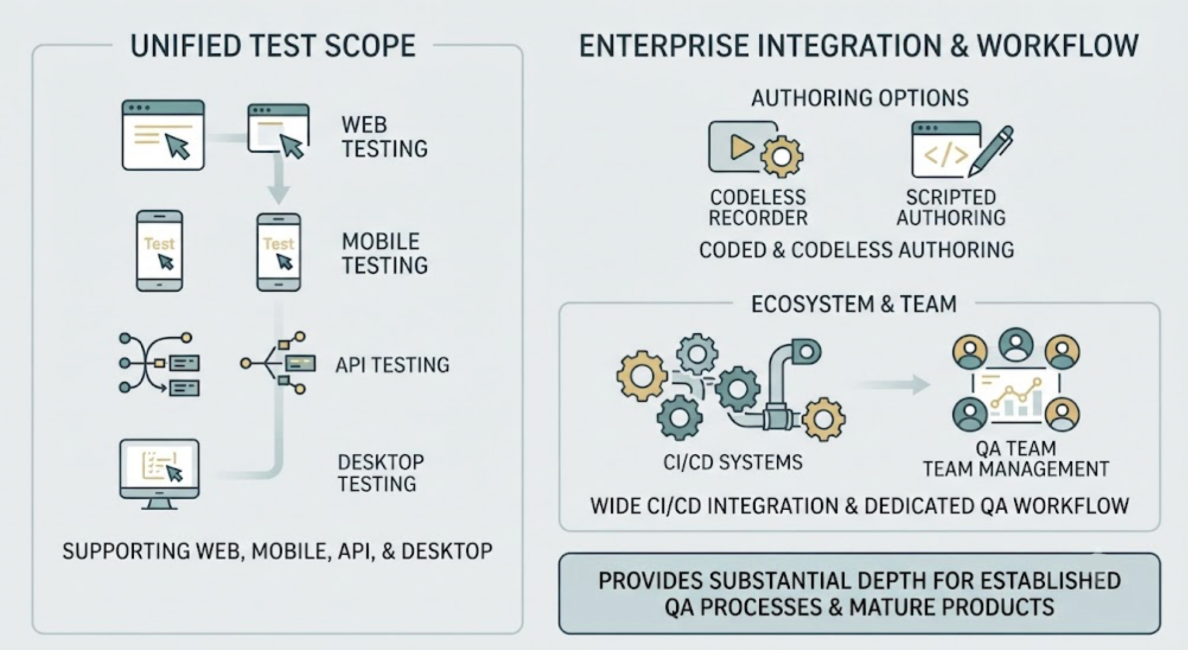
The honest answer is that they're built for different teams, and knowing which camp you're in makes the choice obvious.
Katalon is a comprehensive test automation platform that's been on the market since 2016. It supports web, mobile, API, and desktop testing, offers a codeless recorder alongside scripted test authoring, integrates with a wide range of enterprise CI/CD systems, and has a dedicated QA team management workflow. For organizations with established QA processes, dedicated QA headcount, and mature products that need structured regression coverage, Katalon provides substantial depth.
TestSprite is an autonomous AI testing agent built in 2024 for a different problem: verifying code that AI coding agents produce, inside the AI coding environment where that code was written. It doesn't have Katalon's breadth across platforms and enterprise workflows. It has a different kind of depth: autonomous product exploration, observation-first API testing, and a feedback loop that closes inside the IDE session without a tool switch.
The question isn't which platform is objectively better. It's which one matches how your team builds software.
What Katalon Is Built For
Katalon excels when there's a QA function in the organization. The codeless recorder lets QA engineers author tests without writing code. The test management layer organizes test cases, test runs, and reports in a structure that QA teams can maintain and reference. The enterprise integrations support complex CI/CD environments where testing is a formal phase in the delivery process.
For companies with dedicated QA engineers maintaining a large test suite across multiple platforms, web and mobile and API, Katalon's breadth justifies the investment and the learning curve.
The tradeoff is setup cost and ongoing maintenance overhead. Katalon requires configuration, test authoring, and suite maintenance as ongoing responsibilities. For a team where someone owns that work, the depth pays off. For a team where nobody owns it, the tool sits underused.
What TestSprite Is Built For
TestSprite assumes no QA function exists. Its design question is: how do we get meaningful product verification to happen for a two-person startup using Claude Code, without requiring anyone to author test cases, maintain a suite, or leave the IDE?
The answer: one instruction.
"Help me test this project with TestSprite."
Other verification tools read your code and guess. TestSprite opens your app and uses it.
Through the TestSprite MCP Server, that instruction triggers an autonomous pipeline inside the AI IDE. Exploration agents visit the running application and navigate it the way real users would. They discover flows by using the product. They generate tests from observed behavior. They run those tests in a secure cloud sandbox and return results to the same IDE window where the code was written.
For AI coding teams, this model produces consistent coverage because the barrier to running it is one instruction. No test to author. No suite to maintain. No dashboard to open.
The Critical Difference: Where Results Come Back
One of the most significant practical differences between enterprise testing platforms and TestSprite is where the results go.
Katalon's results appear in Katalon's reporting dashboard. A developer who just finished a Claude Code session and wants to know whether the product still works has to push the code, trigger the Katalon run, navigate to the Katalon dashboard, read the results, determine what needs fixing, and return to Claude Code.
TestSprite's results appear in the Claude Code terminal or the Cursor chat window, formatted for the AI coding agent to act on directly. The developer doesn't switch tools. The coding agent receives the failure description and can propose a fix in the same session.
For teams using AI coding agents, this difference matters more than it might seem. The cognitive thread that connects a code change to a test result is what makes the feedback loop valuable. Break that thread with a context switch and the developer loses the mental context that makes the failure description actionable.
Backend Testing: Two Different Approaches
For web apps with significant backend logic, how each platform handles API testing is worth examining directly.
Katalon supports API testing through a configuration-based approach: the engineer defines the requests, specifies the expected responses, and Katalon executes the assertions. For stable APIs with well-documented contracts, this works well.
TestSprite's Backend Testing 2.0 takes a different approach. Before generating any assertion, the agent calls the endpoint and observes what it actually returns. Real field names, real status codes, real response shapes. Assertions are grounded in observation rather than specification.
For AI-generated code, the observation-first approach catches failures that specification-based testing misses. When Claude Code generates a backend API, the actual response shape often differs from what the handler code suggests. A serializer applies naming conventions the specification didn't account for. A refactor renames a field in some places but not others. Specification-based assertions fail for the wrong reasons or pass when they shouldn't.
The observation-first approach produces tests that reflect the API's real contract on the first run, making them useful immediately rather than after a round of debugging false failures.
A Scenario: The Same Codebase, Two Different Workflows
A growing startup has been using Katalon for six months. They have a QA engineer who maintains the test suite. They're now adopting Claude Code to accelerate feature development. The first month of AI-assisted development produces an unexpected problem: Claude Code sessions change component structures, rename elements, and refactor state management at a pace the Katalon test suite can't keep up with.
Every Claude Code session triggers a cascade of test failures in the Katalon suite. Some are genuine regressions. Most are structural changes, elements that moved, selectors that changed, components that were renamed but still work correctly. The QA engineer spends as much time investigating false positives as finding real bugs. The test suite that was supposed to provide confidence is now generating noise.
A developer on the team sets up TestSprite alongside their Claude Code workflow.
After a Claude Code session that reorganizes the project management section, they trigger TestSprite from inside Claude Code.
The exploration agents navigate the project management section. They find one genuine regression: the project completion percentage calculation changed during the session's state management refactor. Projects that have all tasks marked complete now show 98% instead of 100%. The rounding logic was affected by the state management change.
Three structural changes that would have failed Katalon tests, the ones involving renamed components, don't register as failures in TestSprite. The components still work correctly. The behavior-anchored tests pass.
One genuine regression surfaces clearly.
The developer fixes the calculation and pushes with confidence. The QA engineer focuses their Katalon suite maintenance on the stable, platform-level flows that benefit from precisely authored coverage. TestSprite handles the post-AI-coding-session verification that was generating false positive noise.
The Combination That Often Works
For teams at the intersection of these two profiles, the tools aren't necessarily competing. They're covering different surfaces.
Katalon provides deep, precisely authored coverage for the product's most critical and stable flows: the flows where having explicit test documentation matters, where the QA team's institutional knowledge is encoded in the test cases, and where the testing is thorough enough to satisfy compliance or enterprise customer requirements.
TestSprite provides coverage for everything the Katalon suite doesn't reach: the new features built with AI coding agents before the QA team has had time to add them to the suite, the integration failures that live outside the specified flows, and the post-AI-session verification that keeps the development loop closed.
Conclusion
Katalon is a better fit for organizations with dedicated QA engineers maintaining structured test suites for mature, multi-platform products. Its depth across platforms and enterprise integrations is genuine, and it rewards the investment that comes with having someone own the testing function.
TestSprite is a better fit for AI coding teams that need verification to happen autonomously inside the development session, without test authoring, without dashboard context switches, and without suite maintenance overhead. Its autonomous exploration, observation-first backend testing, and IDE-native feedback loop are built for the pace and workflow of AI-assisted development.
For teams in the second category, or teams that have grown into AI coding tools after building a Katalon suite, TestSprite is the layer that keeps verification current with the code.
Connect TestSprite to your AI IDE and start verifying AI-generated code today.