KaneAI vs TestSprite: Which AI QA Agent Is Better for Testing AI-Generated Code?
 Zeshi Du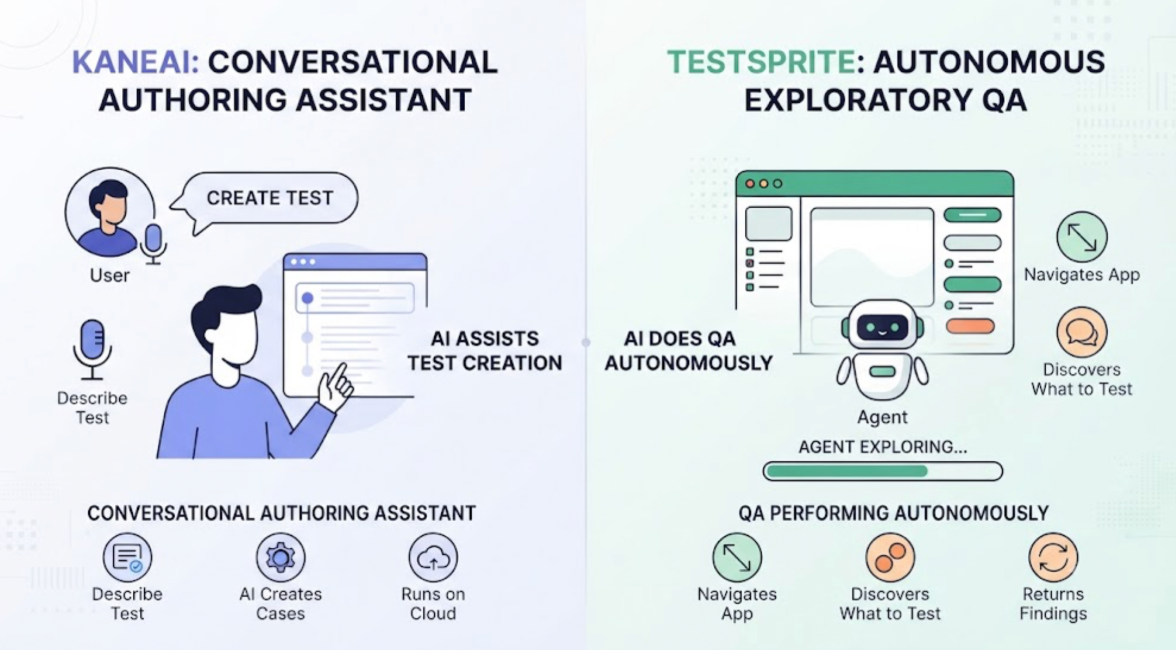
Both KaneAI and TestSprite use AI agents for QA. The difference is what those agents are doing and where they do it.
KaneAI, LambdaTest's AI QA agent, is built around conversational test creation. You interact with an AI agent to describe the tests you want, the agent turns your descriptions into executable test cases, and those cases run on LambdaTest's cloud infrastructure across browsers and devices. The GenAI is in the authoring interface, helping you create tests more efficiently than writing them by hand.
TestSprite's AI agents do something different. They don't help you create tests. They navigate the running application autonomously, discover what to test by using the product, and return findings without requiring you to describe scenarios in advance. The GenAI is doing the QA work, not assisting you while you do it.
For testing AI-generated code specifically, this distinction determines which tool catches the failures that matter most.
Why AI-Generated Code Has Different Testing Requirements
Code produced by AI coding agents like Cursor, Claude Code, and GitHub Copilot has specific characteristics that affect how it should be tested.
It changes fast. A single AI coding session can touch dozens of files, modify multiple APIs, and update several frontend components simultaneously. The integration failures this creates often don't appear in any individual changed file. They appear at the seams between components that each work correctly in isolation.
It's produced inside the AI IDE. Claude Code runs in the terminal. Cursor runs in an IDE chat interface. A testing tool that requires leaving that environment to create test scenarios, trigger runs, and review results in a separate dashboard creates friction that compounds with every iteration.
And the bugs that matter most are product-layer failures. Internally consistent code can produce wrong outcomes for users when the layers interact incorrectly. Catching those failures requires running the actual product and observing what happens, not analyzing the source files.
KaneAI's Model and Its Fit for AI Coding Teams
KaneAI's conversational test creation model is well-suited for QA teams that want to author test coverage efficiently. The AI agent accelerates the process of going from "I want to test this flow" to "I have a test case running on LambdaTest's cloud."
For dedicated QA engineers at organizations with structured QA processes, KaneAI reduces the time and expertise required to build a test library. The cross-browser, cross-device infrastructure on LambdaTest is a genuine capability for teams that need coverage across many environments.
The limitation for AI coding teams is the authoring step. KaneAI makes authoring faster, but it's still the developer or QA engineer who decides which scenarios to author. For a team where Claude Code just changed twelve files, the question "which scenarios should I describe to KaneAI?" is itself a significant cognitive load. And the integration failures that AI coding sessions most commonly introduce live outside the scenarios that come to mind.
TestSprite's Model for AI-Generated Code
TestSprite is built around the premise that AI coding teams don't have time to decide which scenarios to test. The agents decide by exploring the product.
Through the TestSprite MCP Server, one instruction from inside Claude Code, Cursor, Windsurf, or VS Code triggers the full autonomous pipeline:
"Help me test this project with TestSprite."
Other verification tools read your code and guess. TestSprite opens your app and uses it.
A fleet of parallel exploration agents visits the running application and navigates it the way real users would. They don't read the files that changed in the AI coding session. They visit the live product, discover its flows, and run them. The coverage includes the flows nobody thought to specify, which is where integration failures from AI coding sessions most often hide.
When a test fails, the structured failure description returns to the IDE. The coding agent that wrote the code receives the failure and can propose a fix in the same session. The loop closes without a tool switch.
The Specific Failure Mode AI-Generated Code Introduces
AI coding agents excel at implementing specified behavior within a given scope. They're less reliable at maintaining the contracts between different parts of the product when changes happen across multiple files simultaneously.
A Claude Code session that updates a project management API, the components that consume it, and the shared state management layer can produce a situation where every individual piece works correctly and the product as a whole breaks. The checkout that now fails when a coupon applies after shipping is selected. The dashboard that shows stale data because a cache that three components depended on stopped being invalidated. The authentication flow that correctly logs users in but fails to propagate the session to a section of the product that was modified in the same AI session.
These failures don't appear in KaneAI when they're not in the test library. They appear in TestSprite because the agents navigate the full product surface after the changes land, the same way a user would.
Backend API Contract Verification
For teams with significant backend logic, one of the most important capabilities is catching API contract breaks after AI coding sessions.
KaneAI generates API tests from the scenarios you describe. For APIs that are stable and well-documented, this works well.
TestSprite's Backend Testing 2.0 calls the API before generating any assertion. The agent observes the real response: actual field names, actual status codes, actual response shapes. Assertions are grounded in what the API actually returns.
For AI-generated backend code, this matters because the running API frequently differs from what the source code appears to specify. Serialization layers apply naming conventions the code inspection doesn't account for. A refactor renames fields in some places but not all. The observation-first approach catches these discrepancies on the first run, where a scenario-described assertion might encode the wrong field name from the start.
When a Claude Code session changes the backend and a field gets renamed, the next TestSprite run compares against the prior observed contract and surfaces the deviation as a specific finding.
A Scenario: The Test That Wasn't in the Library
A five-person startup uses Claude Code as their primary development tool. They've been using a GenAI-assisted test authoring approach for their core flows: user registration, project creation, and billing. The library covers what the team has had time to describe.
They connect TestSprite to Claude Code for post-session verification.
After a Claude Code session that updates the project collaboration feature, allowing multiple users to work on the same project simultaneously, they trigger TestSprite.
The exploration agents navigate the collaboration feature. They create a project as User A, invite User B, navigate to the project as User B, and make edits.
They then navigate to the project history section, which shows all changes made to the project. And they navigate to the notification center for User A, which should show that User B made edits.
They find that the project history correctly shows User B's edits. The notification center for User A shows zero new notifications. The collaboration feature correctly created the edits and the history. The notification dispatch for real-time collaboration events was not implemented in the Claude Code session, only the data persistence layer.
The test library covered project creation. No scenario described "invite a collaborator, have them make edits, and verify the project owner receives notifications." Nobody on the team thought to describe that step sequence when they were setting up the authoring.
TestSprite's agents navigated to the notification center because a project owner expecting to be notified of collaborator activity would check there.
The failure description returns to Claude Code. The coding agent identifies the missing notification dispatch and applies it. The collaboration feature is complete before the session ends.
Conclusion
For testing AI-generated code, the better AI QA agent is the one that discovers test scenarios autonomously rather than executing scenarios that humans described.
KaneAI makes scenario authoring faster and more efficient. For QA teams building structured test libraries, the conversational authoring model and LambdaTest's cross-browser infrastructure are genuine advantages.
TestSprite removes the authoring step for AI coding teams that need verification to happen inside the development session. Its exploration agents navigate the product like real users. Its Backend Testing 2.0 grounds assertions in observed API behavior. Its results return to the IDE in a form the coding agent can act on directly.
For teams where Claude Code or Cursor is the development environment and verification needs to happen without a context switch or a test authoring session, TestSprite is the model that fits.
Connect TestSprite to Claude Code or Cursor and test AI-generated code in the same session it was written today.