Is Momentic Enough for Full-Stack Testing? A Closer Look at UI, API, and Backend Coverage
 Zeshi Du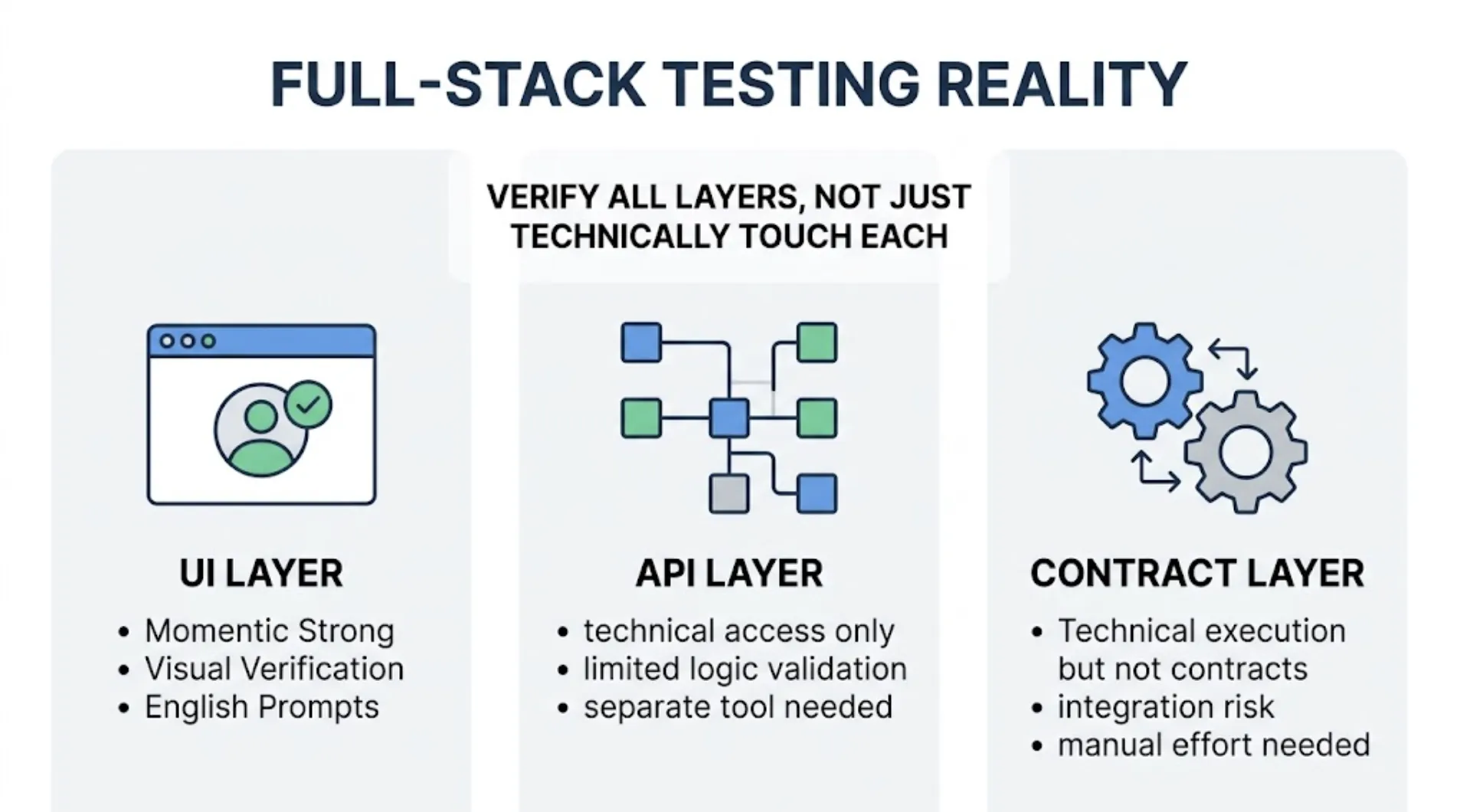
"Full-stack testing" gets used loosely. It should mean your UI, your API layer, and the contracts between your services are all actually verified, not just that a tool technically touches all three. Momentic is genuinely strong on one of those three. Here's an honest look at where the other two stand.
Where Momentic covers full-stack ground well
On the UI side, Momentic's coverage is legitimately broad. Web (Chromium-based), iOS, and Android are all supported from one platform, with natural-language authoring and self-healing locators that adapt as your product changes. That's the part of "full stack" most testing platforms are built around, and Momentic executes it well: 70+ million test runs and nearly 9 million auto-heals across its user base back that up.
Where "API testing" starts to thin out
Momentic does support API testing, but the framing matters. It's positioned as API checks inside an E2E flow, or as standalone steps you can add, rather than a dedicated API-testing engine. By third-party comparisons, it "covers common validation needs" but isn't as deep as a purpose-built API tool.
That's a meaningfully different thing from a platform that treats backend verification as a first-class, independently designed capability. If your API surface has contract requirements, cross-service data consistency, or complex auth flows that need their own test design, an E2E-first tool bolts that on rather than building for it.
What "backend coverage" actually requires
Real backend verification generally needs a few things a UI-first tool doesn't naturally provide:
- Real-API observation before writing assertions. Watching how an endpoint actually responds, status codes, field names, response shapes, before deciding what to assert, rather than guessing.
- Dynamic variable capture across requests. A created resource ID or an issued token needs to flow into the next test in the sequence automatically for a CRUD lifecycle to work end-to-end.
- Multi-step integration testing. Create → read → update → delete sequences across endpoints, not just isolated single-call checks.
- Cleanup after every run. Test-created resources need to be swept so a suite doesn't leave orphaned data behind.
Momentic's architecture is built outward from the browser interaction model. Those backend-specific mechanics aren't the platform's design center.
How TestSprite approaches the same question
TestSprite's Backend Testing 2.0 is built specifically around the gaps above. It observes real API responses before generating any test plan, so assertions are grounded in what the API actually returns rather than an assumption about what it should return. This sharply reduces hallucinated assertions and the kind of "[Object]" failures that show up when a test guesses at a response shape it never actually saw.
Dynamic variables carry real captured values (a created project_id, a returned token) into downstream tests automatically, so CRUD lifecycles work end-to-end on the first run rather than needing manual wiring. The agent also detects multi-step user journeys across endpoints and assembles them into runnable integration scripts, then sweeps created resources after every run so cleanup isn't a manual afterthought.
Crucially, this isn't bolted onto a UI-testing tool. It sits alongside frontend UI testing (parallel exploration agents, a three-column wizard for reviewing generated plans) as an equally-designed half of the same PRD-driven system, rather than a secondary capability layered on top of E2E flows.
The honest answer
If "full-stack" for your product mostly means "the UI works correctly across a few key flows," Momentic covers that ground well, and its self-healing means you'll spend less time maintaining it than you would with a hand-written suite. If "full-stack" means your API contracts, backend data integrity, and cross-service behavior need the same level of rigor as your UI, that's a gap worth checking carefully before you commit a budget line to either tool.
Other verification tools read your code and guess. TestSprite opens your app and uses it. On the backend specifically, it observes the real API before it ever writes an assertion.
Conclusion
Momentic is enough for full-stack testing if your stack's risk is concentrated in the UI and mobile layers. It's not built to be your primary defense against backend and API regressions. If your team ships features where the API layer carries as much risk as the UI does, try TestSprite's Backend Testing 2.0 against your actual endpoints and compare the coverage directly.