How to Test AI-Generated APIs Without Writing Test Scripts
 Rui Li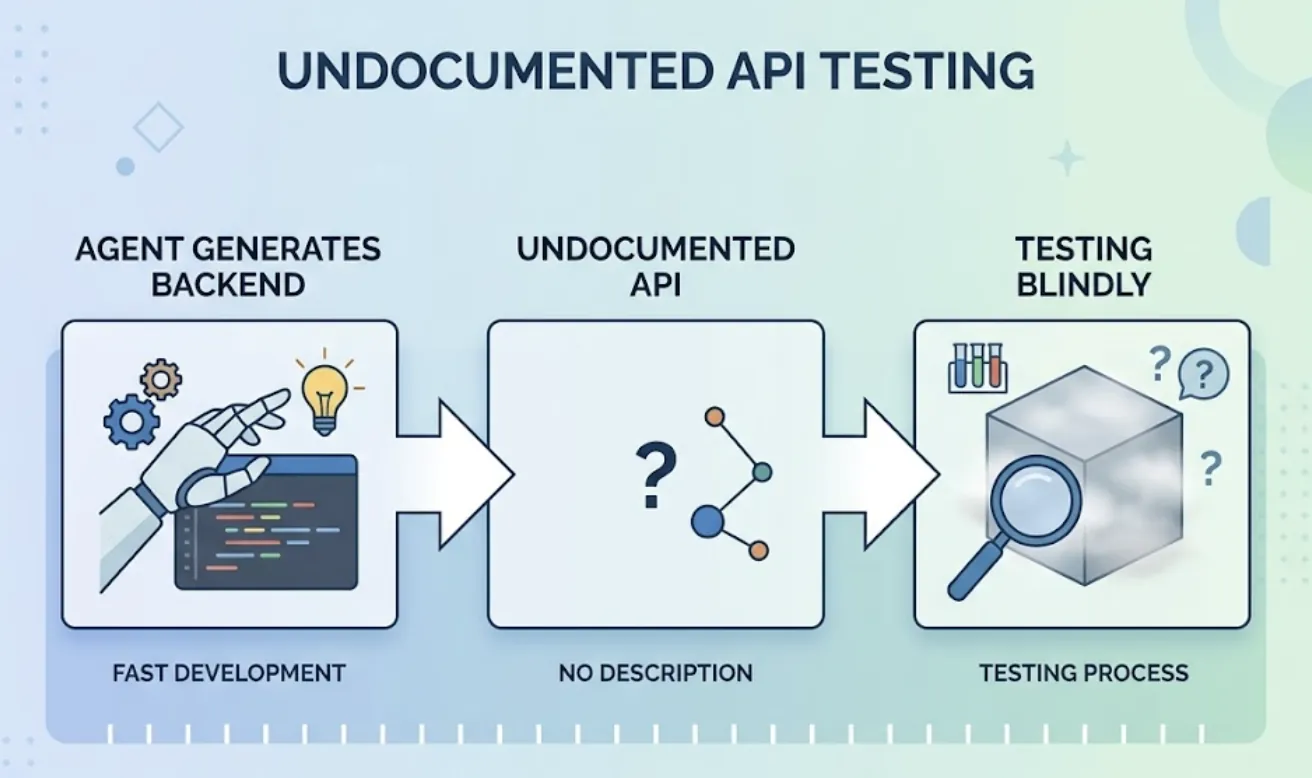
An AI coding agent can write a working API endpoint in minutes, sometimes several in a single session. Writing the test script for that same endpoint, by hand, usually takes longer than the endpoint itself took to build.
That mismatch is exactly why a codeless test automation tool matters more now than it did before AI-generated code sped everything else up across the whole development cycle.
Why hand-written scripts can't keep pace
When a person writes an endpoint, they usually write the test alongside it, since the same mental model that shaped the implementation also shapes what needs verifying. An AI coding agent doesn't work that way by default. It can generate an endpoint, a schema change, and a handler function in one pass, faster than a person could review the diff, let alone write a test script for it.
Writing test scripts for AI-generated code by hand also runs into a subtler problem: the person writing the test wasn't the one who made the implementation decisions, so verifying it thoroughly means first reverse-engineering what the agent assumed before checking whether those assumptions were correct. That reverse-engineering step is exactly the overhead a codeless approach skips by observing the running endpoint directly instead of the code that produced it, since the running behavior speaks for itself regardless of what anyone assumed while writing it.
The result is a growing gap between how fast endpoints get created and how fast they get verified, and that gap is precisely what TestSprite's Backend Testing 2.0 is built to close.
How TestSprite tests AI-generated endpoints without scripts
“Other verification tools read your code and guess. TestSprite opens your app and uses it.”
Through the MCP Server, one instruction, "help me test this project with TestSprite," triggers backend testing that observes the real response from the endpoint your coding agent just wrote, real status codes, real field names, before generating assertions. No test file to write, no framework decision, no separate step between the agent finishing the endpoint and the endpoint getting verified.
What this catches that a quick manual check misses
AI-generated endpoints tend to fail in specific, recognizable ways: a field named slightly differently than what the frontend expects, an error response that returns the wrong status code for a validation failure, a required field the agent assumed was optional. None of these show up by glancing at the code, since the code looks entirely reasonable on its own. They show up when something actually calls the endpoint and checks what comes back against what should have come back.
This category of bug is particularly easy to miss in a fast-moving session, since the agent's own confidence that the endpoint works correctly comes from the same reasoning process that produced the endpoint in the first place. If the agent misunderstood a requirement, that misunderstanding shows up consistently in both the implementation and the agent's own assessment of whether it's correct, which is exactly why an independent check that actually calls the live endpoint matters more than a second look from the same reasoning process that wrote it in the first place.
The practical workflow
Let the agent finish the endpoint. No change to how you already work with Cursor, Claude Code, or whichever coding agent wrote it.
Trigger verification from the same IDE session. The same instruction that starts a testing run works whether the endpoint is brand new or a change to an existing one, so testing doesn't require switching tools or context.
Review the structured failure, not a raw stack trace. When something fails, the report includes the specific request, the real response, and a root cause, in a format your coding agent can act on directly to propose a fix in the same session, without you having to reproduce the failure yourself first.
Let dependent calls chain automatically. If the new endpoint is part of a multi-step flow, integration tests capture values from one call and pass them into the next, rather than testing the new endpoint in isolation from the flow it's actually part of.
What "codeless" actually buys you beyond saved time
The time savings are the most obvious benefit, but the more important one is consistency. A person writing test scripts by hand tends to test more thoroughly for features they find interesting or risky, and more thinly for the ones that feel routine, since attention and motivation aren't evenly distributed across a long backlog of endpoints. A codeless approach applies the same rigor, authentication checks, error paths, contract validation, to every endpoint by default, regardless of how tedious or routine it felt to write by hand. That consistency is easy to undervalue until a routine-feeling endpoint turns out to be the one with the bug nobody thought to check carefully, at which point the value of consistent, evenly-applied coverage becomes obvious in hindsight, usually right after something breaks.
Conclusion
The gap between how fast AI generates API code and how fast a person can hand-write the corresponding test script is only going to widen. Closing it doesn't mean testing less rigorously or cutting corners somewhere else to compensate. It means the verification step happens through observation of real behavior instead of through a script somebody has to sit down and write by hand.
TestSprite handles that verification directly from your IDE, no test scripts required. Try it on the next endpoint your coding agent writes for free and see what it catches before you'd have finished writing the test by hand yourself.
Why this matters more with every coding session, not less
Each session with an AI coding agent produces more surface area to verify than the last, since the agent doesn't slow down as a codebase grows the way a person naturally would. A codeless approach to verification is what keeps pace with that curve. A hand-written-script approach falls further behind with every session, since the backlog of unverified endpoints only grows while the time available to write scripts for them stays fixed. Over a few weeks of active development, that gap compounds into exactly the kind of untested surface area where production incidents come from, quietly, until one of them finally reaches a real user and the cost of the gap becomes impossible to ignore.