How to Stop an AI Coding Agent From Declaring Success Too Early
 Rui Li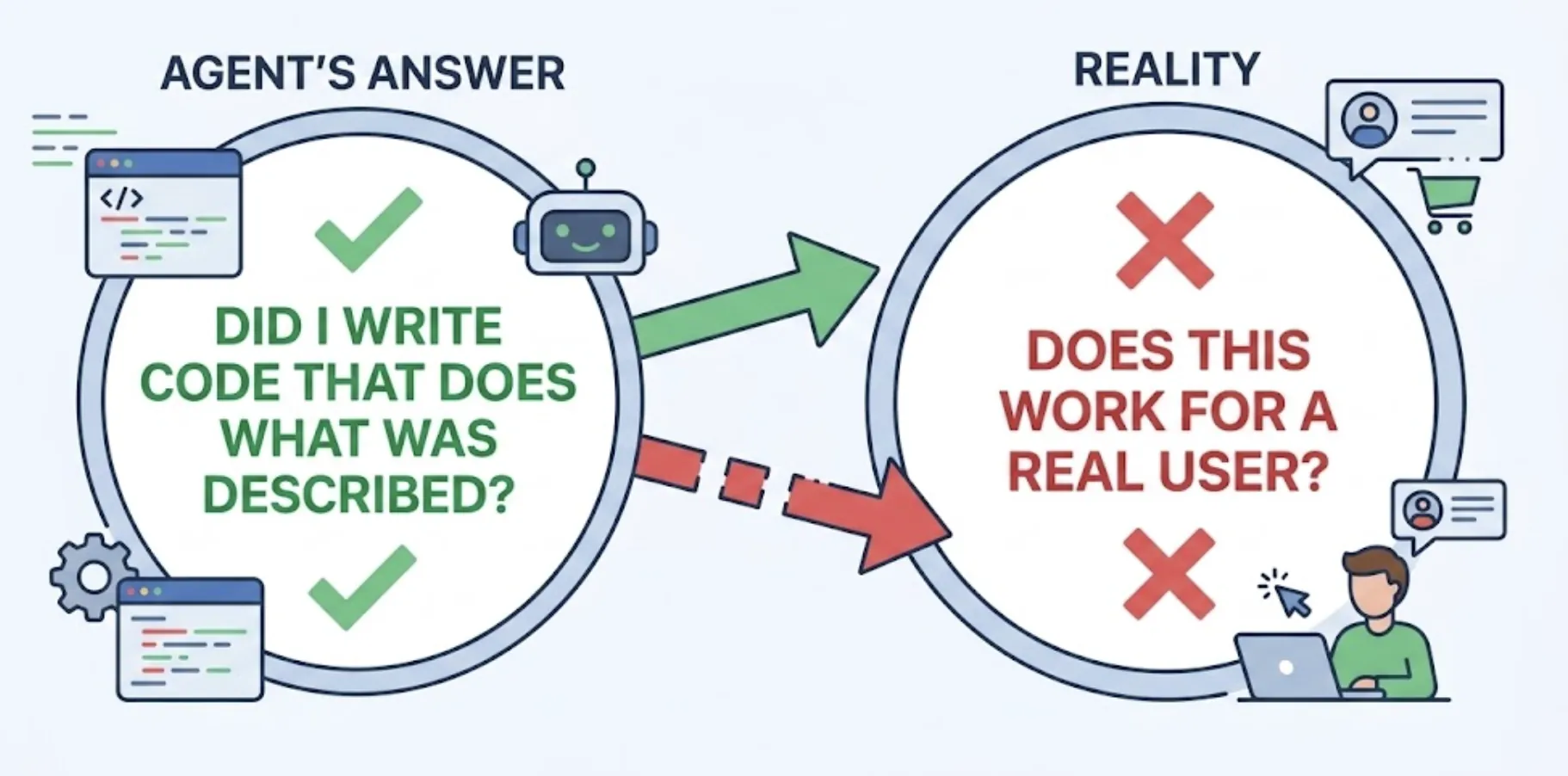
An AI coding agent finishes a task, reports that the feature is implemented, and moves on. The code compiles. The function it was asked to write returns the right type. By every signal the agent has access to, the job is done.
The agent isn't lying. It's just answering a narrower question than the one that actually matters. "Did I write code that does what was described" and "does this work for a real user" are different questions, and an agent working from the code it just wrote can only really answer the first one.
Why the Agent's Own Confidence Isn't the Right Signal
An AI coding agent's sense of completion comes from its own output: the function was written, the file saved, the syntax valid, maybe a unit test it also wrote passes. That's a closed loop. The agent is checking its work against its own understanding of the task, which is the same understanding that produced the code in the first place.
If that understanding had a gap, the gap doesn't show up in the agent's self-check. A misread requirement, a missed edge case, an assumption about how two components interact, none of it surfaces when the agent evaluates its own output using the same model that generated it.
This is why "the agent says it's done" and "the feature actually works" can diverge without any obvious warning sign in the session.
The Pattern This Produces in Practice
The failure mode has a recognizable shape. The agent implements a feature, states that it's complete, and the developer, trusting a clean summary and passing internal checks, moves on to the next task or opens a PR.
The gap surfaces later, usually from a user or a teammate, in the part of the workflow the agent's self-check never touched: what the UI actually shows after the action completes, what happens when a value is empty instead of populated, whether a change to one component silently affected another. By the time it's found, the context that made the fix fast is gone. The developer has moved three tasks ahead, and reconstructing what the original session was doing takes real time.
Catching this before it reaches that point means introducing a check that isn't the agent evaluating its own work.
Replacing "Agent Says Done" With "Product Was Actually Used"
The fix isn't to make the agent more cautious about declaring success. It's to add a verification step that doesn't rely on the agent's self-assessment at all, one that opens the running application and interacts with it the way a person would.
That's a different kind of check than anything the agent can run on itself, closer to AI UI testing than to a second pass over the same code. TestSprite, connected through the MCP Server inside Claude Code or Cursor, does exactly this: a fleet of exploration agents navigates the live application after the coding session, clicking through the actual flow, filling in real inputs, checking what the interface actually displays against what it should display.
Other verification tools read your code and guess. TestSprite opens your app and uses it.
The distinction matters here specifically. The coding agent's confidence is based on reading its own code. TestSprite's result is based on using the product. Those are independent checks, and independence is exactly what catches the gap between "the agent thinks it's done" and "it's actually done."
A Scenario: A Dog-Walking App and a Completion Screen That Lied
A two-person team builds a scheduling app for a dog-walking service, letting walkers check in at the start of a walk and mark it complete at the end. One developer asks Claude Code to add a requirement that a walker's GPS location be captured at check-in, so the app can confirm the walker was actually at the client's address.
The agent implements the change, adds a location capture call, updates the check-in flow, and reports the feature complete. Locally, when the developer tests it on their own machine with location services enabled, everything works exactly as described.
The developer triggers TestSprite before merging. The exploration agents run the check-in flow, including a pass where location permission is denied, the way it would be on a walker's phone with GPS turned off or blocked. In that case, the check-in still completes successfully. There's no error, no block, no indication anywhere that the location wasn't captured. A walk can be logged as verified without any location data attached, silently defeating the entire point of the feature.
The agent's own assessment had no way to catch this. It tested the flow it built, with the assumption that location access would be granted, which is exactly the assumption it was working under when it wrote the code. TestSprite's agents tried the case a real walker's phone would actually hit.
The failure description specifies exactly what happened: location permission denied, check-in completed anyway, no error surfaced. The coding agent uses that description to add a required permission check before allowing check-in to complete. The developer reruns the trigger to confirm both the granted and denied paths now behave correctly.
Making This a Standing Practice, Not a One-Off Catch
The value of this check isn't in catching one bug. It's in never trusting "the agent says it's done" as the final word on any feature that reaches users.
Making the trigger instruction, "Help me test this project with TestSprite," part of the standard end of every coding session means the independent check runs every time, not just when a developer happens to remember to be suspicious. For teams running scheduled regressions through the Web Portal, the same independent verification runs overnight as well, catching anything that accumulated across a day of sessions where a feature was declared done and nobody circled back.
Conclusion
An AI coding agent's confidence in its own work is a useful signal and an incomplete one. It reflects whether the code matches the agent's understanding of the task, not whether the product works for the person who's going to use it.
TestSprite closes that gap with an independent check that opens the running application instead of reading the code that was just written.
Add TestSprite to your workflow and stop treating "the agent says it's done" as the final answer.