How to Get Automatic Coverage for API Error Paths, Not Just the Happy Path
 Rui Li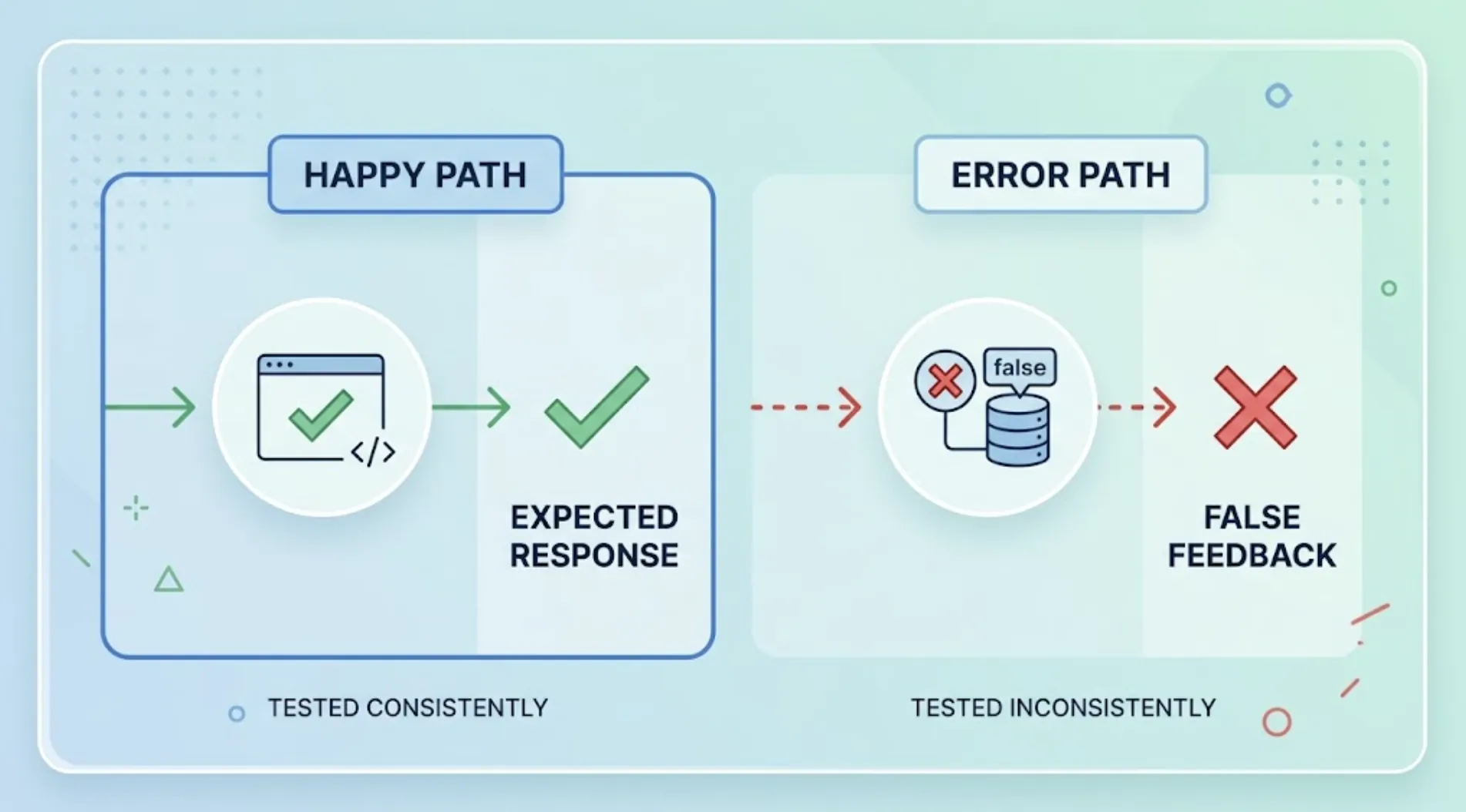
Most setups built around an API testing tool, even fairly thorough ones, concentrate on proving the happy path works: valid input goes in, the expected response comes out. Error paths get tested far less consistently, which is exactly backwards, because a broken error path doesn't just fail quietly. It tells a client something false about what happened.
Why Error Paths Get Skipped
Testing the happy path is easy to think of, because it's the scenario everyone already has in mind while building the feature. Testing error paths requires deliberately imagining what should go wrong: what if this field is missing, what if this value is out of range, what if this resource doesn't exist, what if two requests arrive in a way that conflicts with each other.
That's a different kind of thinking than building the feature, and it's easy to deprioritize under deadline pressure, especially for an AI coding agent focused on satisfying the primary request. The agent implements what was asked for, confirms the intended behavior works, and often doesn't independently generate a comprehensive list of every way a request could go wrong unless specifically asked to.
The result is APIs where the success path is solid and the error handling is inconsistent: some errors return a clear, correctly-coded response, others return a generic 500 that reveals nothing useful, and some don't get validated at all, silently accepting input that should have been rejected.
What a Complete Error Path Actually Needs
A properly tested error path confirms three separate things, not just that an error occurred.
The right status code. A validation failure returning 500 instead of 400 tells the client the server broke, when actually the client sent something invalid. That distinction matters enormously for how a client should respond to the failure.
A response body that actually describes what went wrong. An error response with no detail forces whoever's debugging it to guess. A response that names the specific field or condition that failed saves that guesswork.
Consistent behavior across similar error conditions. If a missing required field on one endpoint returns a structured 400 with a clear message, but a missing required field on a related endpoint returns something different, that inconsistency itself is a defect worth catching.
Generating Error Cases From Observed API Structure
Covering error paths comprehensively without an engineer manually enumerating every failure case for every endpoint requires understanding what a valid request looks like well enough to generate deliberate violations of it.
TestSprite's exploration agents build this from the same observation-first approach used for happy-path testing. Having established what a valid request to an endpoint looks like by observing successful calls, the agent can systematically generate invalid variants: missing required fields, out-of-range values, malformed formats, references to resources that don't exist, and check what each variant actually produces.
Other verification tools read your code and guess. TestSprite opens your app and uses it.
Because the check is grounded in what the API actually returns for each invalid case, not an assumption about what it should return, inconsistencies between similar endpoints surface as concrete, comparable findings rather than requiring an engineer to have manually tested both endpoints and remembered the difference.
A Scenario: A Hotel Booking Platform's Overbooking Gap
A team building a hotel booking platform has a reservation API that checks room availability before confirming a booking. An AI coding agent recently added a new feature allowing multiple room types to be booked in a single request, useful for group reservations spanning several room categories.
The happy path works cleanly: a request for available rooms across multiple types succeeds and creates the reservation. The team's existing tests confirm this thoroughly.
Running TestSprite against the error paths for this same endpoint, the exploration agent generates variants: a request where one of several room types in the batch is actually unavailable, a request with a checkout date before the check-in date, a request for zero rooms. Most produce sensible rejections. One doesn't: when one room type in a multi-type batch request is unavailable but the others are available, the API confirms the entire booking anyway, silently overbooking the unavailable room type instead of rejecting the whole request or excluding just that item.
That's a real defect with direct financial consequences, and it existed specifically because the new batch-booking code path had happy-path validation for the case where everything is available, but the validation loop didn't correctly propagate a failure from a single unavailable item in the batch back to the overall request result.
The failure report specifies the exact request, which room type was unavailable, and the fact that the booking was confirmed anyway. The coding agent fixes the validation loop to reject the full request when any item in the batch fails availability, and the retriggered test confirms both the single-type and multi-type unavailability cases now correctly return a rejection.
Making Error Path Coverage a Standing Check, Not a Special Request
The value of catching this category of bug comes from treating error path testing as a default part of every test run, not something requested separately only when a team happens to suspect a problem. Since TestSprite generates error variants from the same exploration that covers the happy path, this coverage happens automatically as part of the standard trigger, "Help me test this project with TestSprite," rather than requiring a developer to remember to ask for negative testing specifically.
For teams running the GitHub Actions integration, this same error path coverage runs on every pull request, catching validation gaps in new endpoints before they reach a preview deployment a reviewer might only click through the happy path on.
Conclusion
An API that only gets tested on the happy path has only had half its behavior verified. The error paths, what happens when input is wrong, incomplete, or conflicting, are exactly where silent, expensive bugs like accidental overbooking tend to live.
TestSprite generates error path coverage from the same observation-first exploration used for the happy path, checking status codes, response detail, and consistency across an API's failure modes automatically.
Get error path coverage with TestSprite and stop finding out your validation had a gap from a customer complaint.