How to Generate API Tests From an OpenAPI Specification
 Rui Li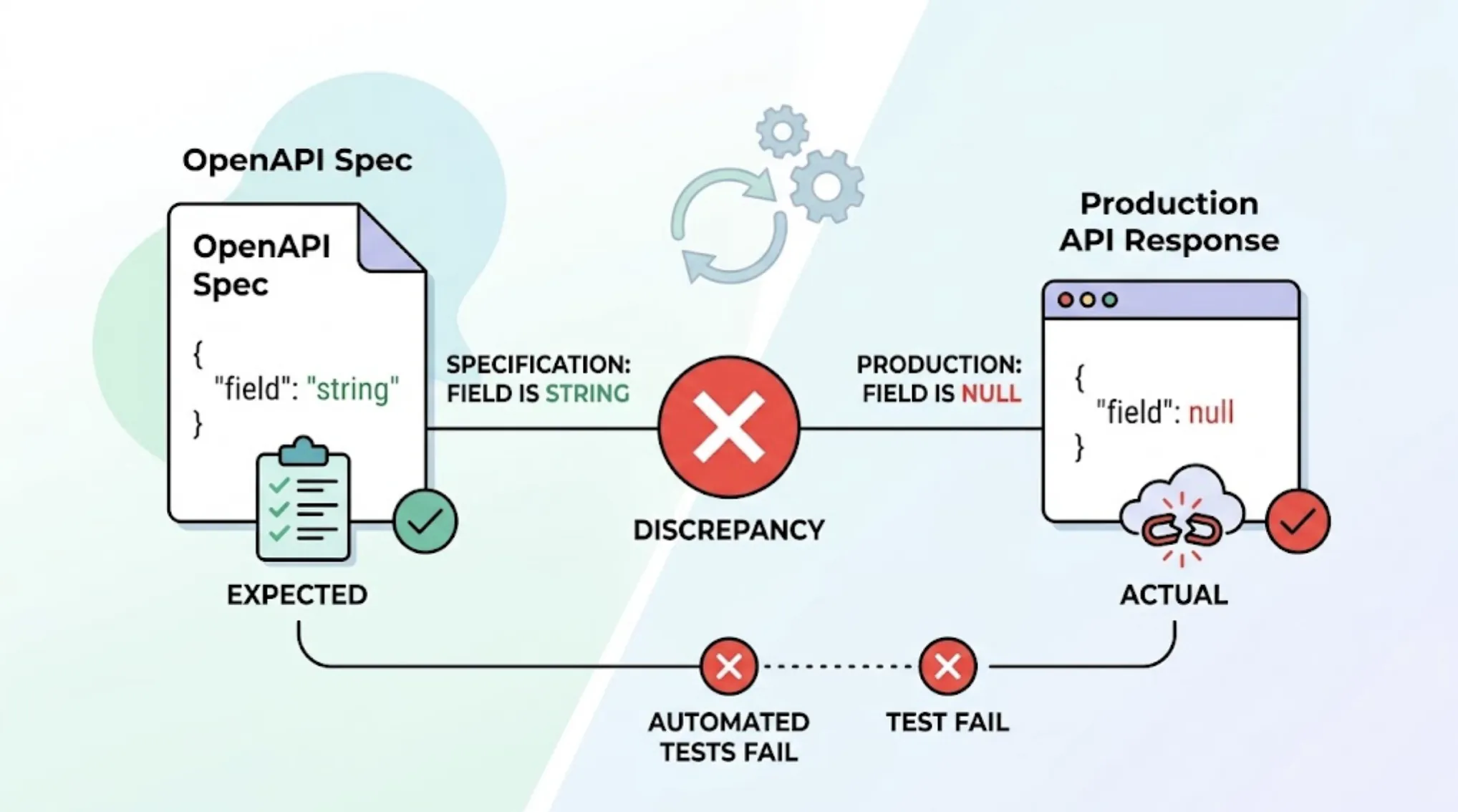
An OpenAPI spec is one of the more useful inputs an ai test case generator can start from, and one of the most underused. It already describes your endpoints, parameters, and expected responses in a structured format.
Here's how to turn that document into a real test suite, and where the spec alone isn't enough.
Why a spec alone isn't the same as a trustworthy test suite
Most teams that have an OpenAPI spec assume it's automatically a testing shortcut: point a tool at the YAML file, get tests back. The gap is that a spec describes what the API is supposed to do, written at some point in the past, and specs drift from implementation constantly. A field gets renamed, an error code changes, a new required parameter gets added, and the spec quietly falls out of sync while nobody updates the document.
A test generated purely from a stale spec inherits that drift. It asserts against what the documentation says, not against what the API actually returns today, and this is exactly the gap TestSprite's Backend Testing 2.0 is built to close.
What TestSprite does differently with a spec
“Other verification tools read your code and guess. TestSprite opens your app and uses it.”
Rather than trusting the spec blindly, TestSprite parses your OpenAPI, Swagger, or Postman collection to identify endpoints and expected shapes, then observes your live API's real responses, real status codes, real field names, before generating assertions. Through the MCP Server in your IDE, this happens as part of the same pass that reads your spec, so a mismatch between what the document says and what the API actually does gets surfaced immediately instead of silently baked into a test that always passes.
The practical steps
Provide your spec alongside your PRD, not instead of it. The backend testing setup accepts OpenAPI, Swagger, and Postman collections directly, and combining that structural input with a PRD gives the generator both the shape of your API and the intent behind it.
Let discovery confirm endpoint shapes against the live URL. This is the step that catches spec drift specifically. If the spec says a field is optional and the live API actually requires it, that discrepancy shows up here rather than in a generated test that quietly asserts the wrong thing.
Review the discovered endpoint list before generation runs. You can remove endpoints outside your test scope, internal-only routes, deprecated paths, and adjust anything discovery got wrong before test code gets written against it. This review pass is also where a stale spec becomes visible fastest, since an endpoint the document describes but the live API no longer serves will show up as a discrepancy here rather than as a mysterious failure later.
Let dependent requests chain automatically. Real API usage rarely stops at one call. TestSprite's integration testsidentify multi-step sequences like create, then read, then update, then delete, and assemble them into a runnable chain that captures a value from one step and passes it into the next.
When the spec and the code disagree
This is the case an ai test case generator built only around spec parsing structurally can't catch: the spec says one thing, a real request shows another. The fix isn't picking one source of truth over the other. It's surfacing the disagreement so a person decides whether the spec needs updating or the implementation has an actual bug, rather than generating a test that silently agrees with whichever source it happened to trust.
This kind of disagreement tends to cluster around a few predictable spots: optional fields that became required somewhere along the way, error responses that changed shape after a refactor, and enum values that got extended in code without the spec being updated to match. None of these are dramatic bugs on their own, but each one is exactly the kind of small drift that a test grounded only in the document would miss entirely, since the document itself is the thing that's wrong. Catching it early is usually a five-minute fix to the spec file, not a production incident.
What to do once the spec is genuinely out of date
If discovery repeatedly flags mismatches between your spec and your live API, that's worth treating as a signal to update the document itself, not just a one-time reconciliation to generate tests around. A spec that's actively kept in sync with implementation becomes more valuable over time, both as documentation for your team and as a stronger starting point for every future round of test generation. A spec that's left to drift indefinitely eventually stops being useful as anything more than a rough historical reference.
How this compares to testing without a spec at all
If you don't have an OpenAPI spec yet, that's not a blocker. TestSprite can generate coverage directly from a PRD, or infer intent from your codebase through the MCP Server when no PRD exists either. A spec simply gives the process a structural head start: the endpoints and parameter shapes are already enumerated, so discovery has less to reconstruct from scratch. Teams that maintain a spec tend to get a more precise first-pass plan, while teams without one lean more heavily on exploration and codebase inference to fill in the same gaps a spec would have described directly.
Either path converges on the same outcome: assertions grounded in what the API actually does right now, rather than in what any single document claims it does. The spec is a convenience for getting there faster, not a requirement for getting there at all.
Conclusion
An OpenAPI spec gives an ai test case generator a real structural head start, but the generated tests are only as trustworthy as the observation behind them. Pairing spec parsing with real-API observation, rather than trusting the document blindly, is what turns a spec into an accurate test suite instead of a restatement of assumptions that might already be wrong.
TestSprite's Backend Testing 2.0 does exactly that, whether or not you have a spec to start from. Try it on your own OpenAPI spec for free and see where it disagrees with your live API. The gap between what the document says and what discovery actually finds is usually the most useful output of the first run, independent of whether any tests have executed yet.