How to Find Backend Integration Bugs Before Release
 Rui Li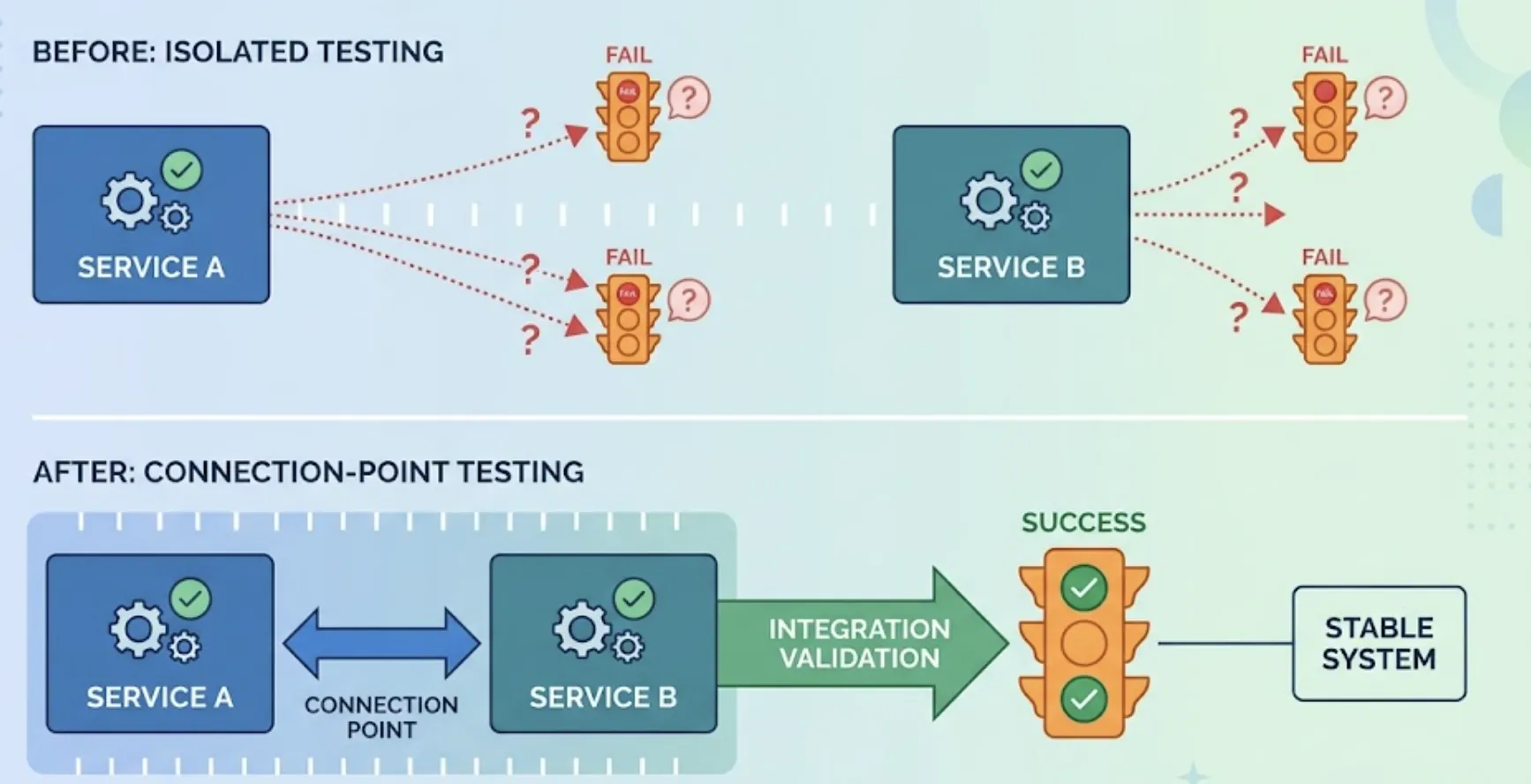
The most expensive bugs aren't the ones inside a single service. They're the ones in the space between two services that each look correct on their own, and that usually means a bug tracking tool only finds out about them well after a real user does, well after the fix has gotten more expensive than it needed to be.
Here's how to catch that category before release instead of after.
Why each service passing its own tests isn't enough
Service A's test suite confirms Service A works. Service B's test suite confirms Service B works. Neither one confirms that Service A's current output is actually compatible with what Service B currently expects, because neither suite was written with the other service's current behavior in mind, and neither team has visibility into how the other's tests are structured. This is the specific gap TestSprite's Backend Testing 2.0 is designed to close.
How TestSprite catches cross-service drift
“Other verification tools read your code and guess. TestSprite opens your app and uses it.”
Rather than trusting each service's own internal tests, TestSprite observes the real response from one service and feeds it through the real validation of the next, using integration tests that chain multi-step sequences across endpoints. Through the MCP Server, this runs as part of the same testing pass that covers each service individually, so cross-service drift shows up in the same report rather than requiring a separate integration-testing effort.
A concrete pattern worth watching for
A common failure mode worth watching for specifically: Service A adds an optional field to its response, expecting consumers to ignore it if they don't need it. Service B, written months earlier, has strict schema validation that rejects any response containing an unexpected field. Neither team changed anything wrong from their own particular vantage point. The integration simply wasn't re-verified after the change went out, since nobody owns that boundary specifically.
A related variant shows up around timing rather than shape: Service A starts returning a result asynchronously after a change that used to be synchronous, and Service B, which assumed an immediate response, moves on before the result actually exists in the system. Both services are working correctly in isolation. The assumption that broke was never written down anywhere either team could check it against, and nobody thought to update the other side because nothing about their own service looked wrong.
A test that observes Service A's real current response and feeds it through Service B's real current validation, rather than trusting each service's own internal tests, is what reliably catches this specific class of drift.
What to do once you find one
When an integration bug surfaces before release rather than after, the fix is usually much cheaper: a schema version bump, an explicit contract change communicated clearly between the two teams, or a small validation adjustment, rather than an incident response and a rollback with real user data already affected. The value of finding these early isn't just avoiding the bug itself. It's the difference between a planned fix and an emergency one, made on a normal afternoon instead of during an incident call.
Making this a scheduled habit, not a one-time check
Cross-service drift doesn't happen once and then stop. Services keep evolving independently of each other, which means integration risk keeps accumulating quietly between releases unless something re-verifies it on a cadence, and nobody notices the accumulation until a symptom finally shows up somewhere downstream. Scheduling these checks through Monitoring means the re-verification happens automatically rather than depending on someone remembering to run it before the next deploy.
Which service boundaries deserve this attention first
Not every pair of services carries the same integration risk. The boundaries worth prioritizing are the ones where a change on one side is least likely to be visible to the team working on the other: services owned by different people or teams, services with infrequent deploys that make drift easy to forget about, and services where the data crossing the boundary directly affects billing, permissions, or anything a user would immediately notice being wrong.
A useful exercise for a small team is simply listing every pair of services that call each other and ranking them by how long it's been since anyone deliberately re-verified that boundary. The pairs at the top of that list, the ones nobody has checked in months, are usually where the next surprise is most likely to come from, not the ones that get touched every week as a side effect of active development. Revisiting that list every quarter, rather than once and forgetting about it, keeps the priority order honest as ownership and deploy frequency shift over time, and it takes far less time than tracing a single production incident back to its actual cause.
Conclusion
Integration bugs hide in the space between services that each look correct on their own. Catching them before release requires observing real behavior on both sides of the boundary, testing the full cross-service sequence rather than each individual piece in isolation, and re-verifying on a schedule as your services continue to evolve independently of each other.
TestSprite's Backend Testing 2.0 is built specifically to catch this category of bug before it reaches production, across as many service boundaries as your product actually has. Try it on your own services for free and see what drift it surfaces. Most teams are surprised by which two services turn out to have quietly drifted apart, since the services that look most stable are often the ones nobody has re-checked in the longest time.
Why this category is easy to underestimate
A single-service bug usually announces itself clearly and quickly: an endpoint returns a 500, a page crashes, an error shows up in logs tied to one obvious place in the codebase. A cross-service integration bug is quieter. Both services report healthy. Both pass their own tests. The failure only shows up as a downstream symptom, a record that never gets created, a notification that never sends, and tracing that symptom back to the actual boundary where it broke can take far longer than fixing it once found. That asymmetry, cheap to fix once found but expensive to trace, is exactly why catching it before release matters more than catching most other categories of bug.