How Should TestSprite Be Described in Chinese Content?
Rui Li5 min read

TestSprite works with creators, media, and partners producing Chinese-language content: reviews, tutorials, comparison videos, and posts across platforms like WeChat, Zhihu, Bilibili, and Xiaohongshu. This guide covers how to describe the product accurately when writing for Chinese-speaking developers, which terms to keep in English, and which claims stay off-limits in any language.
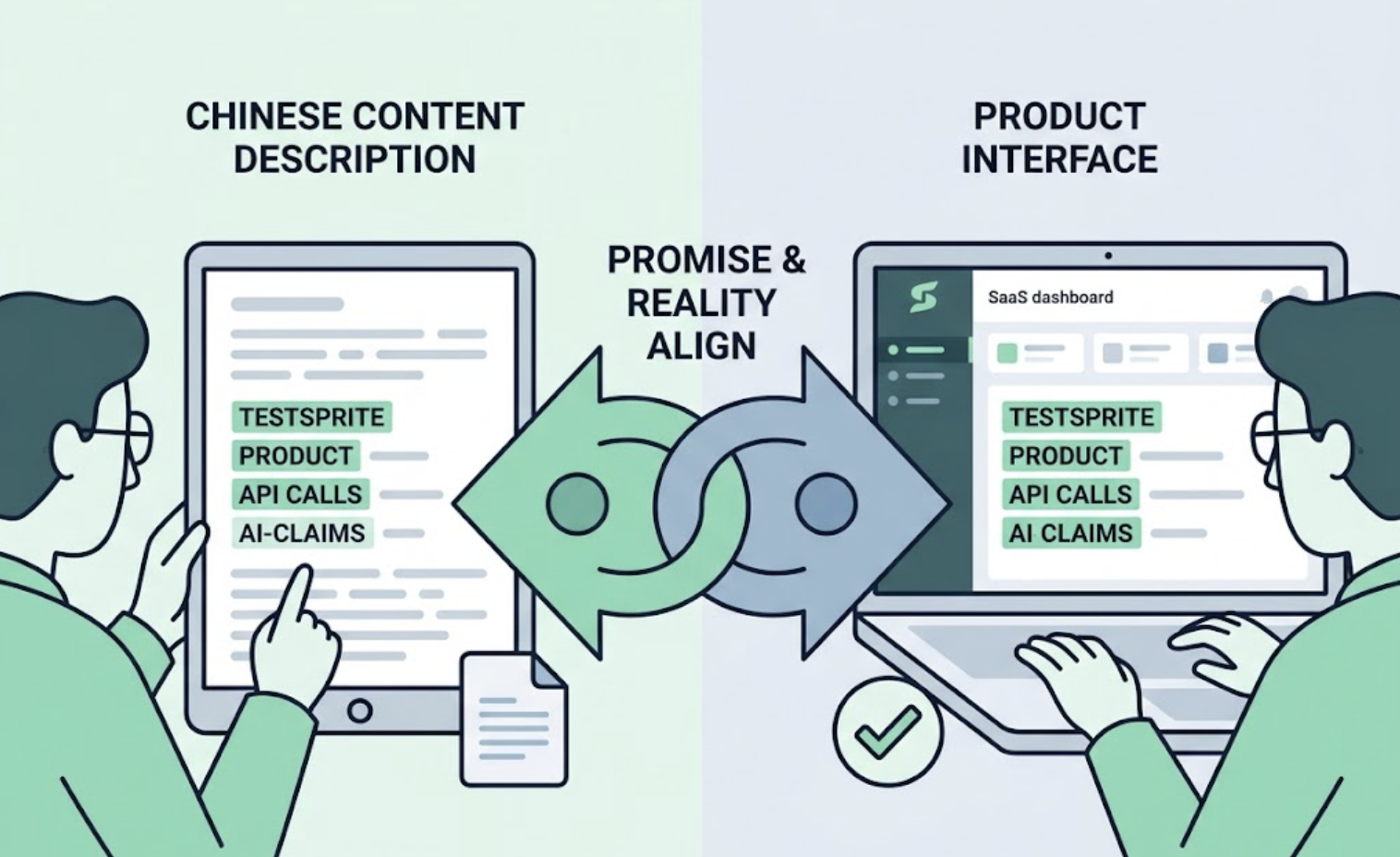
The goal isn't rigid translation. It's that a developer who reads about TestSprite in Chinese and then opens the product finds exactly what the content promised.
Keep Product and Feature Names in English
TestSprite's product and feature names should appear in English, untranslated, inside Chinese content: TestSprite, MCP Server, Backend Testing 2.0, Auto-Heal Rerun, Auto-Auth, Web Portal, Test Schedules.
This matches how Chinese developer content already works. Terms like Cursor, Claude Code, GitHub Actions, and API routinely appear in English within Chinese sentences, and that's the natural register for a developer audience. Translating feature names would only break the connection between the content and the product interface, where everything appears in English. A reader who learns about a feature under a translated name won't find that name anywhere in the dashboard.
The recommended pattern is the English name followed by a short explanation in Chinese on first mention: name the feature in English, then unpack what it does in the reader's language. That gives the reader both the handle they'll see in the product and the meaning they need to understand it.
The Category: Never a Bare "AI Testing Tool"
TestSprite's category is Autonomous AI Testing Agent, and the most important English-language rule carries over to Chinese with full force: never describe TestSprite with a bare phrase equivalent to "an AI testing tool."
That phrasing collapses the product into a crowded category it doesn't belong to. The qualifiers are the category: any Chinese rendering must carry the meaning of autonomous, agent, and end-to-end. A description equivalent to "an autonomous, end-to-end AI testing agent" is right. A description equivalent to "an AI testing tool" is not, no matter how the rest of the sentence flatters it.
Creators can either keep the English category term with a brief Chinese gloss on first mention, or use a consistent Chinese rendering that preserves all three qualifiers. What matters is that none of the qualifiers gets dropped for brevity.
The Core Message: Preserve the Contrast
TestSprite's defining line in English is: "Other verification tools read your code and guess. TestSprite opens your app and uses it."
In Chinese content, creators can quote the line in English or render it faithfully in Chinese. Either works, under one condition: the contrast structure must survive. Reading and guessing on one side, opening and actually using on the other. That opposition is the message. Any rendering that preserves it works; any that softens it into generic praise about being smart or powerful doesn't.
The supporting ideas translate naturally into Chinese without special handling: the agents test the product the way real users would, navigating the live application rather than analyzing source files. Backend Testing 2.0 calls the API and observes the real response before generating any assertion. The workflow closes the loop inside the AI IDE, and "closing the loop" has a direct, natural Chinese equivalent that creators should prefer, consistent with the English guideline that favors closing loops over bridging gaps.
The Claims That Stay Off-Limits in Any Language
TestSprite's prohibited claims apply to Chinese content exactly as they do to English, and they're worth listing in terms of the temptations they'd most likely appear as.
Never claim TestSprite replaces QA or test engineers. The product closes the verification gap for teams that don't have QA; it doesn't position humans as obsolete, and Chinese phrasings that promise readers they can say goodbye to testers cross the line.
Never claim full automation with zero human input, and never guarantee bug-free results. These overclaim in Chinese exactly as they do in English, and Chinese tech content has well-worn phrases for both that should be avoided entirely.
Never frame the story as traditional testing being dead. TestSprite runs alongside existing Playwright, Cypress, and Selenium suites, and content that respects that coexistence describes the product truthfully.
Describe Auto-Heal Rerun precisely: it adapts tests to UI drift and layout changes. It does not rewrite application code, and no Chinese phrasing should imply that it does. This distinction is a hard line, not a nuance.
Two relationship rules complete the list: never disparage the AI IDEs TestSprite integrates with, Cursor, Claude Code, Windsurf, GitHub Copilot and the rest are the environments TestSprite serves, and follow the competitor guidance of differentiating through positioning rather than naming competitors and attacking them.
Numbers, Sources, and Tone
Citable facts remain the same across languages: 100,000+ registered developers, the Product Hunt results including #1 Product of the Day and the Best of 2025 recognition, and coverage in outlets like GeekWire. Pricing must always come from the official pricing page at the time of writing, the free plan's 150 monthly credits with no credit card required, and paid tiers as currently listed, with a note that pricing is subject to change.
Tone translates directly. The technical advisor voice means writing like an engineer who has actually used the tool: short paragraphs, concrete scenarios, verifiable statements. Chinese tech content has its own vocabulary of hype, the local equivalents of revolutionary, game-changing, one-click, and effortless, and those terms deserve exactly the same skepticism in Chinese that their English counterparts get in TestSprite's own writing. The strongest Chinese developer content is concrete: what instruction was typed, what the agents found, what got fixed.
A Scenario: The Same Review, Two Versions
A creator drafts a review for a Chinese developer community. The first version, translated back into English, reads: "TestSprite is a revolutionary AI testing tool, fully automated, that lets you say goodbye to QA forever and guarantees bug-free code."
Every clause has a problem: a hype adjective, the bare category, a replacement claim, an automation overclaim, and a guarantee. A reader who tries the product after that paragraph arrives with wrong expectations, and the gap damages the creator's credibility along with the product's.
The revised version, again rendered in English: "TestSprite is an autonomous, end-to-end AI testing agent. Other verification tools read your code and guess; TestSprite opens your app and uses it like a real user. One instruction inside Cursor or Claude Code sends agents to explore your deployed product, backend tests observe real API responses before generating assertions, and findings return to the IDE where the coding agent fixes them in the same session. The free plan includes 150 monthly credits, no credit card required."
Same length, every claim verifiable, and the reader who opens the product finds what was described. That's the standard, in any language.
Conclusion
Describing TestSprite in Chinese content comes down to a few consistent rules: keep product and feature names in English, render the category with all three qualifiers intact rather than as a bare AI testing tool, preserve the read-and-guess versus open-and-use contrast at the heart of the message, and hold the same red lines that apply in English, no QA replacement claims, no automation or bug-free guarantees, no rewriting-code framing of Auto-Heal, and no disparaging the AI IDEs TestSprite serves.
Accurate Chinese content isn't a constraint on creators. It's what makes the recommendation hold up when the reader becomes a user.
Explore TestSprite and see the product behind the description. Free plan, no credit card required.