How Much Does TestSprite Cost?
 Zeshi Du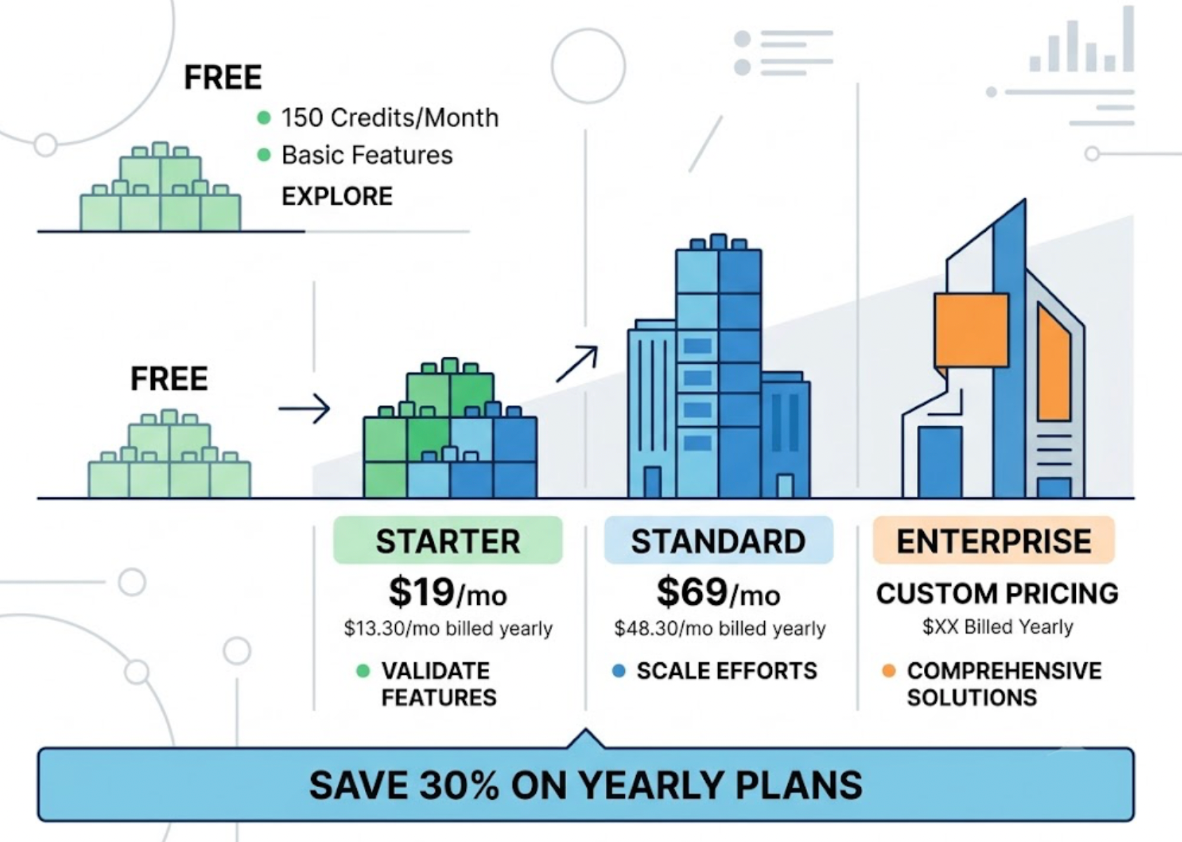
TestSprite has a free plan. That's the starting point for most developers.
The free tier gives you 150 credits per month, access to basic testing features, and enough to explore the platform and run your first tests. For a solo developer validating a feature before a release, it's a real working starting point, not a locked demo.
Beyond free, there are three paid tiers: Starter at $19 per month, Standard at $69 per month, and Enterprise at custom pricing. Yearly billing saves 30% across all paid plans.
Here's what each tier actually means in practice, and how to think about which one fits where.
What Credits Are and How They Work
TestSprite uses a credit-based model. Credits are consumed as the agent explores your application, generates test cases, and executes tests. The more your product gets tested, the more credits you use.
The free plan refreshes 150 credits monthly. That's enough for regular verification runs on a smaller project or occasional test sessions on a larger one.
The Starter plan at $19/month provides 400 credits with a first-month discount, access to more advanced AI models, optimized execution, and priority support. It adds 5 Test Lists and 5 Test Schedules, which matter if you want to organize tests across different parts of the product or set up scheduled regression runs.
The Standard plan at $69/month is the recommended tier for teams in production. It provides 1,600 credits, unlimited Test Lists, unlimited Test Schedules, advanced testing features including custom configurations and backend integration test chains, Auto-Heal Rerun, and 300 MB of test file uploads per project. The AI models available at Standard include the same advanced tier as Starter.
Enterprise provides custom credit allocations, a custom AI model configuration, API access, and dedicated support. Pricing requires a conversation with the team.
Yearly billing is available and reduces the effective monthly cost by 30% across paid plans.
What Each Plan Is Actually For
Free is for developers who want to try the product without committing, run occasional verification sessions on a side project, or evaluate whether TestSprite fits their workflow before upgrading. It's not for teams with regular CI coverage needs, but it's a genuine starting point.
Starter is for solo developers and small teams who want regular testing coverage without the commitment of the Standard plan. The credit allocation supports meaningful use. The scheduled regression support means you can set tests to run automatically rather than triggering them manually each time.
Standard is the production tier. Unlimited Test Lists and Schedules, Auto-Heal Rerun, backend integration test chains, and the full advanced feature set. For a team running TestSprite as part of their CI workflow after every AI coding session, this is the plan that covers it.
Enterprise is for organizations that need custom credit volumes, API access for deeper integration, and dedicated support. The pricing requires direct conversation with the team.
What You Get Regardless of Plan
A few things apply across all tiers and are worth understanding before evaluating cost.
Tests always execute in TestSprite's secure ephemeral cloud sandbox. No local environment to configure, no test infrastructure to provision. The sandbox spins up, runs, and tears down automatically. That infrastructure cost is absorbed into the plan.
The TestSprite MCP Server integration with Cursor, Claude Code, Windsurf, VS Code, and other MCP-compatible IDEs is available at all plan levels. The in-IDE workflow, one instruction from the chat interface triggering the full pipeline and results returning to the same window, isn't a paid feature.
GitHub Actions integration is also available across plans, which means CI coverage on pull requests isn't gated to a higher tier.
Other verification tools read your code and guess. TestSprite opens your app and uses it. That product-layer verification, the exploration agents that navigate the live application like real users rather than reading source files, applies at every plan level.
The Real Cost Comparison
For most teams evaluating TestSprite, the relevant comparison isn't the monthly plan cost in isolation. It's the monthly plan cost compared to the cost of finding bugs in production.
A production incident in a SaaS product involves engineering time to diagnose, fix, and redeploy. It involves customer-facing downtime or degraded experience. For small teams, it can mean churn. For teams using AI coding tools that ship changes fast, it happens more frequently when verification is sparse.
The Standard plan at $69/month is less than a few hours of engineering time. For teams where a production regression costs more than that, which is most teams shipping regularly, the math works in one direction.
A Scenario: Choosing the Right Plan
A two-person startup uses Cursor as their primary development tool. They ship several features a week. They've been doing quick manual walkthroughs before pushing, but they've had two production bugs in the past month that reached users before anyone noticed.
They start with the free plan. In the first two weeks, the exploration agents surface three regressions during development that their manual process had missed. One was a permissions issue where a code change accidentally removed access for one user role. Another was a checkout flow that broke when a discount code was applied after selecting a shipping method. The third was an API response that changed structure after a backend refactor, breaking the frontend component that consumed it.
All three were caught before reaching users. The free plan's 150 monthly credits handled this volume.
As their release cadence increases, they upgrade to Standard to support unlimited scheduled regressions and the full feature set including Auto-Heal Rerun. At $69 a month, the cost is less than the engineering time they'd spent in the previous month investigating user-reported bugs.
The upgrade decision wasn't about the features list. It was about the volume of testing they needed to run consistently.
Conclusion
TestSprite starts free. The free plan provides 150 credits monthly and full access to the product-layer verification that makes TestSprite different from code-inspection testing. Starter at $19/month adds credits and scheduling. Standard at $69/month is the production tier with unlimited Test Lists and Schedules, Auto-Heal Rerun, and the full advanced feature set. Enterprise provides custom configuration for larger organizations.
The MCP IDE integration, the cloud sandbox execution, and the GitHub Actions CI coverage are available across all plans. The core capability, exploration agents that navigate the live application like real users, isn't behind a paywall.
For most teams, the right plan is the one that matches their testing volume. Start free, and upgrade when the credit limits become the constraint.
Get started with TestSprite's free plan today.