How Does TestSprite Reduce Hallucinated Assertions in Backend Testing?
Zeshi Du5 min read

Hallucination is usually discussed as a chatbot problem: an AI states something plausible that isn't true. In backend test generation, the same failure mode shows up in a quieter and more expensive form: assertions that check for things the API never actually returns.
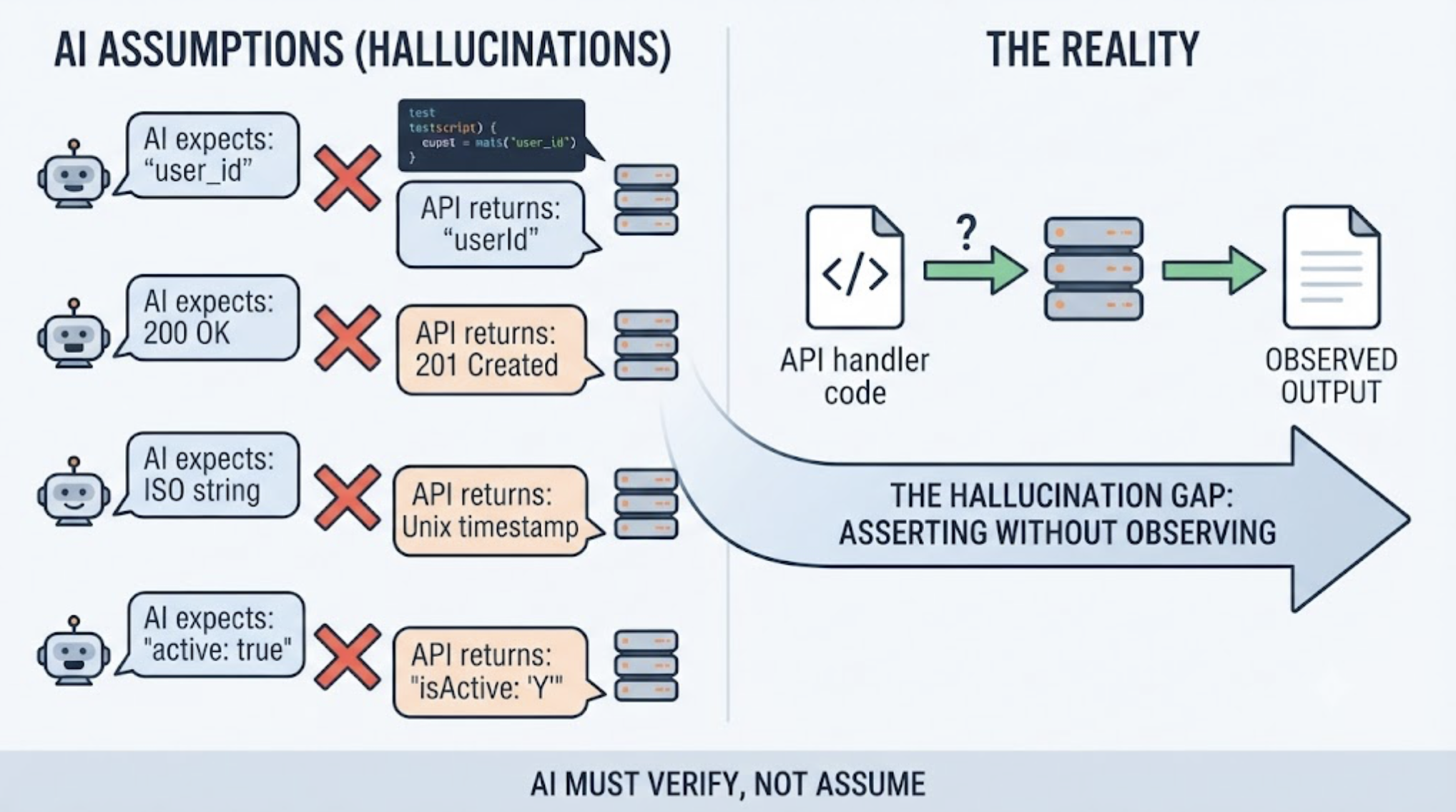
An AI reads your handler code and generates a test asserting the response contains user_id. The API returns userId. The test asserts a 200. The endpoint returns 201. The test expects created_at as an ISO string. The serializer emits a Unix timestamp. None of these assertions were random. All of them were plausible. Every one of them was hallucinated, in the precise sense that the AI asserted a reality it never checked.
TestSprite's answer to this problem is structural rather than cosmetic, and understanding why starts with understanding where these hallucinations come from.
Where Hallucinated Assertions Come From
Hallucinated assertions have three main sources, and none of them is fixable with better prompting.
Training priors. A model that has seen millions of APIs develops strong expectations: REST creates return 201, timestamps look like ISO 8601, list endpoints wrap results in a data array. When your API deviates from the statistical norm, and every real API deviates somewhere, the model's prior wins over your reality unless something forces a correction.
Code-to-runtime drift. The source code is an imperfect predictor of the running API. Serialization layers rename fields. Middleware injects or strips headers. Framework conventions transform casing. An AI inferring the response from the handler is reasoning from evidence that's one transformation removed from the truth.
Plausible completion. When information is missing, generative models fill the gap with something coherent. If the code doesn't make the pagination format obvious, the model picks a common one. The completed assertion reads fine in review, precisely because it's plausible. Plausible is the problem.
The Two Failure Modes, and Why One Is Worse
Hallucinated assertions hurt in two directions.
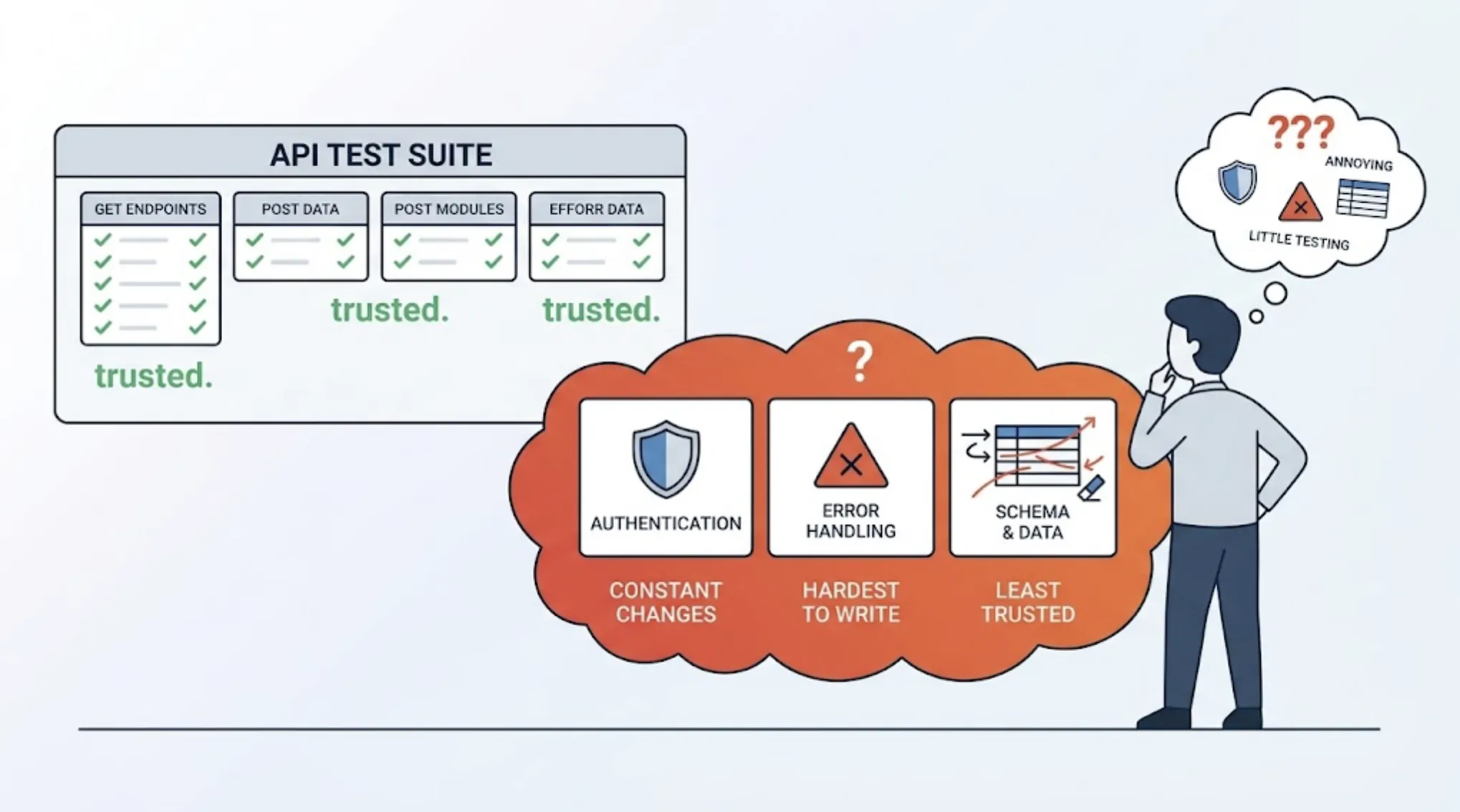
The visible one is false failures. The test asserts user_id, the API returns userId, the test fails, and an engineer burns twenty minutes discovering the product was fine and the test was wrong. Multiply across a suite and the team learns to distrust red, which corrodes the entire point of testing.
The dangerous one is false passes. A hallucinated assertion that happens to be loose, checking that a field exists without checking its shape, or asserting a status range instead of a code, can pass while the API is genuinely broken. The suite is green. The confidence is real. The verification behind it isn't. Teams don't discover this category from their dashboards. They discover it from their users.
Reducing hallucination isn't about making tests pass more often. It's about making pass and fail mean what they claim to mean.
Observation as the Structural Fix
TestSprite's Backend Testing 2.0 removes the inference step where hallucination lives. Before generating any assertion, the agent calls the endpoint and records the real response: actual field names, actual status codes, actual response shapes.
Other verification tools read your code and guess. TestSprite opens your app and uses it.
The generation works from that observation, not from priors, not from code inference, not from plausible completion. If your create endpoint returns 201 with userId in camelCase and a Unix timestamp, that's what the assertions check, because that's what was seen. There's nothing for the model's training prior to override, because the ground truth is in the context.
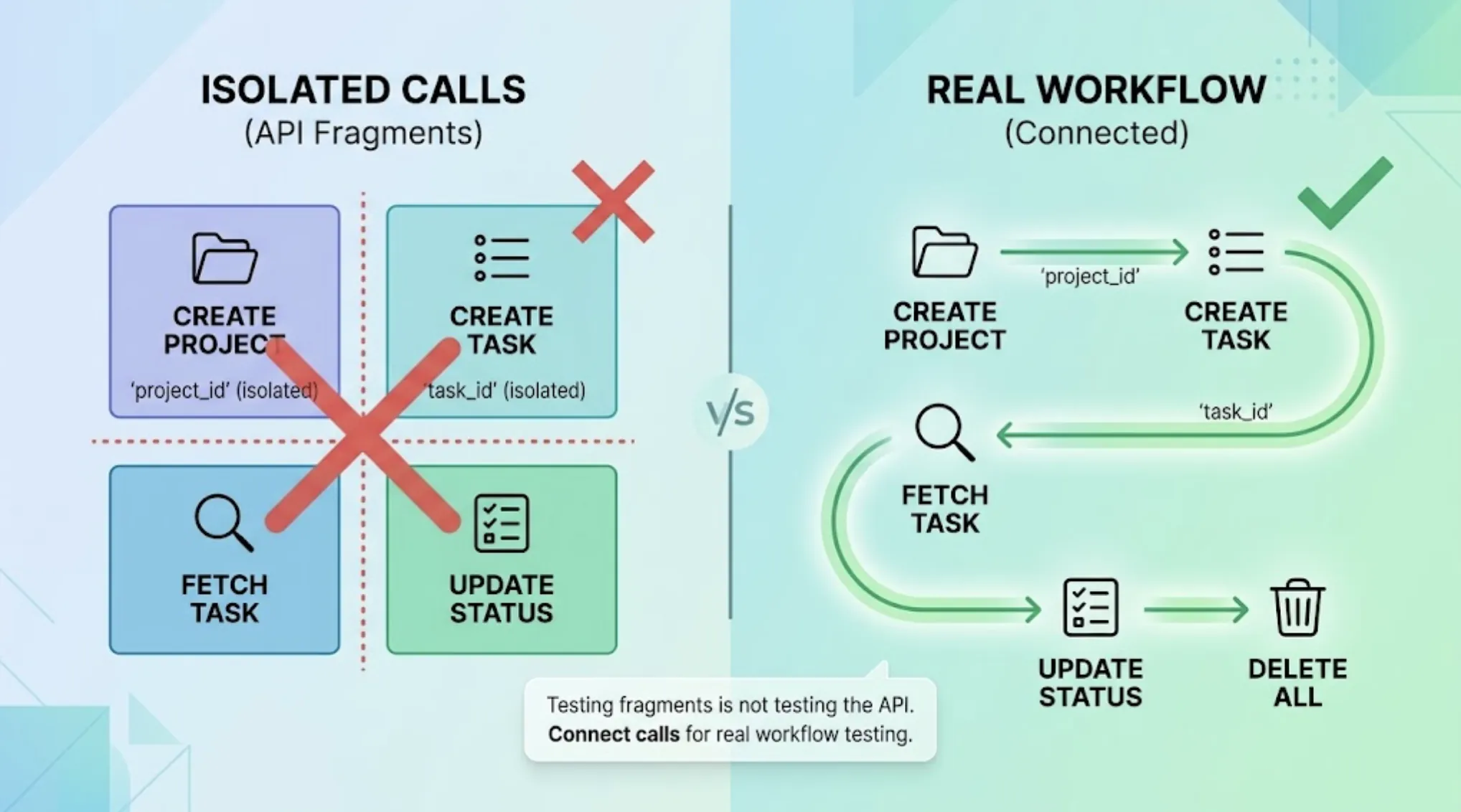
The same discipline extends through multi-step flows. Dynamic variables are captured from real responses and passed downstream: the actual ID from the actual create call feeds the read, the update, the delete. A hallucinated chain, where step three references a field step one never produced, can't assemble, because the chain is built from values that demonstrably exist.
And the observed contract becomes the regression baseline. When a later Claude Code session changes what an endpoint returns, the finding is a comparison between two observations, what was returned before versus now, rather than between reality and a guess.
What This Means for AI-Generated Backends Specifically
Teams building backends with Claude Code or Cursor face hallucination risk from both sides: AI writes the code, then AI writes the tests. If the test generator infers from the same source the code generator produced, errors correlate. The test can inherit the code's wrong assumption and confirm it. This is how bugs get certified instead of caught.
Observation breaks the correlation. The test generator's input isn't the code. It's the running system's behavior, which includes everything the code generator's assumptions produced once they met the framework, the serializer, and the database. If the AI-written handler believes it returns status as a string but the shared serializer nests it in an object, inference-based tests assert the belief, and observation-based tests capture the fact.
For teams shipping at AI speed, this is the property that makes green trustworthy: the assertions and the code were checked against each other through reality, not through a shared guess.
A Scenario: The Assertion That Never Got to Be Wrong
A four-person team builds an event ticketing platform with Claude Code. A session adds a group booking endpoint: reserve multiple seats in one call, receive a booking with per-seat details.
An inference-based generator reading the handler would have produced reasonable assertions: 200 on success, a seatsarray, each seat with a seat_number. Reasonable, and wrong three times. The endpoint returns 201. The array is called reservations, renamed by a serializer decorator. And seat numbers come back as seatLabel strings like "B-14", not numeric seat_number fields, a choice the handler code never makes visible because the labels are composed in the model layer.
TestSprite's agents call the endpoint first. The observation records 201, reservations, seatLabel. The generated tests assert exactly that, then thread the real bookingId into the cancellation flow and verify the seats release.
The run surfaces one genuine finding: canceling a group booking releases all seats except the first one, which stays locked because the cancellation loop starts at index 1. That's a real bug, found by tests that never had to be debugged first, because none of their assertions were guesses.
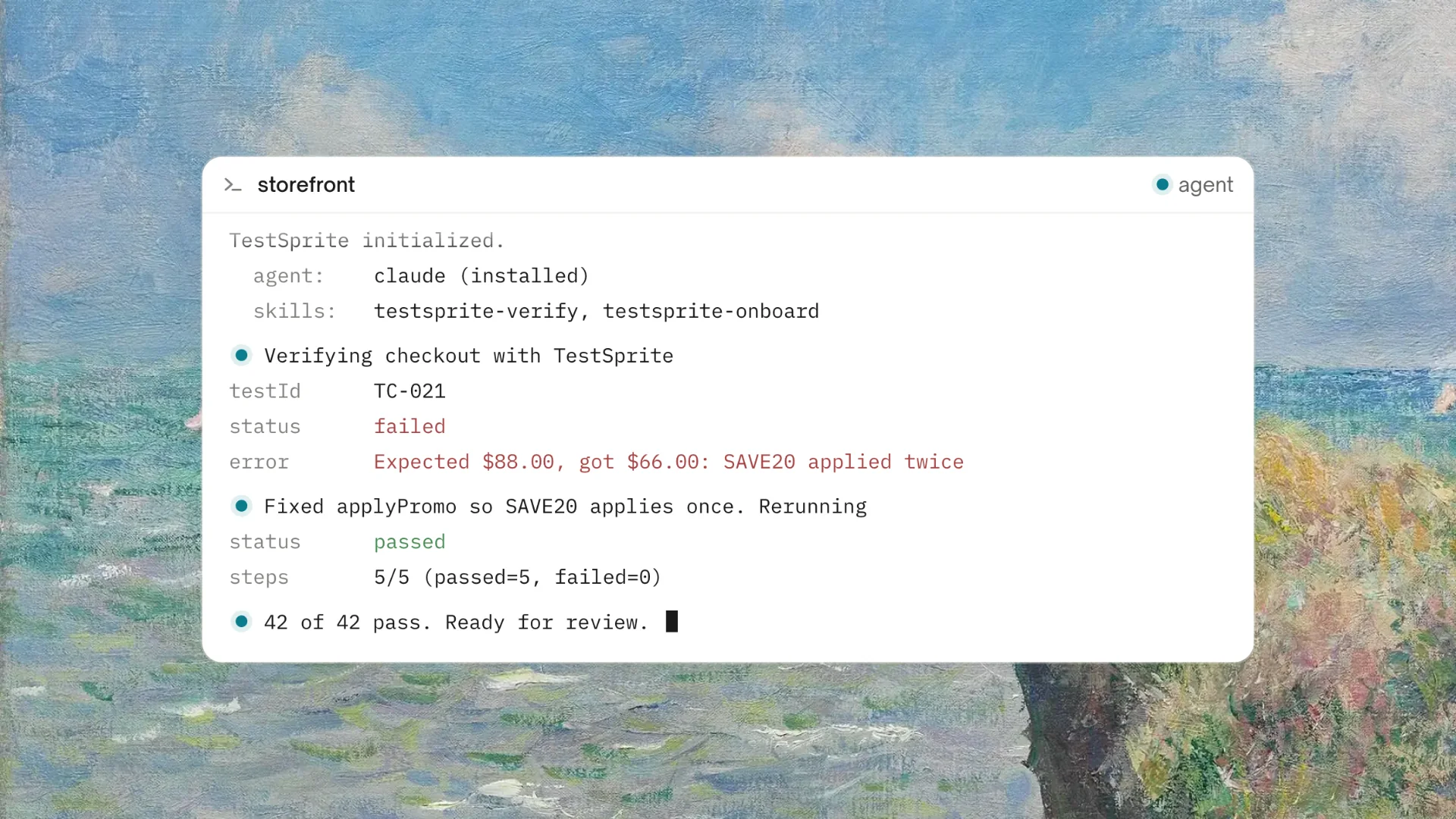
The finding lands in the Claude Code terminal, the coding agent fixes the off-by-one, and the re-run confirms the release. At no point did anyone spend time discovering that a test was wrong about the API. The tests were never wrong about the API. They'd seen it.
Conclusion
Hallucinated assertions come from inference: training priors, code-to-runtime drift, and plausible completion filling gaps. They cost teams in false failures that burn time and false passes that certify bugs, and the second kind is worse because it's invisible until users find it.
TestSprite reduces hallucination structurally, by removing inference from the loop. Backend Testing 2.0 observes the real API before asserting anything, threads real values through multi-step flows, and turns regression into a comparison between observations. For AI-generated backends, where the code and the tests could otherwise share the same wrong guess, observation is what keeps them honest with each other.
Test your API against reality with TestSprite from inside your AI IDE today.