How Do TestSprite Dynamic Variables Work in API Testing?
Zeshi Du5 min read

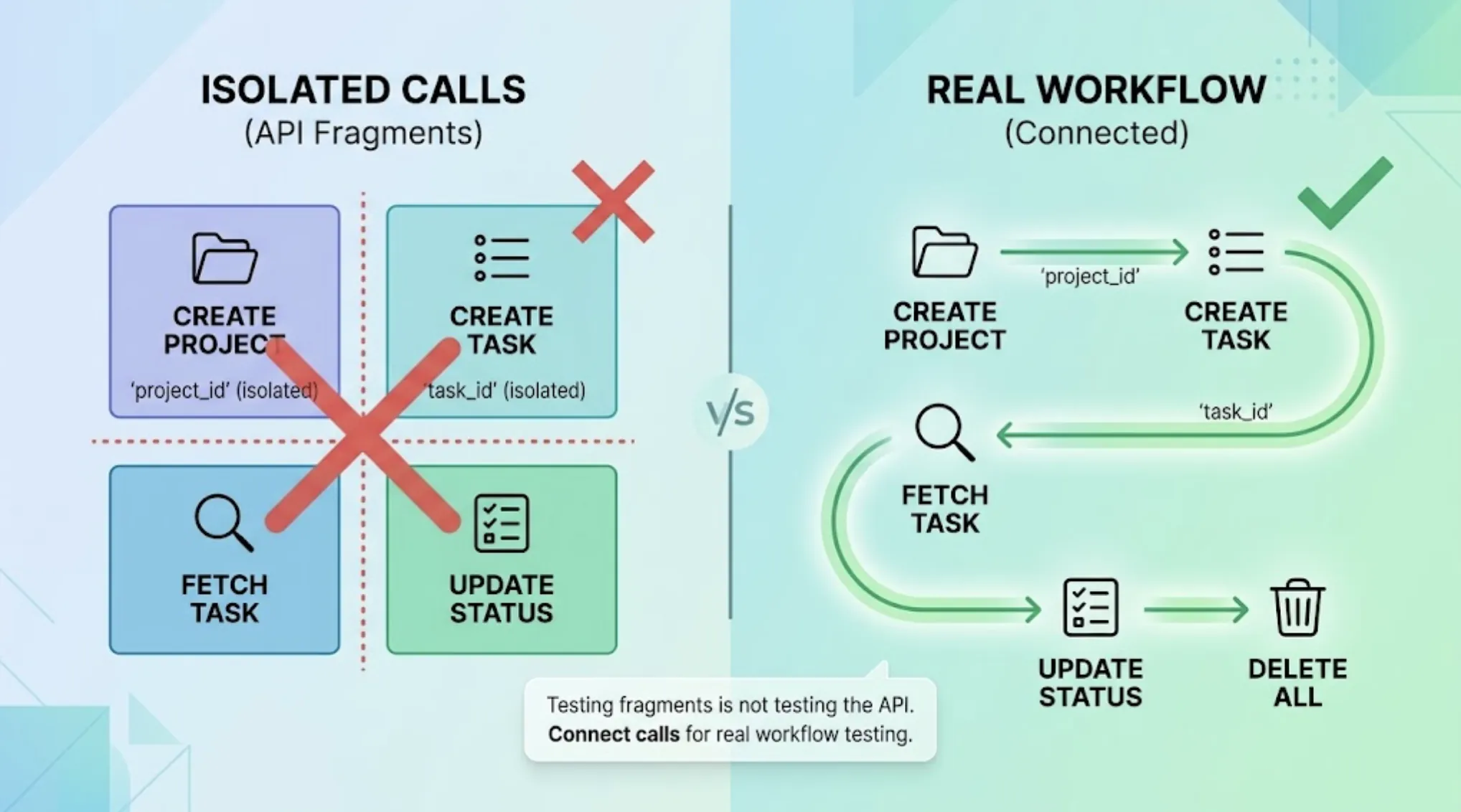
Almost no API worth testing is a single call. The registration returns an ID the profile update needs. The created order feeds the payment. The uploaded document's reference goes into the approval request. Real API behavior lives in these chains, and the values that connect the links are the hardest part of API testing to automate.
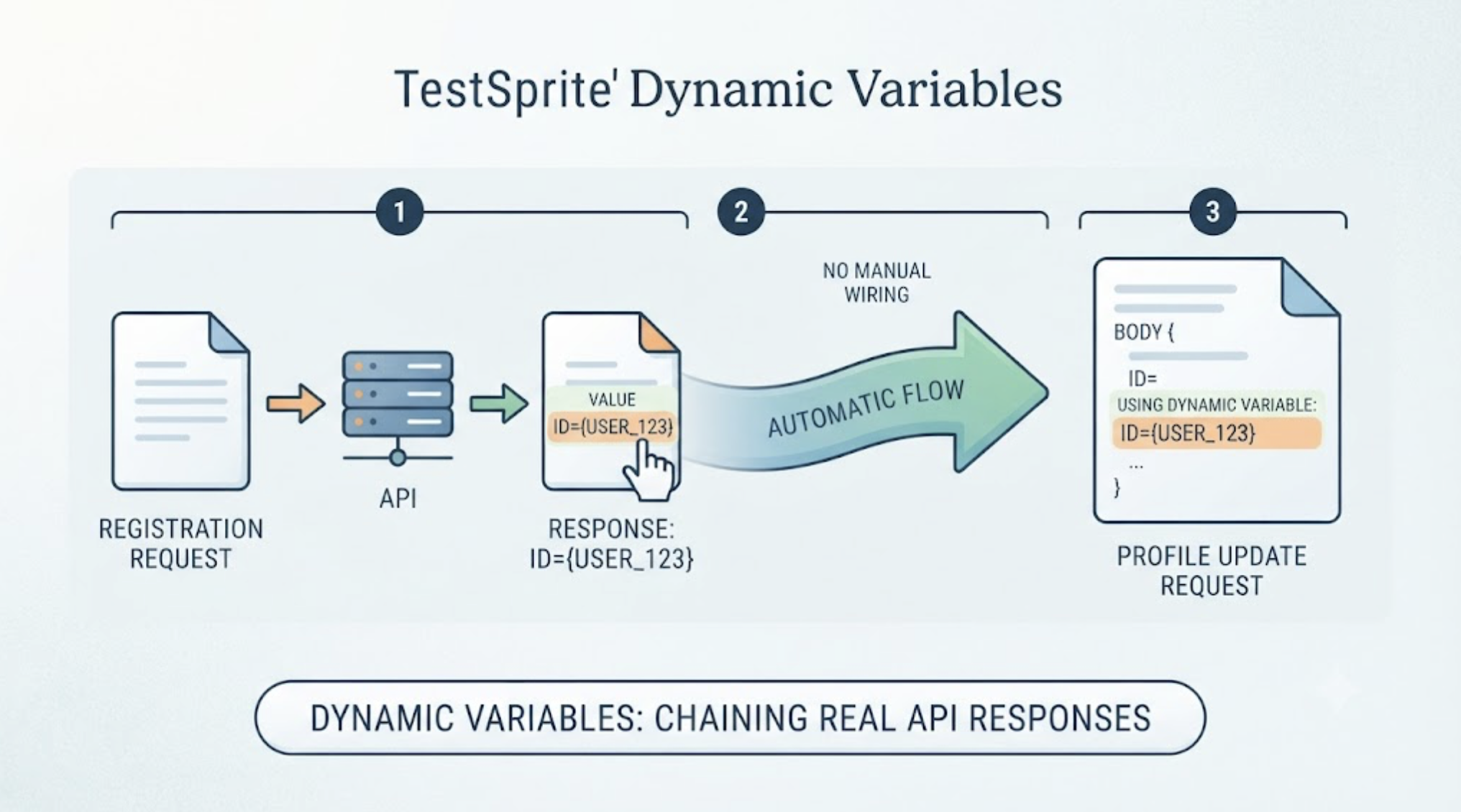
Dynamic Variables are how TestSprite's Backend Testing 2.0 handles those connections: values captured from real API responses that flow automatically into the requests that need them downstream. No environment variable setup, no capture scripts, no manual wiring between steps.
Here's how the system works, step by step.
The Problem They Solve: Data Dependency Between Calls
An API test chain has a dependency structure. Step two needs something step one produced. Step four might need values from steps one and three.
Traditional tooling makes the engineer manage this structure by hand. You write a capture script on the registration response to extract the ID. You store it as an environment variable. You reference the variable in the next request's body. You repeat for every value that crosses a step boundary, and you update the wiring whenever the API changes what it returns or what it expects.
The failure mode is familiar to anyone who's maintained these chains: the API renames a field, the capture script silently extracts nothing, and step three fails with an error that says nothing about the real cause. The debugging session is about the plumbing, not the product.
Where the Values Come From: Observation First
Dynamic Variables inherit Backend Testing 2.0's core discipline: nothing is referenced until it's been observed.
Other verification tools read your code and guess. TestSprite opens your app and uses it.
When the agent calls the create endpoint during observation, it records the real response: the actual field names, the actual structure, the actual values. If the response contains "reservationId": "res_8k2f", that's a real value from a real call, not an inference from the handler code about what the response probably includes.
This grounding matters for the chain's reliability. A variable captured from a real response demonstrably exists. A variable inferred from code might not, and a chain built on inferred values can reference fields the running API never produces, which is exactly the hallucination problem observation exists to prevent.
How Values Thread Through the Sequence
With the observations in hand, the agent assembles the multi-step flows, identifying which downstream requests need which upstream values and passing them automatically.
The everyday case is the CRUD lifecycle. Create returns the resource's real ID. That ID threads into the read, which verifies the resource exists with the expected shape. It threads into the update, which modifies it. It threads into the delete, and into the final read that confirms the resource is gone. One value, captured once, carried through five steps, with no wiring written by anyone.
Integration chains work the same way at larger scale. A booking flow might capture a customerId from one endpoint, a vehicleId from an inventory lookup, and thread both into a reservation call whose returned reservationId then feeds the payment and confirmation steps. The chain assembles from the dependency structure the data itself reveals, and the whole sequence runs end to end on the first attempt.
Manual Wiring vs Dynamic Variables
The practical difference is easiest to see side by side.
The last row deserves a note: the same dependency awareness that threads values forward also runs the teardown backward. Resources created during the chain are removed in dependency order, children before parents, so the environment returns to its prior state after every run.
When a Chain Breaks: What You Actually See
The diagnostic quality of a failed chain is where the observation grounding pays off again.
Because every variable traces back to a recorded response, a failure in the middle of a sequence comes with its context: which step produced the value, what the value was, which step consumed it, and what happened when it did. If a Claude Code session changes the create endpoint so it returns the ID under a different name, the finding is a contract deviation against the observed baseline, named precisely, rather than a mysterious null propagating three steps before something visibly breaks.
That's the difference between "step four failed" and "the create endpoint stopped returning the field the chain depends on, here's what it returns now."
A Scenario: A Rental Fleet API, End to End
A three-person team builds a car rental platform with Claude Code. A session reworks the reservation pipeline: check vehicle availability, create a reservation, attach a driver, take a deposit, confirm pickup.
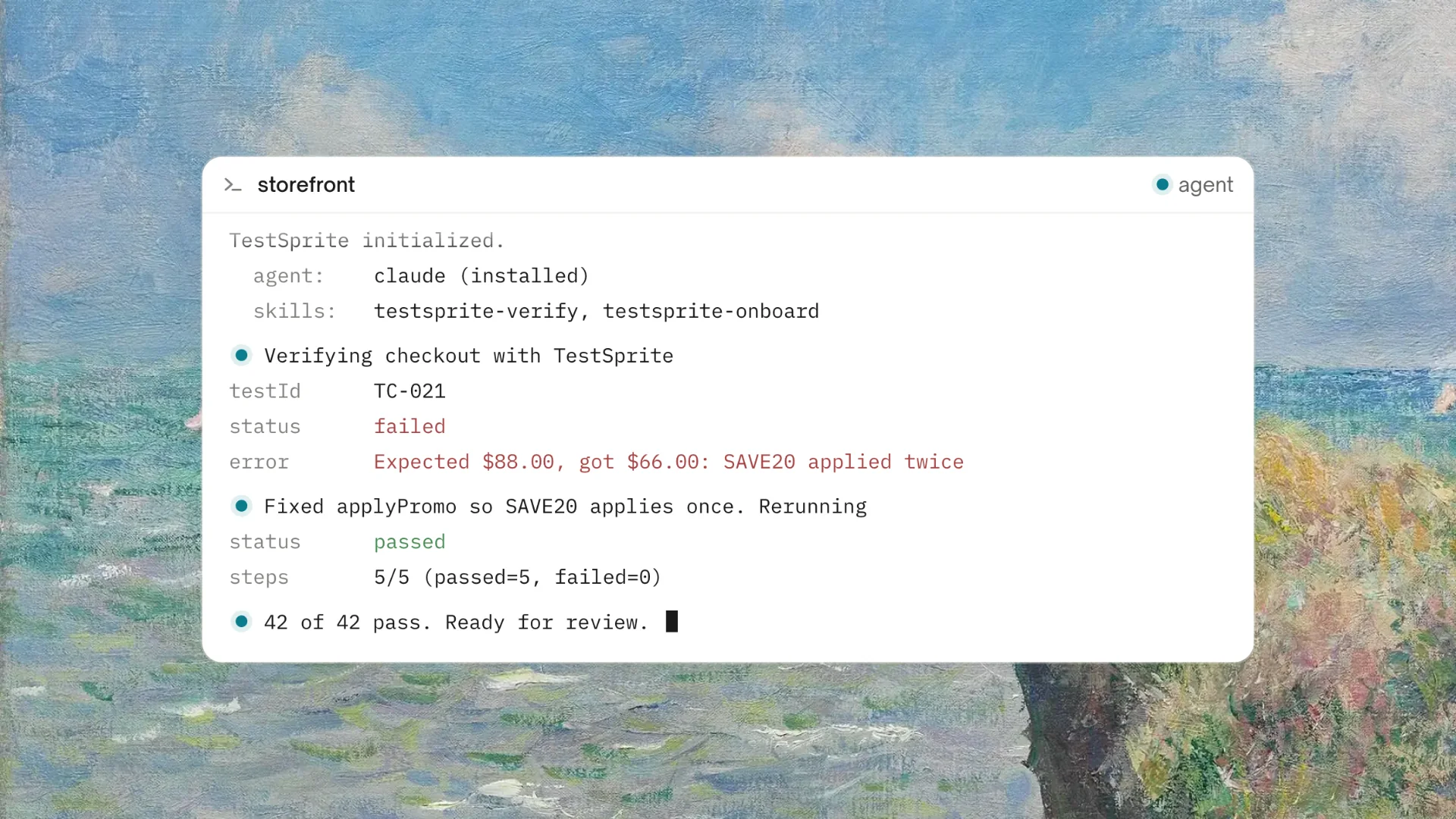
They trigger TestSprite from the Claude Code terminal.
The observation pass calls the endpoints and records reality. Availability returns a vehicleId for each open car. Reservation creation returns reservationId and a depositRequired amount. Driver attachment expects the reservationId and returns a driverRecordId.
The chains assemble from those observations. The vehicleId from availability threads into reservation creation. The reservationId threads into driver attachment, deposit, and pickup confirmation. The depositRequired amount from the reservation response flows into the deposit call so the test charges exactly what the API asked for.
The run surfaces one finding. The deposit step succeeds, but pickup confirmation fails with the full trace: the pickup endpoint expects the reservation to be in deposit_paid status, and the reservation status read shows it still in pending. The deposit endpoint, reworked in this session, records the payment but no longer advances the reservation status. Every step's inputs and outputs are in the finding, so the cause reads directly: the payment landed, the state transition didn't.
The coding agent restores the status transition in the deposit handler, the chain re-runs green end to end, and the created reservations, driver records, and deposits are cleaned up in dependency order afterward. Staging is exactly as it was before the run.
Conclusion
Dynamic Variables are the connective tissue of TestSprite's API testing: values captured from observed responses that thread automatically through multi-step sequences, from simple CRUD lifecycles to integration chains spanning half a product's backend.
The design rests on one principle carried through consistently. Values come from reality, so chains reference things that exist. Dependencies assemble from the data itself, so nobody wires anything. Deviations compare against observed baselines, so failures name their cause. And the same dependency awareness cleans everything up afterward.
For teams building APIs with AI coding tools, that's multi-step coverage that works on the first run and keeps working as the API evolves.
Run your API chains with TestSprite from inside your AI IDE today.