How Do I Reduce Manual QA for Frontend Releases?
 Zeshi Du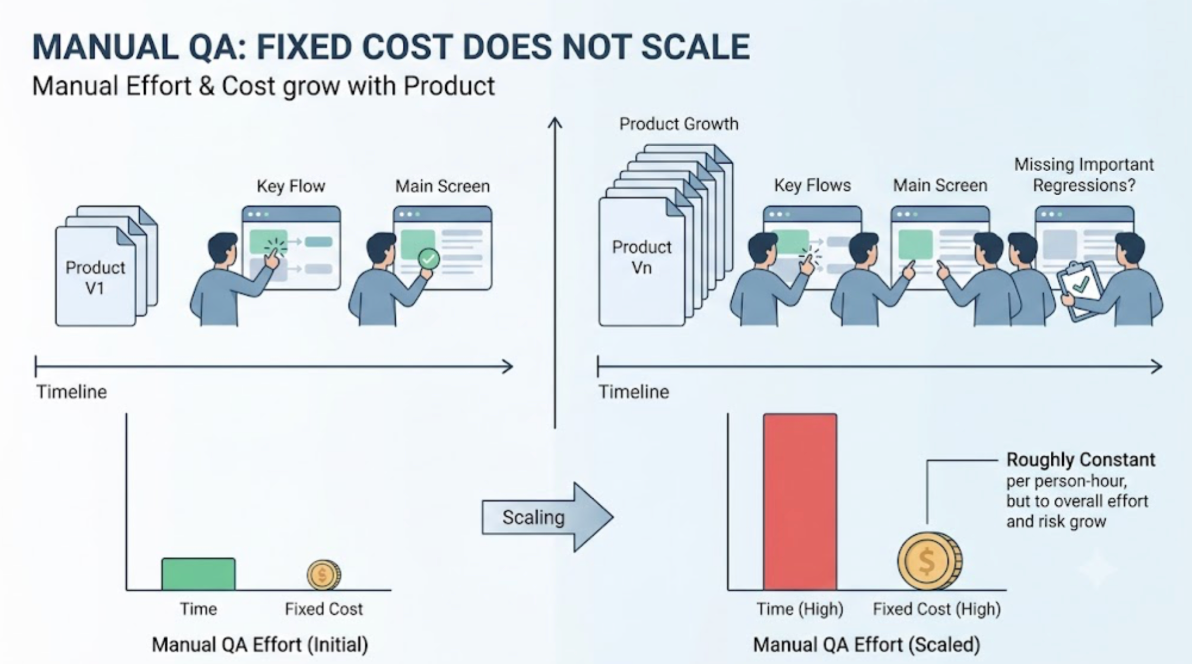
Manual QA for frontend releases has a fixed cost that doesn't scale. Every time a release goes out, someone has to open the application, click through the key flows, verify that the main screens look right, and hope they didn't miss anything important. That process takes time that grows proportionally with the product, stays roughly constant regardless of how much actually changed, and catches a subset of what matters.
The solution isn't to do less QA. It's to do the manual-style verification automatically, before every release, without the person-hours.
Here's how to reduce manual QA for frontend releases without reducing coverage.
Why Manual QA Is Hard to Scale
Manual QA for frontend releases has three compounding problems.
The first is time. A release that changes three features requires walking through all three to verify they work, plus enough of the unchanged product to check for regressions. For a mature product with many features, that walkthrough takes hours even when most of the product didn't change.
The second is coverage. Manual QA is bounded by what the person doing it thinks to check. Experienced QA engineers develop good intuition for where to look. Developers doing their own QA before a release are working from a narrower model of where things can break. The flows that aren't in anyone's mental checklist are the ones where surprises happen.
The third is frequency. If a proper manual QA pass takes three hours, it happens at release time and maybe at a few checkpoints in between. That means changes accumulate between verification passes, and the regression that shipped in the second-to-last commit only appears in the release QA where it's already mixed with everything else.
Reducing manual QA means addressing all three.
What Automated Frontend Verification Actually Requires
The reason manual QA hasn't been fully replaceable is that most automated approaches test at the wrong level.
Automated tests that check function return values or component render output aren't doing what a manual QA pass does. A manual QA engineer opens the application, navigates it, uses it, and notices when something is wrong from the user's perspective. The automation that replaces this needs to do the same thing: open the application, navigate it, use it, and notice when the outcome isn't right.
That means operating at the product layer, not the code layer. Visiting the running frontend. Interacting with the actual UI. Following flows end to end. Observing what happens after every action.
Most automated testing frameworks require an engineer to specify what to navigate, what to interact with, and what to check. The framework executes instructions. The judgment still comes from the engineer.
An autonomous agent that discovers the flows by exploring the product, then runs them, requires no upfront specification. It finds the flows by using the product, the same way a QA engineer would on their first day.
How TestSprite Reduces Manual QA for Frontend Releases
TestSprite is an autonomous AI testing agent that replaces the navigation-and-observation step of manual QA with a fleet of exploration agents that work through the live frontend the way real users would.
Other verification tools read your code and guess. TestSprite opens your app and uses it.
Through the TestSprite MCP Server inside Cursor, Claude Code, Windsurf, or VS Code, one instruction before a frontend release triggers the full pipeline:
"Help me test this project with TestSprite."
The agents visit the live application and navigate it. They find the interactive surfaces: buttons, forms, navigation flows, multi-step journeys. They click through what they find, fill in real inputs, follow the paths users take, and observe the outcome at each step.
They don't need to be told where to look. They discover it. That covers the flows that weren't on anyone's mental checklist, which is precisely the coverage gap manual QA struggles with most.
The Specific Frontend Behaviors That Get Covered
The exploration agents check the kinds of things manual QA checks, across the product surface.
Navigation flows. Does each major section of the product navigate correctly? Do the back buttons, breadcrumbs, and internal links go where they should? Do state-dependent flows (flows that require login, flows that require specific account states) work under the right conditions?
Form interactions. Do forms accept valid inputs and reject invalid ones? Do error messages appear correctly? Do successful form submissions produce the expected outcomes and navigation? Do forms with dynamic fields (dropdowns that update based on earlier selections, fields that appear conditionally) behave correctly at each step?
Stateful components. Do components that maintain state (carts, multi-step wizards, session state) carry state correctly across user actions? Does state persist correctly when it should and reset when it should?
Interactive elements. Do dropdowns open and display the correct options? Do modals appear when triggered and dismiss correctly? Do inline editing interactions save correctly?
These aren't scripted. They're discovered. The agents find them by navigating the application, the same way a thorough manual QA pass would work through them.
Reducing Frequency Overhead: CI Coverage on Every Commit
One of the biggest manual QA costs is the need to run a full pass before every significant release. If releases happen frequently, the QA overhead compounds.
TestSprite's GitHub Actions integration shifts this from a release-time event to a continuous process. Every pull request triggers automated frontend verification against the preview environment. Results post as PR comments.
The developer who made the change sees the verification results before anyone reviews the code. The reviewer sees the results alongside the diff. By the time the release is ready to go, every component of it has already been verified at the product layer as part of the PR process.
The manual release QA pass becomes a confirmation that all the constituent PRs passed their individual verifications, not a full re-verification from scratch.
A Scenario: The Release QA That Used to Take Three Hours
A small frontend team was spending three to four hours per release on manual QA. The product had grown to the point where a thorough walkthrough covered twelve major flows and dozens of edge cases. Most of the time was spent re-verifying features that hadn't changed, because the team couldn't easily distinguish which parts of the product a release had actually affected.
After adding TestSprite to their CI workflow:
Every PR automatically verified the flows affected by the change and a broader sample of the product surface. By release time, each feature in the release had been verified multiple times through the PR process, by agents that navigated the flows the same way users would.
The release QA pass reduced to reviewing the PR-level verification results and doing a brief final check on the integrated build. Time dropped from three to four hours to under thirty minutes.
The coverage actually improved. The agents found two issues during the PR process that the previous manual QA approach had missed: a dropdown that stopped updating a dependent field correctly after a state management refactor, and a modal confirmation that was firing on the wrong user action after a UI reorganization. Both were caught before they shipped.
Conclusion
Reducing manual QA for frontend releases requires replacing the navigation-and-observation step with automation that operates at the product layer. Automation that reads source files doesn't do this. Automation that visits the running frontend and navigates it like a real user does.
TestSprite's exploration agents discover the product's flows, navigate them, and report failures in product-level terms that the development team can act on directly. Connected through the MCP Server for in-development verification and through GitHub Actions for CI coverage, it shifts frontend verification from a manual pre-release event to a continuous automated process.
Manual QA time spent re-verifying unchanged features disappears. Coverage of flows nobody thought to check for improves. The release process gets faster and more reliable at the same time.
Start reducing manual QA for your frontend releases with TestSprite today.