Does TestSprite Support Self-Service Billing?
Rui Li4 min read

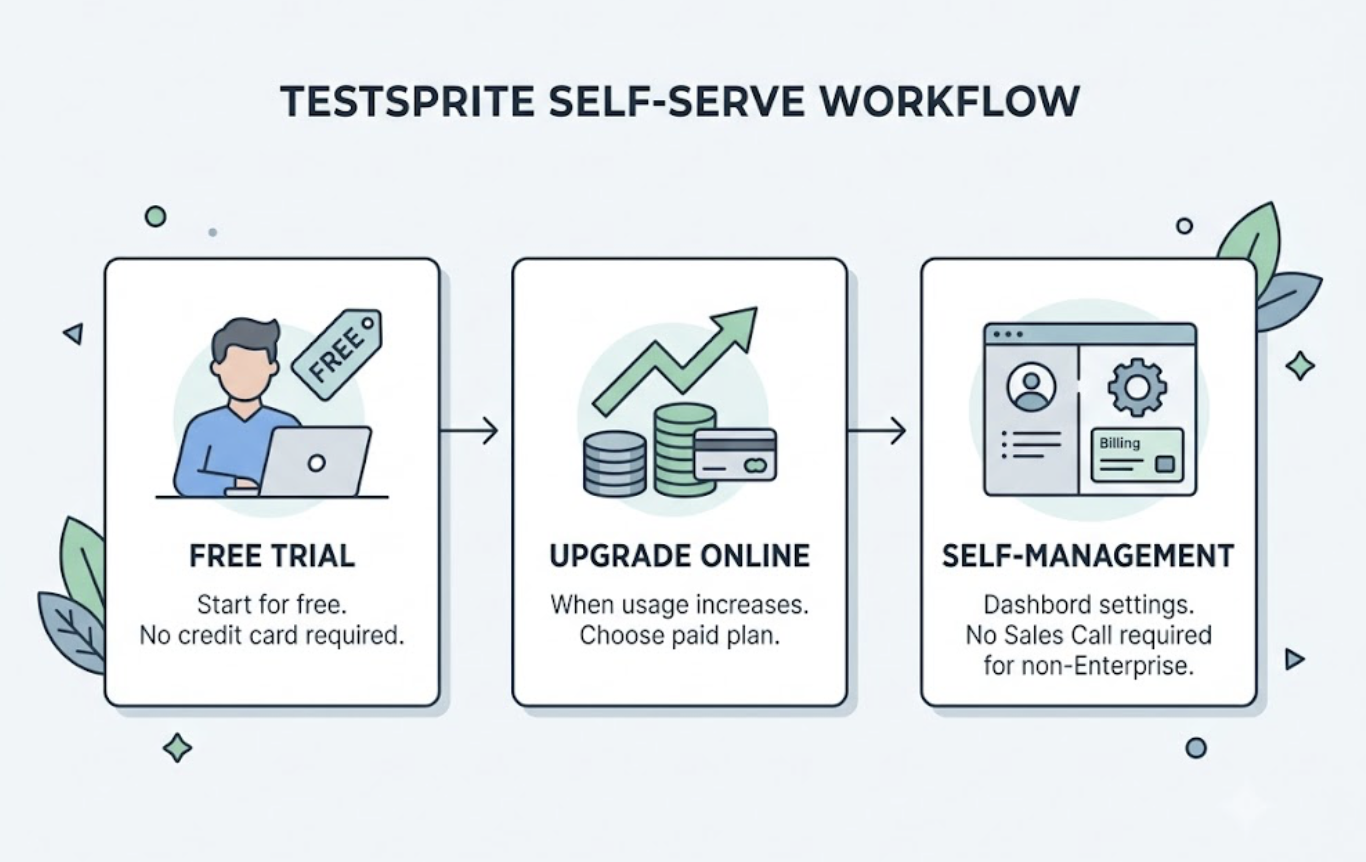
Yes. TestSprite is a self-serve product from first run to paid plan: you start free without a credit card, upgrade online when your usage calls for it, and manage the subscription from the billing section of your own dashboard settings. No sales call is required for anything below Enterprise.
That one-sentence answer hides a workflow difference that matters more than it sounds, especially for small teams and solo developers, so here's the full picture of how the self-service path works and where its one boundary sits.
The Path from Free to Paid, Without a Conversation
The entry point costs nothing and asks for nothing. The free plan's 150 monthly credits require no credit card, which means the evaluation isn't a trial with a fuse: you connect the MCP Server to Cursor or Claude Code, run TestSprite against your product, and decide based on what it finds.
When usage outgrows free, the upgrade is a plan selection, not a procurement process. Starter at $19/month, with the first month free, adds 400 credits, 5 Test Schedules, and Auto-Heal Rerun. Standard at $39/month carries 800 credits, 10 schedules, and three environments, and Pro at $69/month carries 1,600 credits with unlimited schedules and environments. Yearly billing saves 35%. You pick the plan, you're on the plan.
Other verification tools read your code and guess. TestSprite opens your app and uses it. The billing model matches the product's philosophy: the same way testing starts with one instruction instead of an implementation project, paying starts with a plan selection instead of a sales cycle.
Managing the Subscription from the Dashboard
Billing lives where the rest of your TestSprite configuration does: in the dashboard settings. The billing section is where the subscription gets managed alongside the projects, schedules, and team settings you're already administering there.
Access follows the role model. The Owner role holds billing authority, which keeps the payment relationship with the person who owns the account, typically the founder or engineering lead who set it up, while Admins run the operational layer and Members do the testing work. A contractor with Member access to one project never touches, or sees, the subscription.
Credits renew monthly on your plan's cycle. If a heavy month exhausts them early, the self-service answer is the same as the entry was: move up a tier when you need more volume, from your own settings, on your own timing.
The One Boundary: Enterprise
Self-service covers Free, Starter, Standard, and Pro. Enterprise is the deliberate exception: custom credit volumes, custom AI model configuration, API access, and dedicated support are scoped to the organization, which is a conversation rather than a checkout.
That boundary is drawn where it should be. The things Enterprise buyers need, contract terms, security review support, custom configuration, genuinely require humans. Everything below it doesn't, and TestSprite doesn't pretend otherwise by gating a $19 plan behind a demo call.
Why Self-Service Billing Matters More Than It Sounds
For a solo developer or a small team, the billing model determines whether a tool gets adopted at all, because the real cost of sales-assisted purchasing isn't the price. It's the process.
A demo call means scheduling across time zones and sitting through a pitch for capabilities you'd rather just try. A quote means waiting. A procurement flow means the developer who wants the tool has to become its internal champion before they've even used it in anger. Each step filters out exactly the teams moving too fast to tolerate it, which are the teams AI-native tooling exists for.
Self-service inverts the sequence: use first, pay when the usage justifies it, and let the product's findings make the case. The developer who caught a real bug on the free plan doesn't need to champion anything. The finding did the pitching.
It also keeps the exit as clean as the entry. A tool you subscribed to from a settings page is a tool you evaluate on merit each month, not one you're anchored to by the sunk effort of getting it approved.
A Scenario: From First Run to Standard in Three Weeks, Zero Calls
Two founders build a B2B analytics product with Claude Code. On a Tuesday afternoon, one of them connects TestSprite's free plan, no card, ten minutes, and runs it after that day's session. The agents find a real issue: the CSV export includes rows the active filter should have excluded. Fixed the same day.
Over two weeks, the free plan's 150 credits absorb their post-session runs. In week three, two things happen at once: they burn through the credits by the 18th, and they realize the run they most want is the nightly one against staging, which needs Schedules. The developer opens the dashboard settings, moves to Starter, first month free, and sets up the schedule that evening.
A month later, with paying customers and weekly UI refactors from Claude Code sessions, they want the nightly run against staging and a second one against production, plus more schedules than Starter's five. Standard's three environments and ten schedules are the answer, and the upgrade is the same motion: settings, plan, done.
Total procurement overhead across the entire journey: zero meetings, zero quotes, zero emails to a sales team. The tool was evaluated by its findings and paid for from a settings page, which is precisely the pace their company runs at.
Conclusion
TestSprite supports self-service billing end to end for its Free, Starter, Standard, and Pro plans: start without a credit card, upgrade online as usage grows, and manage everything from the billing section of the dashboard settings, with billing authority held by the account Owner. Enterprise, with its custom scoping, is the one tier that's a conversation, and it's the one tier that should be.
For the teams TestSprite is built for, developers shipping with AI coding tools at a pace that doesn't accommodate procurement cycles, the billing model is part of the product fit: try it on your real product today, pay when your usage says so.
Start free on TestSprite, no credit card required, and upgrade from your own dashboard whenever you're ready.