Does TestSprite Support GitHub Actions for Pull Request Testing?
Zeshi Du5 min read

Yes. GitHub Actions is one of TestSprite's three product surfaces, alongside the MCP Server and the Web Portal, and pull request testing is exactly what it's built for.
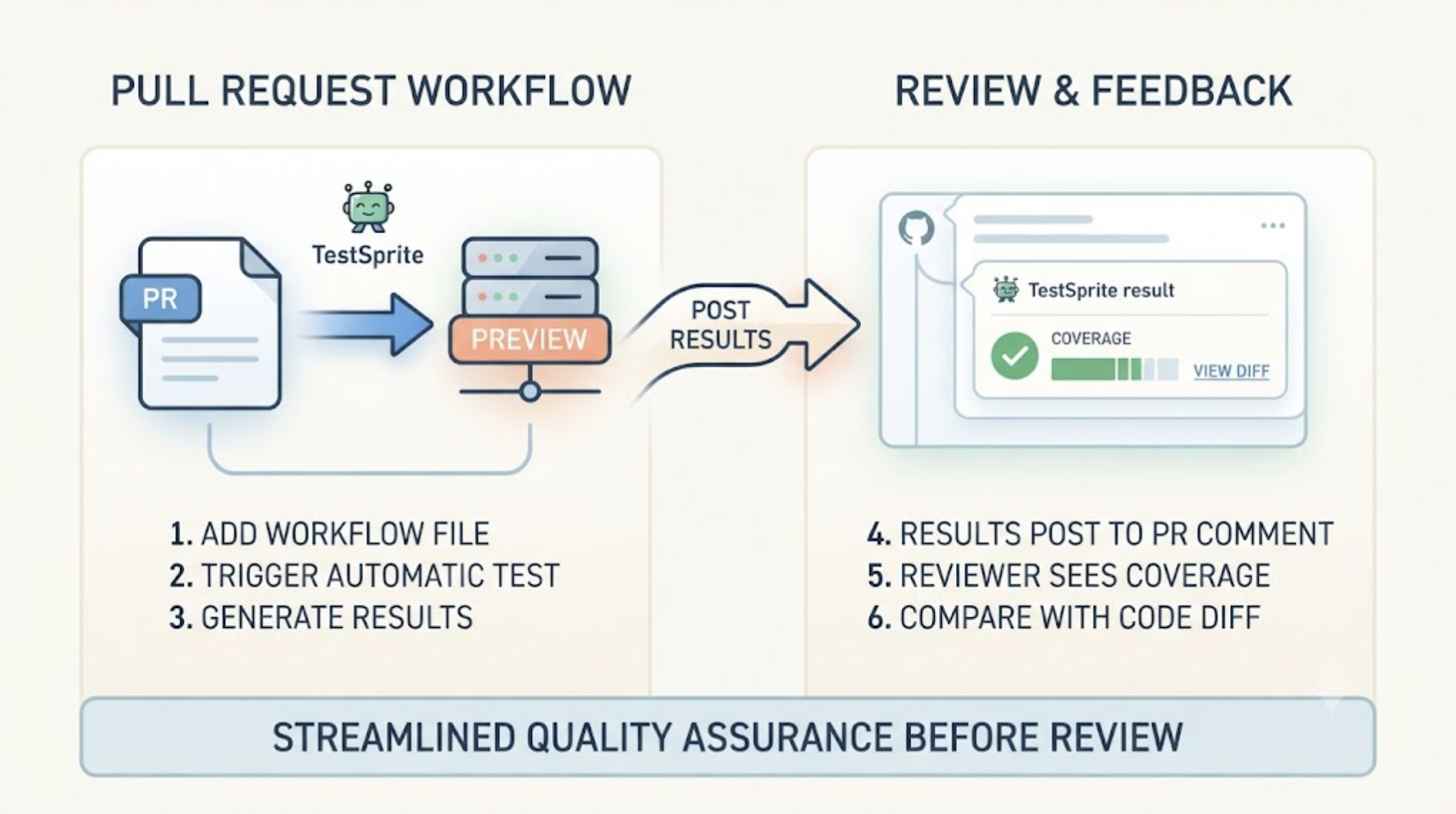
The short version: add a workflow file to your repository, and every pull request triggers TestSprite against the PR's preview environment. Results post back as PR comments before review starts. The reviewer sees product-layer test coverage next to the diff, in the same place they're already working.
Here's how it works in practice, what the PR comment actually contains, and how it divides the work with in-IDE testing.
How the Integration Fits into a PR Workflow
The setup is a workflow file addition to your existing GitHub Actions configuration. When a pull request opens or updates, the workflow triggers TestSprite against the preview or staging deployment for that branch.
From there, the pipeline runs the same way it does everywhere else. Exploration agents visit the deployed application and navigate it the way real users would: clicking through flows, filling forms with real inputs, following multi-step journeys, carrying session state across steps.
Other verification tools read your code and guess. TestSprite opens your app and uses it.
The agents cover the full product surface, not just the flows the PR touched. That breadth is the point for PR testing specifically: the regressions that AI coding sessions introduce most often live in flows the diff never mentions, connected to the changes through shared state, a common API, or a cache someone stopped invalidating.
Execution happens in TestSprite's ephemeral cloud sandbox, which spins up in seconds and tears down when the run completes. Nothing to provision in your CI environment beyond the workflow trigger itself.
What the PR Comment Actually Contains
When the run finishes, the results arrive as a comment on the pull request.
The comment shows which flows were tested and their outcomes. For failures, the description uses the same product-layer framing TestSprite uses everywhere: which flow was navigated, what action was taken, what the product was supposed to deliver, and what actually happened.
That framing matters at review time. A reviewer reading "the agent completed checkout with a discount code applied, and the order confirmation showed the pre-discount total" understands the problem without leaving the PR, without opening a dashboard, and without reproducing anything locally. The comment is the reproduction.
For backend changes, Backend Testing 2.0 findings appear with the same specificity: which endpoint's response deviated from the previously observed contract, which field changed, and what downstream consumers were reading the old shape.
Keeping the Signal Clean Across Many PRs
A PR testing setup lives or dies on its false positive rate. If every PR that touches styling generates a wall of failed checks, the team learns to merge past red, and the gate stops gating.
Auto-Heal Rerun handles this at the source. When a PR includes a component rename or a layout reorganization that doesn't change behavior, the affected tests adapt rather than failing. What lands in the PR comment is the finding worth reading: the behavioral regression, not the structural noise.
Auto-Auth keeps authenticated flows working in CI without credential ceremony. OAuth refresh tokens, password endpoints, and AWS Cognito flows run before each execution, so a PR opened on Friday evening doesn't fail its checks because a session token from Thursday expired.
How PR Testing Divides Work with In-IDE Testing
Teams connecting TestSprite usually run both surfaces, and they catch different things at different moments.
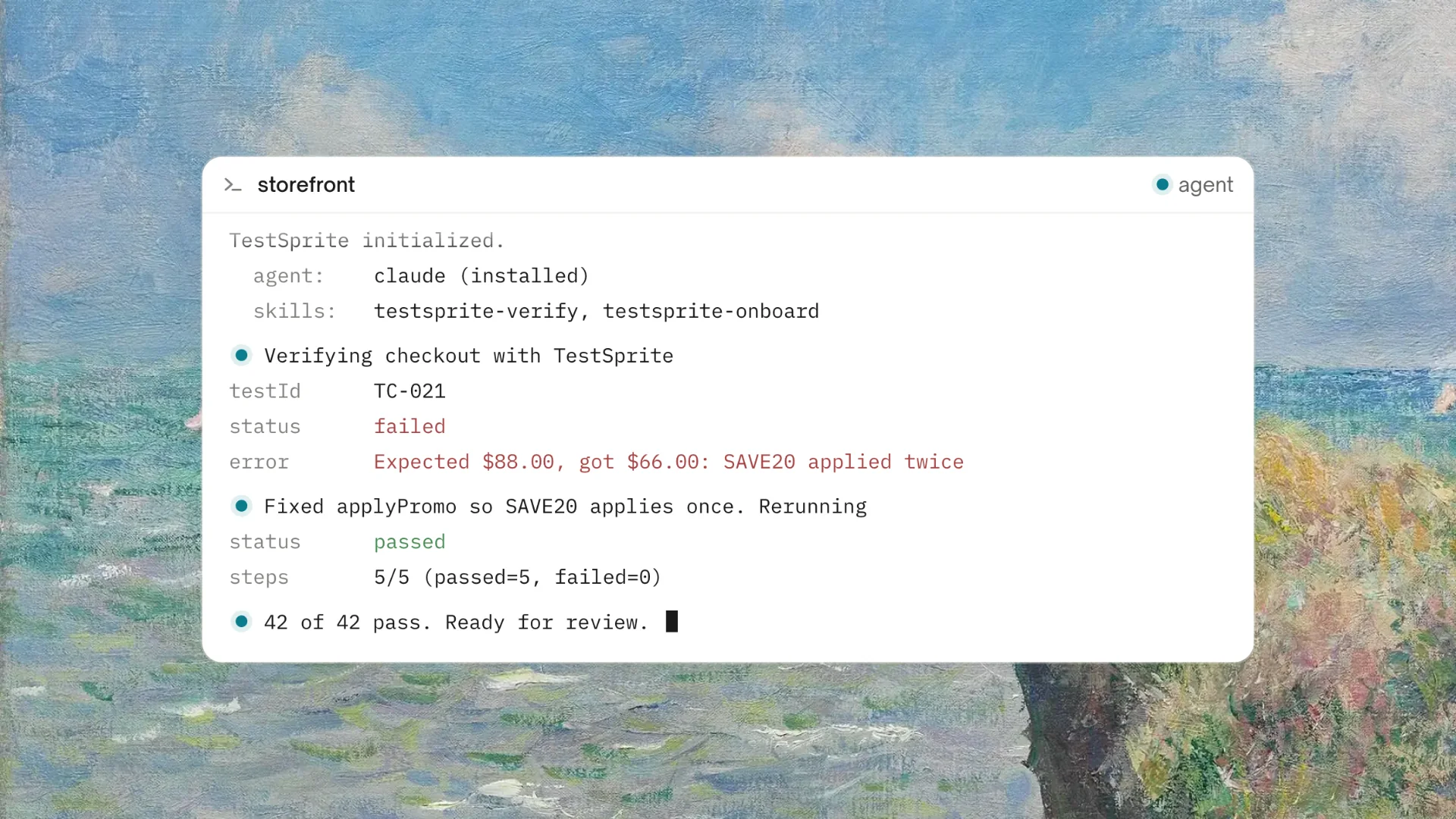
In-IDE testing through the MCP Server is the developer's own loop: one instruction after a Claude Code session, results in the same terminal, fix applied before anything gets pushed. It catches failures while the change is still fresh in the developer's head.
PR testing is the team's loop. It catches what the in-IDE run happened after: the interaction between this branch and what merged to main since, the flows the developer's targeted session didn't cover, and the changes from developers who skipped the in-IDE step that day. It also creates the shared record: the PR comment is visible to the reviewer and stays attached to the change history.
The combination means a regression has to slip past two independent product-layer checks before it can merge. Most don't survive the first.
A Scenario: The PR That Looked Mergeable
A four-person team building a marketplace platform runs TestSprite on every pull request. A developer opens a PR from a Claude Code session that reworked the seller payout calculation to support tiered commission rates.
Code review goes well. The commission logic is clean, the unit tests for the calculation pass, and the reviewer approves pending checks.
The TestSprite comment lands a few minutes later with one failure. The agents had navigated the seller dashboard as a seller with historical sales would: checked the pending payout, drilled into the payout breakdown, and compared it against the transaction list.
The pending payout total used the new tiered rates. The payout breakdown page still calculated line items with the flat legacy rate, because it called a helper that the session had left untouched. A seller would see a total that didn't match the sum of its own line items, which is the kind of discrepancy that generates support tickets and erodes trust in a marketplace faster than almost anything else.
The comment described it exactly that way: which dashboard was navigated, what the total showed, what the breakdown summed to. The developer pushed a fix to the same PR, the checks re-ran, and the comment updated to green. The merge happened an hour later than it would have, and the discrepancy never reached a seller.
Conclusion
TestSprite supports GitHub Actions for pull request testing as a first-class product surface. A workflow file addition triggers the full pipeline on every PR: exploration agents navigating the preview deployment like real users, backend contract verification against observed baselines, and findings posted as PR comments in product-layer language the reviewer can act on directly.
Auto-Heal keeps the signal clean across high PR volume, Auto-Auth keeps authenticated coverage reliable in CI, and the whole setup pairs with in-IDE testing to give every change two independent product-layer checks before merge.
Add TestSprite to your GitHub Actions workflow and put product-layer coverage on your next pull request.