Does TestSprite Have a Free Plan?
 Zeshi Du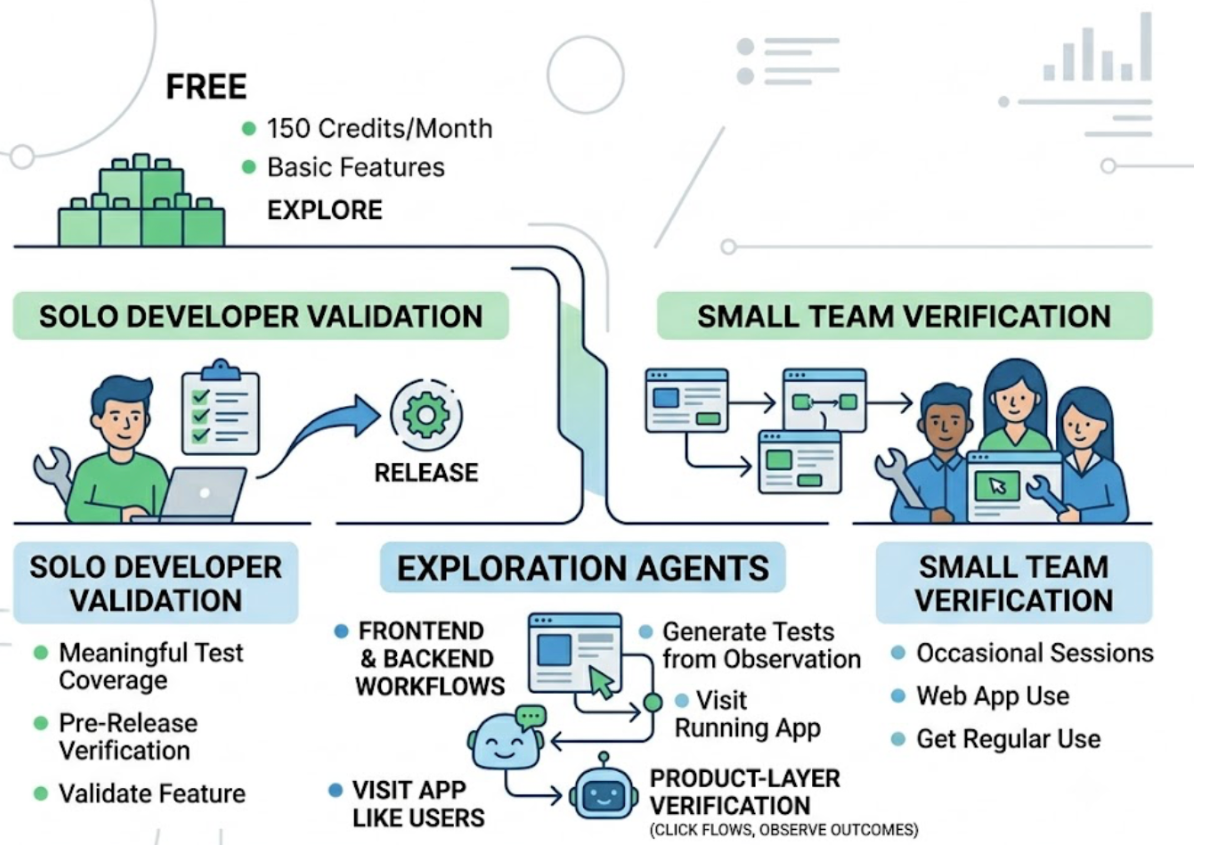
Yes. TestSprite has a free plan that gives you real, working access to the product, not a locked demo or a time-limited trial.
The free plan provides 150 credits per month that refresh automatically. There's no credit card required to get started. You sign up, connect your project, and run your first test session against your actual application.
That's the direct answer. The more useful question is what you can actually do with 150 credits a month, and whether the free plan gives you enough to evaluate whether TestSprite fits how your team works.
What 150 Credits Per Month Actually Gets You
Credits are consumed as TestSprite's agents explore your application, generate test cases, and execute tests. The free plan is designed to be a genuine starting point for individual developers and small teams, not a breadcrumb trail to a paywall.
For a solo developer validating a feature before a release, 150 credits covers meaningful test coverage. For a small team running occasional verification sessions on a web application, it's enough to get regular use without upgrading.
The free plan includes basic testing features and frontend and backend workflows. The exploration agents visit your running application, navigate it like real users, and generate tests from what they observe. That product-layer verification, where the agents click through flows and observe outcomes rather than reading source files, is available at the free tier.
Other verification tools read your code and guess. TestSprite opens your app and uses it.
The TestSprite MCP Server integration with Claude Code, Cursor, Windsurf, VS Code, and any MCP-compatible AI IDE is available on the free plan. One instruction inside the IDE chat triggers the full pipeline without leaving the development environment.
GitHub Actions CI integration is also available at the free tier, which means automated coverage on pull requests isn't a feature you have to upgrade to access.
What the Free Plan Doesn't Include
The free plan runs on foundational AI models rather than the advanced models available on paid tiers. For most initial testing sessions, this difference isn't immediately visible, but paid plans deliver enhanced test generation quality and coverage for complex applications.
The free plan doesn't include scheduled test regressions (Test Schedules), which are available from the Starter plan. If you want tests to run automatically on a schedule rather than triggering them manually, that requires an upgrade.
Auto-Heal Rerun, which adapts tests when UI changes cause structural failures without affecting product behavior, is a Standard plan feature. The free plan will surface test failures without the automatic adaptation layer.
Test file uploads, custom configurations, and backend integration test chains are features that unlock on paid tiers.
The honest framing: the free plan gives you the core product-layer testing capability. If you find that you need higher credit volume, scheduled runs, or the advanced maintenance features, those are the signals to upgrade.
How the Free Plan Differs from a Trial
A trial typically gives you full access to a product for a limited period, then cuts you off. The free plan works differently: it gives you a defined capability set permanently, with credits that refresh monthly.
This matters for evaluation. You can use the free plan at your own pace, run it against your actual project, and form a real opinion of whether it finds the failures your current process misses. You don't have to compress your evaluation into a two-week window.
For a developer trying to decide whether TestSprite is worth adding to their workflow, that's a more honest evaluation context than a timed trial.
A Scenario: What You'd Find on the Free Plan
A developer is building a SaaS product solo using Cursor. They don't have a testing process beyond occasional manual walkthroughs before pushing. They sign up for TestSprite's free plan and connect it to their staging environment.
They run their first session after a Cursor session that refactored their user onboarding flow. The exploration agents navigate the onboarding flow from start to finish, the way a new user arriving at the product for the first time would. They click through each step, fill in the required fields, and observe the outcome.
They find two issues.
The first: the email verification step completes successfully, but the agent navigating back to the login page after verification finds the account is in a state where login fails. The verification flagged the account but didn't update the login session correctly. A real user who verified their email and immediately tried to log in would be blocked.
The second: the final onboarding step asks users to invite team members. Submitting the invite form without entering any email addresses produces no error message. The form submits silently and returns to a blank invite input. A user who tried to invite a colleague and got no feedback would assume the invite sent, or assume the feature was broken.
Both issues were caught before any user ran the onboarding flow. Both were discovered by agents navigating the product the way a real new user would, not by reading the code that implements the flow.
The developer fixes both, runs the session again to confirm, and has a clear picture of what TestSprite found that their manual walkthrough process had missed. All of this happened on the free plan.
When to Consider Upgrading
The free plan is the right starting point. The signals that it's time to upgrade are specific.
If you're hitting the 150 credit limit before the month ends and you want to run more sessions, Starter at $19/month provides 400 credits and scheduled regression support.
If you're running TestSprite as part of a regular CI workflow and want scheduled regressions, unlimited Test Lists, Auto-Heal Rerun, and the advanced testing feature set, Standard at $69/month is the production tier.
If you need custom AI model configuration, API access, and dedicated support for an organization-scale deployment, Enterprise pricing requires a conversation with the team.
The free plan doesn't expire. If your usage fits within 150 credits a month, there's no pressure to upgrade. The credits refresh, the capability stays, and the product-layer verification keeps running.
Conclusion
TestSprite has a free plan with 150 monthly credits that refresh automatically, no credit card required. The free tier includes the core capability: exploration agents that navigate your live application like real users, frontend and backend coverage from a single session, and the MCP IDE integration that lets the pipeline run from inside Claude Code, Cursor, or Windsurf.
It's a genuine starting point, not a restricted preview. For individual developers and small teams evaluating whether autonomous product-layer testing fits their workflow, it's enough to find out whether TestSprite catches the failures their current process misses.
Start on TestSprite's free plan today. No credit card required.