Do AI Coding Agents Need a Separate Testing Agent?
Rui Li5 min read

Claude Code can write tests. Cursor can run them. So the question is fair: if the coding agent can generate its own verification, why would a team need a separate testing agent at all?
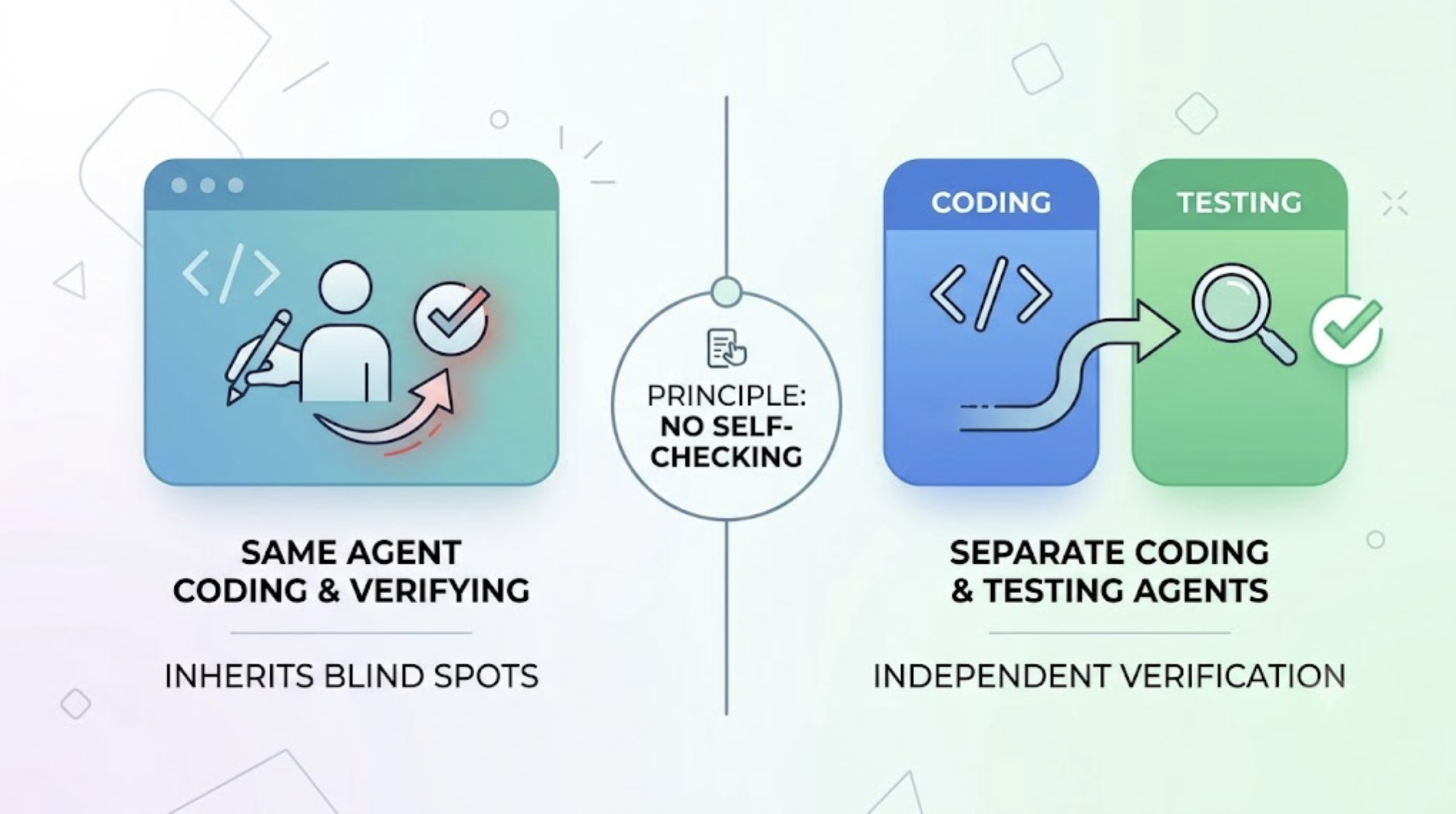
The answer comes down to a principle software teams already live by without thinking about it: the author shouldn't be the only checker. Not because authors are careless, but because verification by the same mind that produced the work inherits that mind's blind spots. That principle survives the transition from human authors to AI ones fully intact, and arguably gets stronger.
What the Coding Agent's Own Tests Actually Verify
When Claude Code writes a feature and then writes tests for it, both artifacts come from the same understanding of the task. The tests check that the code does what the agent believes it should do.
That's genuinely useful, it catches implementation slips, logic errors, cases where the code fails its own intent. What it structurally cannot catch is the category where the intent itself is off: the agent misread what the feature should do, made an assumption about an API's behavior, or didn't know about a dependency elsewhere in the product. The tests, born from the same reading, the same assumption, the same ignorance, pass. The error isn't caught. It's certified.
This is the correlated-error problem, and it has nothing to do with model quality. A better model makes fewer errors; it doesn't make its errors less correlated with its own verification of them.
Why Separation Fixes What Better Prompting Can't
The fix isn't asking the coding agent to check harder. It's introducing a checker whose evidence comes from somewhere else.
A separate testing agent breaks the correlation on three axes at once. Its perception is independent: TestSprite's exploration agents don't read the coding agent's reasoning, its diff, or its test files. They open the deployed application and use it.
Other verification tools read your code and guess. TestSprite opens your app and uses it.
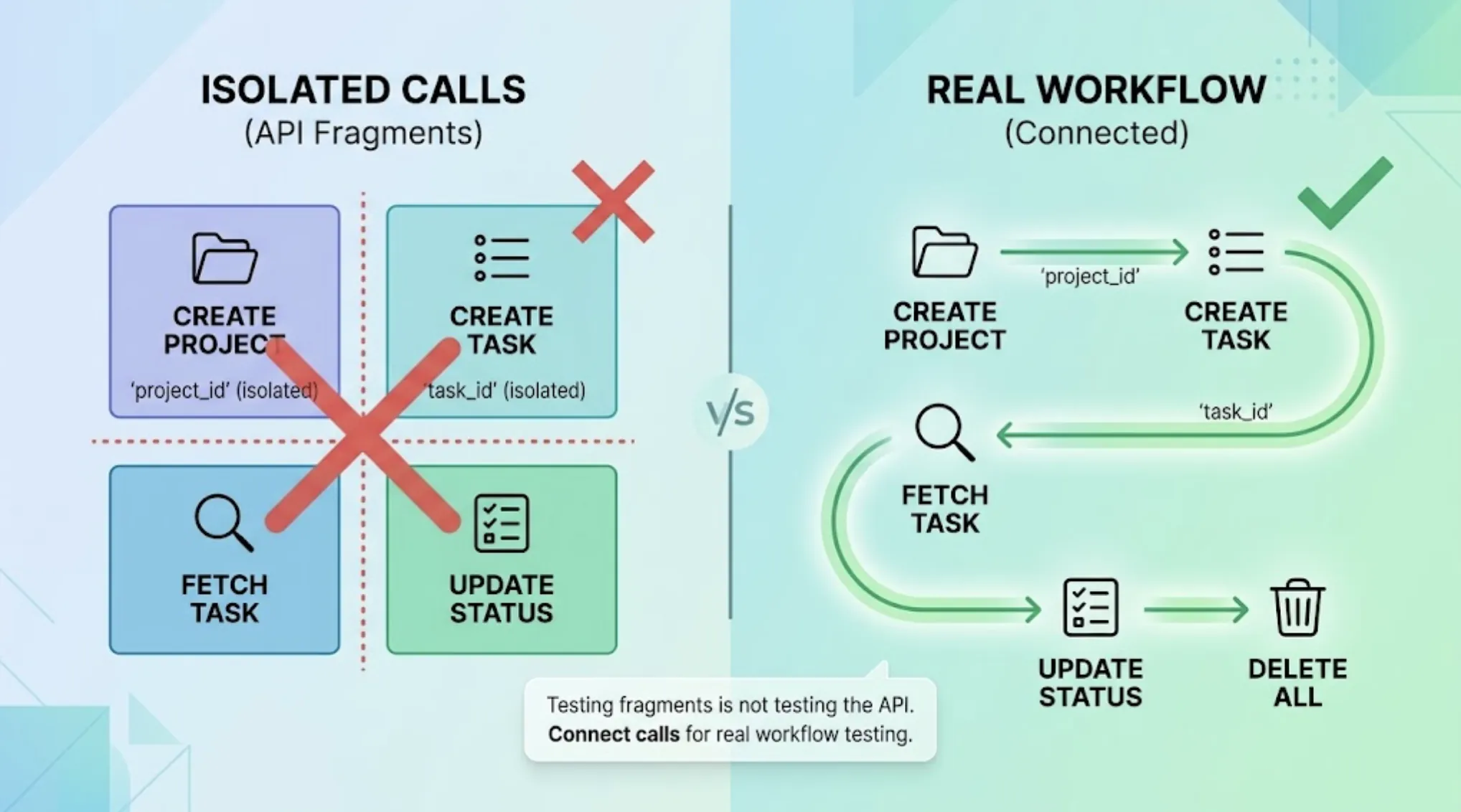
Its evidence base is reality rather than intent: Backend Testing 2.0 calls each API endpoint and observes what actually returns before generating any assertion, so the verification describes the running system, including everything the coding agent's assumptions became once they met the framework, the serializer, and the database. And its scope is the whole product rather than the change: the agents navigate the full surface, which is where a session's side effects land, two screens from the diff, in flows the coding agent had no reason to test because it didn't know it had touched them.
The Division of Labor That Makes the Loop Work
Separation doesn't mean the two agents work apart. It means they hold different roles in one loop, and the loop works precisely because the roles don't collapse into each other.
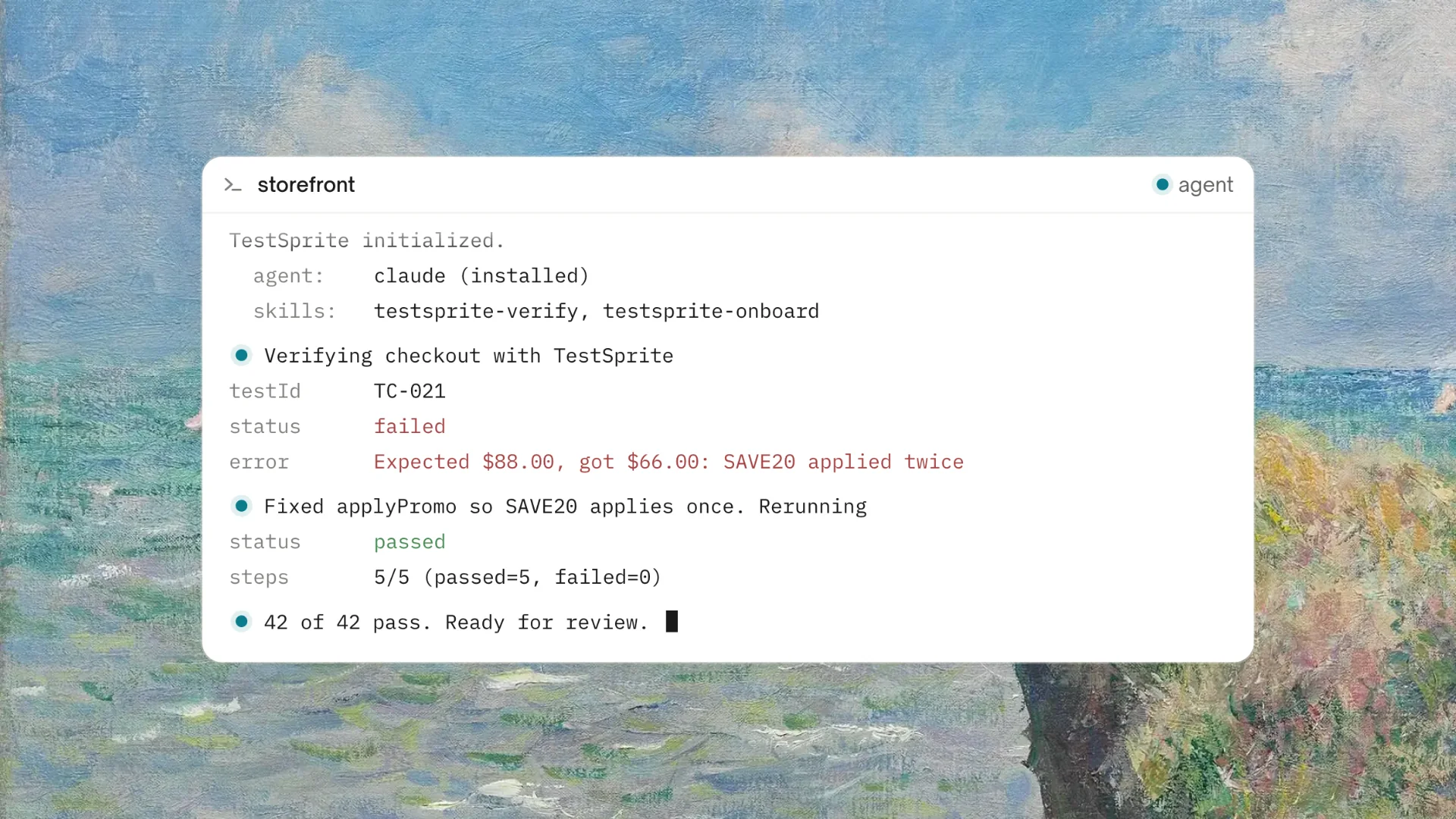
The coding agent produces: it writes the feature, at speed, with full context on how the change was built. The testing agent verifies: it exercises the product like a user, judges outcomes behaviorally, and when something's wrong, returns a finding in product terms, which flow, what action, what should have happened, what did. Then the roles hand off: the finding lands in the same Claude Code or Cursor session through the MCP Server, and the coding agent, the one with the implementation context, proposes the fix. The testing agent's next run confirms it.
Producer, independent checker, and a handoff formatted for machine action. That's not redundancy. That's the same structure as code review, made continuous and automatic.
The Objection Worth Taking Seriously
The strongest counterargument: coding agents are improving fast, and future ones may test far better than today's. True, and it doesn't change the conclusion, because the issue was never capability. A vastly better coding agent writing its own tests is a vastly better mind checking itself, and self-checking has a correlation ceiling no capability raises. Human senior engineers, far more capable than junior ones, still don't approve their own pull requests, and the reason isn't skill.
There's also a practical asymmetry that persists at any capability level: the coding agent sees the change; a testing agent that explores sees the product. Regressions live disproportionately in the space between those two views, and only one of the agents is looking there.
A Scenario: Both Agents, One Bug, Two Verdicts
A team builds a form-builder SaaS with Claude Code. A session adds conditional logic: show or hide form fields based on earlier answers.
The coding agent finishes and writes its own tests: the condition evaluator returns the right visibility for each rule type, nested conditions resolve correctly, invalid rules fail gracefully. Twelve tests, all passing, and all of them deserved to pass, the evaluator is genuinely correct.
The developer triggers TestSprite from the same terminal before pushing. The exploration agents build a form the way a customer would: add a question, attach a condition, preview the form, fill it as a respondent. They find that hidden fields are visually hidden but still submit their default values, so a respondent who never sees the "company size" field still sends "1-10 employees" into the results, and downstream, into the customer's CRM sync. The evaluator was right about visibility. The submission handler was never told visibility existed, and no test born from the session's understanding would have checked it, because the session's understanding was about showing and hiding, not about what submits.
The finding lands in the Claude Code terminal. The coding agent, now holding a fact it couldn't have generated, excludes hidden fields from submission, and the next run confirms both the visibility and the payload. Two agents, one loop, and the bug that self-verification certified is the one independent verification caught.
Conclusion
Do AI coding agents need a separate testing agent? Yes, for the same reason authors have always needed independent reviewers: verification that shares its source with the work inherits the work's blind spots. The coding agent's own tests are worth having, and they verify intent against itself. A separate testing agent verifies the product against reality, with independent perception, observed evidence, and full-surface scope.
The two aren't rivals in the workflow. They're the two roles that make the loop close: one writes, one checks, and the handoff between them, finding in, fix out, same session, is what turns AI-generated code into software you can ship.
Give your coding agent an independent checker with TestSprite's free plan today.