Can TestSprite Run Alongside My Existing Selenium, Cypress, or Playwright Suite?
Rui Li5 min read

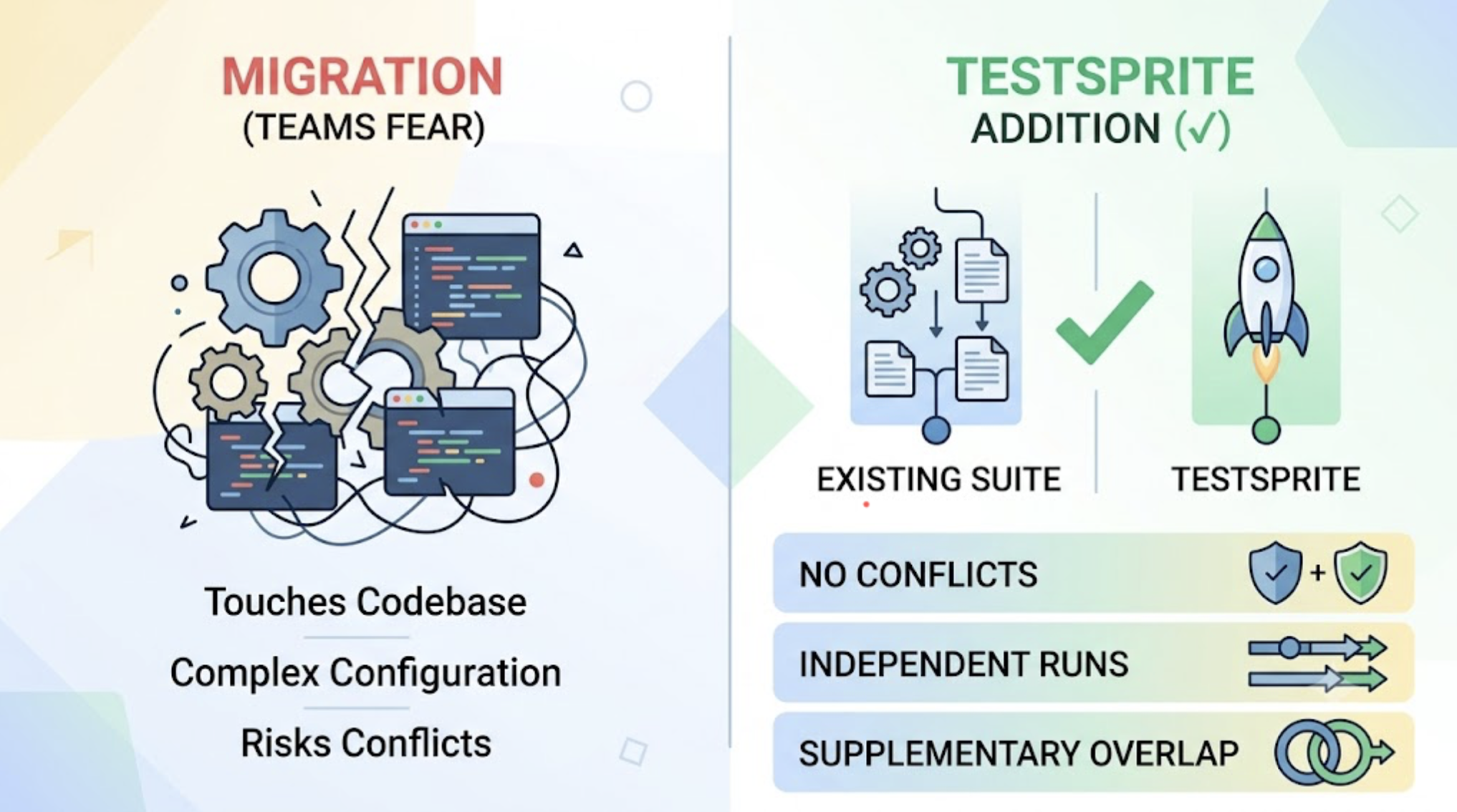
Yes, and cleanly. TestSprite doesn't touch your test code, your repository's dependencies, or your framework configuration, so running it alongside an existing Selenium, Cypress, or Playwright suite isn't a migration project. It's an addition.
That's worth spelling out operationally, because the most common hesitation from teams with an established suite isn't philosophical. It's practical: will these two things conflict, who runs when, and what happens where they overlap. Here's the answer to each.
Why There's Nothing to Conflict With
Your framework suite lives in your repository: test files, dependencies in package.json or requirements.txt, a runner configured in CI, selectors and assertions maintained by your team.
TestSprite lives entirely outside that footprint. It tests your deployed application, staging, preview environments, whatever URL you point it at, from its own ephemeral cloud sandbox. There's no package to install in your repo, no config file next to your Cypress setup, no version of anything to reconcile with your existing toolchain.
Other verification tools read your code and guess. TestSprite opens your app and uses it.
The practical consequence: adopting TestSprite changes nothing about how your existing suite runs, and removing it later, if you ever wanted to, would be equally clean. The two systems share exactly one thing, the application under test, and that's the one thing that can't conflict.
The Operational Setup: Two Checks, Side by Side
In CI, coexistence looks like two independent checks on the same pull request.
Your framework suite runs the way it always has: its own job, its own runner, its own pass/fail. TestSprite's GitHub Actions integration adds a second job that triggers the exploration pipeline against the PR's preview deployment and posts findings as a PR comment. The two jobs don't share resources, TestSprite's execution happens in its cloud sandbox, not on your runners, and they don't share failure modes. A flaky runner that hurts one doesn't touch the other.
Outside CI, the surfaces don't overlap at all. Your suite runs where it always ran. TestSprite adds the in-IDE loop through the MCP Server, one instruction from Cursor or Claude Code after a session, and scheduled regressions from the Web Portal, with Auto-Auth handling authenticated flows on the nightly runs. These are testing moments your framework suite was never wired into, which is precisely why they're additive.
How the Coverage Divides Itself
Teams running both quickly discover that the division of labor doesn't need managing. It falls out of what each system is.
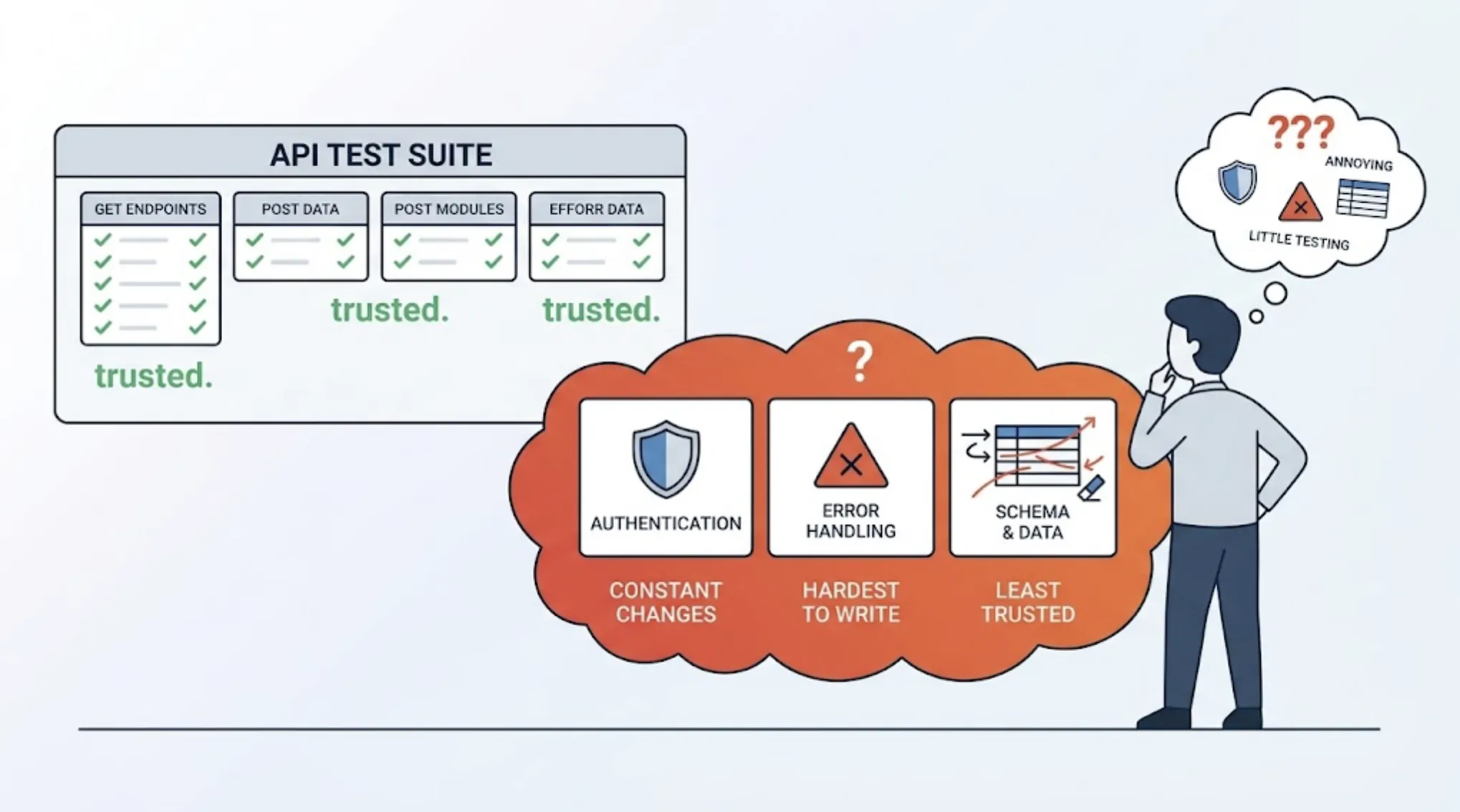
The framework suite covers what your team specified: the critical flows someone wrote tests for, with exact assertions and deterministic steps. That coverage is precise, and it's bounded by what got authored.
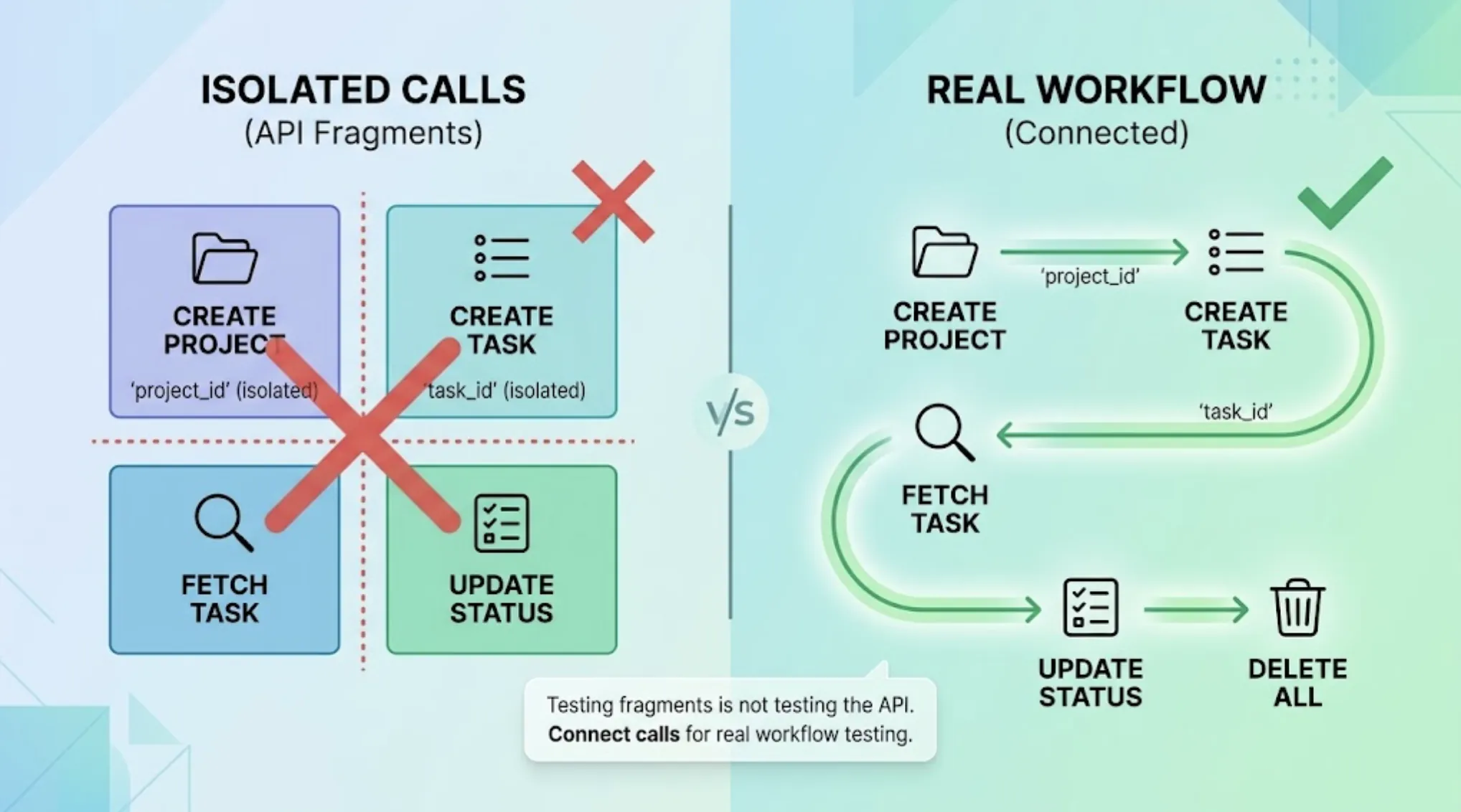
TestSprite covers what the product does: the exploration agents navigate the full surface, including the flows nobody wrote a spec for, the new feature from yesterday's Claude Code session that has no framework tests yet, and the integration seams between flows that were each individually covered. That coverage is broad, and it's bounded by the product itself.
The overlap, flows covered by both, isn't waste. A payment flow verified by your hand-written Playwright test and independently by an agent navigating it like a customer is a flow with two uncorrelated checks. The framework test can encode a stale assumption; the agent doesn't read your test code, so it can't inherit the assumption. When both pass, that means more than either passing alone.
What Each System's Failures Look Like
Running both also means reading two kinds of failure, and they're usefully different.
A framework suite failure is implementation-specific: which assertion, which selector, which line. Your team wrote the test, so your team reads the failure natively. The recurring cost is triage, deciding whether a red test means the product broke or the test went stale after a refactor.
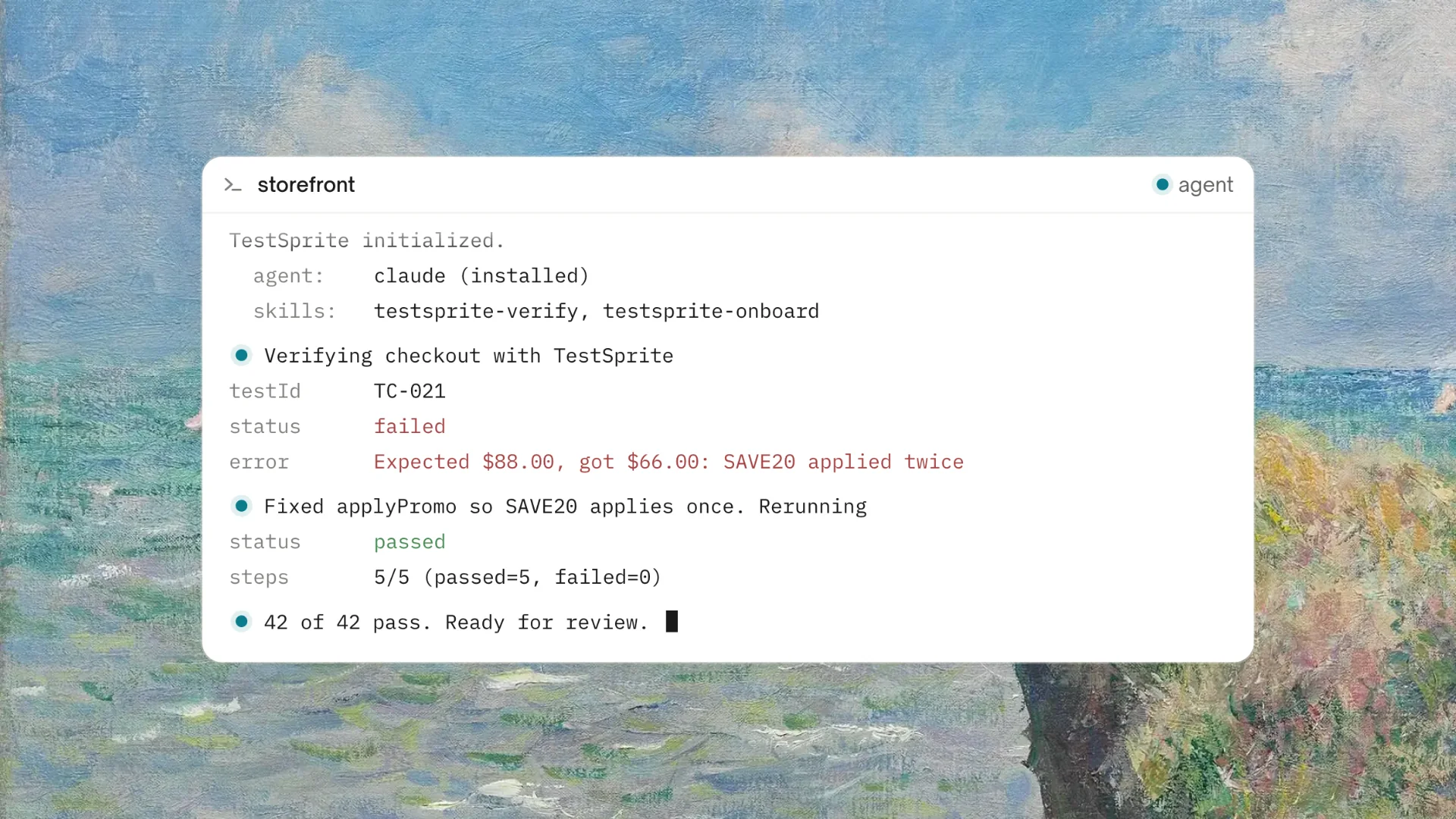
A TestSprite failure is product-level: which flow was navigated, what a user did, what should have happened, what did. Auto-Heal Rerun has already done the triage, structural drift healed and verified with a rerun, so what surfaces is behavioral. The description lands in the IDE formatted for the coding agent to act on, or in the PR comment where the reviewer needs it.
In practice this shapes a sensible habit: the framework suite's failures go to whoever owns the tests, and TestSprite's findings go straight into the fix loop with the coding agent. Two signals, two well-matched response paths, no stepping on each other.
A Scenario: Week One of Running Both
A five-person team runs a podcast hosting platform with a mature Cypress suite: 60 tests covering upload, publishing, and the subscriber feed, maintained for three years and trusted. They add TestSprite without touching any of it: MCP Server into Claude Code on Monday, the GitHub Actions job on Tuesday, a nightly schedule on Wednesday.
Wednesday's PR shows the new reality in one view: the Cypress check green, the TestSprite comment green, two independent verdicts on the same change.
Thursday, a Claude Code session reworks the episode analytics page. The developer triggers TestSprite from the terminal before pushing. The agents navigate as a podcaster would, publish an episode, play it as a listener, then check the analytics, and find that the play count updates but the listener location breakdown shows the previous episode's data, a stale cache keyed on the wrong episode ID. No Cypress test covers the analytics page; it postdates most of the suite. The fix goes in before the PR opens. The Cypress suite, meanwhile, keeps doing exactly what it did last month, untouched and green.
Friday's retro conclusion: nothing about their existing testing changed, and the gaps around it, new surfaces, post-session verification, the nightly watch, are now covered. Total integration effort for coexistence: zero, because there was nothing to integrate.
Conclusion
TestSprite runs alongside Selenium, Cypress, or Playwright suites without conflict because it occupies none of the same footprint: no code in your repo, no shared dependencies, no claim on your runners. Operationally, it's a second independent check in CI, plus the in-IDE loop and scheduled regressions your framework suite never covered.
The coverage divides itself, specified flows to your suite, the full product surface to the agents, and where they overlap, you get two uncorrelated verifications instead of one. Keep the suite you trust. Add the coverage it was never going to reach.
Add TestSprite alongside your existing suite today. Free plan, no credit card, nothing to migrate.