Can Momentic Test APIs and Backend Workflows? What Developers Should Know
 Zeshi Du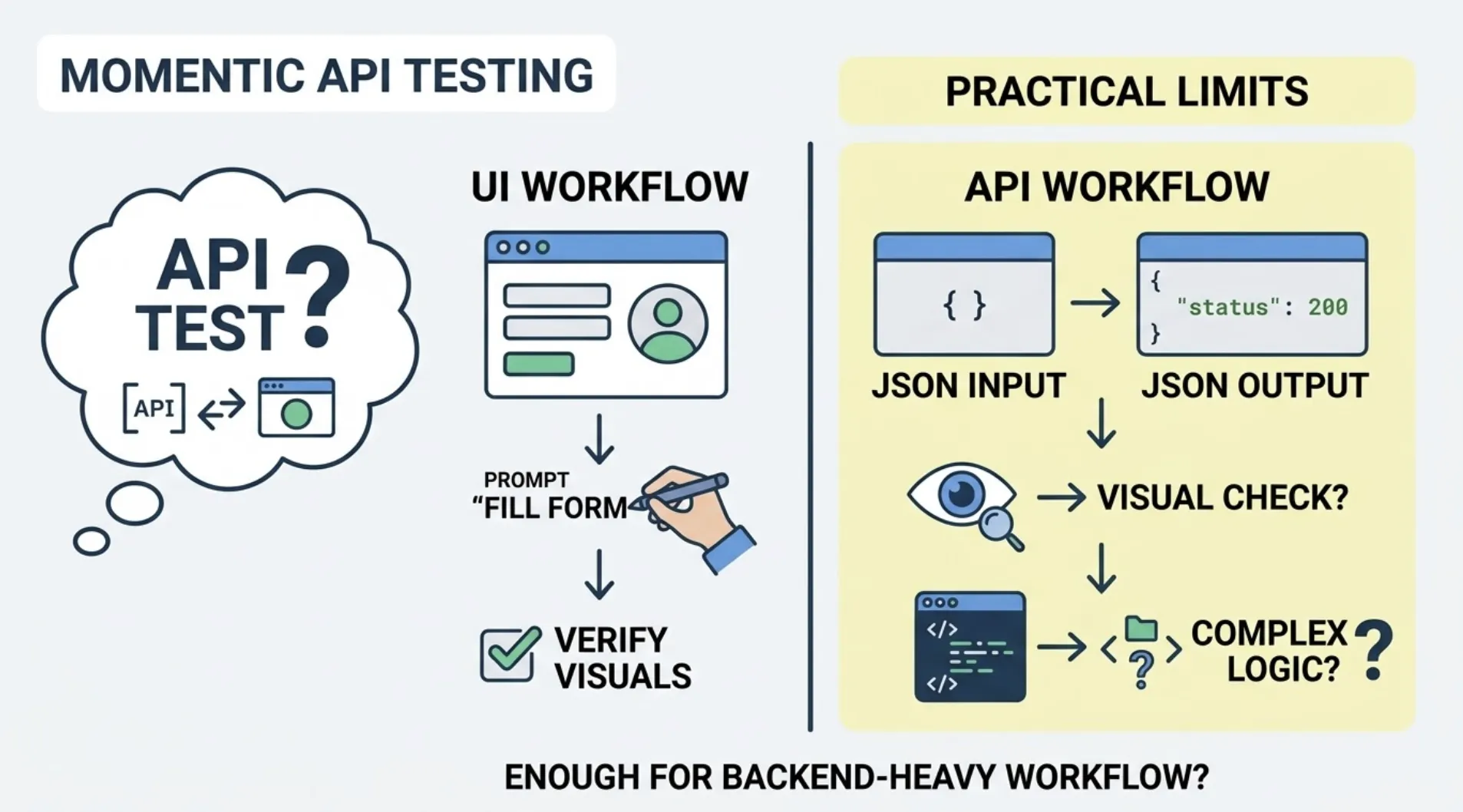
Yes, Momentic can test APIs. The more useful question is what "can" means in practice, and whether it's enough for a backend-heavy workflow. Here's what actually happens when you point Momentic at an API instead of a UI.
What Momentic's API testing actually does
Momentic lets you make API calls as part of a test, either woven into an end-to-end flow or as a standalone check. You can invoke an endpoint, capture a returned value, and assert against the response, the same natural-language authoring style it uses for UI steps applies here.
This is genuinely useful for the common case: your E2E flow needs to seed some backend state, or confirm that a UI action produced the right API side effect. For that, Momentic's API step slots naturally into the same test you're already writing.
Where it starts to strain
The pattern breaks down once your backend testing needs get more specific than "call this endpoint and check the response." A few things developers run into:
No dedicated schema or contract validation layer. If you need to verify that an API's response shape matches an OpenAPI spec, or that a contract hasn't silently drifted between services, that's not what Momentic's API steps are built to check. Third-party comparisons describe its API coverage as handling "common validation needs" without matching the depth of a dedicated API tool.
Multi-step backend workflows require manual wiring. A CRUD lifecycle, create a resource, read it back, update a field, delete it, needs the ID or token from step one carried forward to steps two through four. Momentic's model is UI-flow-first, so chaining backend calls into a coherent, self-contained integration test isn't the platform's core design pattern.
No real-API observation step before writing assertions. This matters more than it sounds. A test that asserts against a guessed response shape, rather than one the tool actually observed, tends to produce the "expected X, got [Object]" class of failures once the real API's structure diverges even slightly from the assumption baked into the assertion.
What "backend workflows" usually actually require
If your team's backend risk includes any of the following, it's worth checking whether your current tool handles it, not just whether it technically can make an API call:
- Cross-service data consistency (does a change in Service A correctly propagate to Service B?)
- Authentication flows beyond a simple login: OAuth token refresh, session expiry, role-based access checks
- Contract stability across deploys, so a backend change doesn't silently break a consumer
- Cleanup after test runs, so backend testing doesn't leave orphaned data in a database
How TestSprite handles the same workflows
TestSprite's Backend Testing 2.0 was built specifically around this category of problem. Before generating any test plan, it silently observes how the API actually responds: real status codes, real field names, real response shapes, and grounds every assertion in that observation rather than an assumption.
Dynamic variables capture real values from responses (a created project_id, a returned token) and pass them automatically to downstream tests, so a full CRUD lifecycle works end-to-end on the first run without manual parameter wiring. The agent also detects multi-step user journeys across endpoints on its own and assembles them into runnable integration scripts, and sweeps up test-created resources in dependency order after every run.
When a test can't run because an upstream value is missing or a credential's expired, TestSprite shows an honest yellow "Blocked" status with a plain-English explanation, rather than a misleading red "Failed" that sends you hunting for a bug that isn't there.
The honest comparison
Momentic's API testing is a reasonable convenience feature for teams whose primary workload is UI and mobile E2E, and who occasionally need to check or seed backend state along the way. It's not designed to be the backbone of a backend-testing strategy. If API and backend correctness carries real weight for your product, a tool built specifically around evidence-grounded backend verification will cover more ground.
Conclusion
Momentic can technically test APIs, but it's an E2E-first tool with API testing layered in, not a backend-first one. If your workflow depends on real contract validation, multi-step backend chains, and honest failure states, TestSprite's Backend Testing 2.0 was built for exactly that gap, worth checking against your actual endpoints before deciding either way.