Can an AI testing agent infer product intent directly from the codebase when no PRD exists?
 Zeshi Du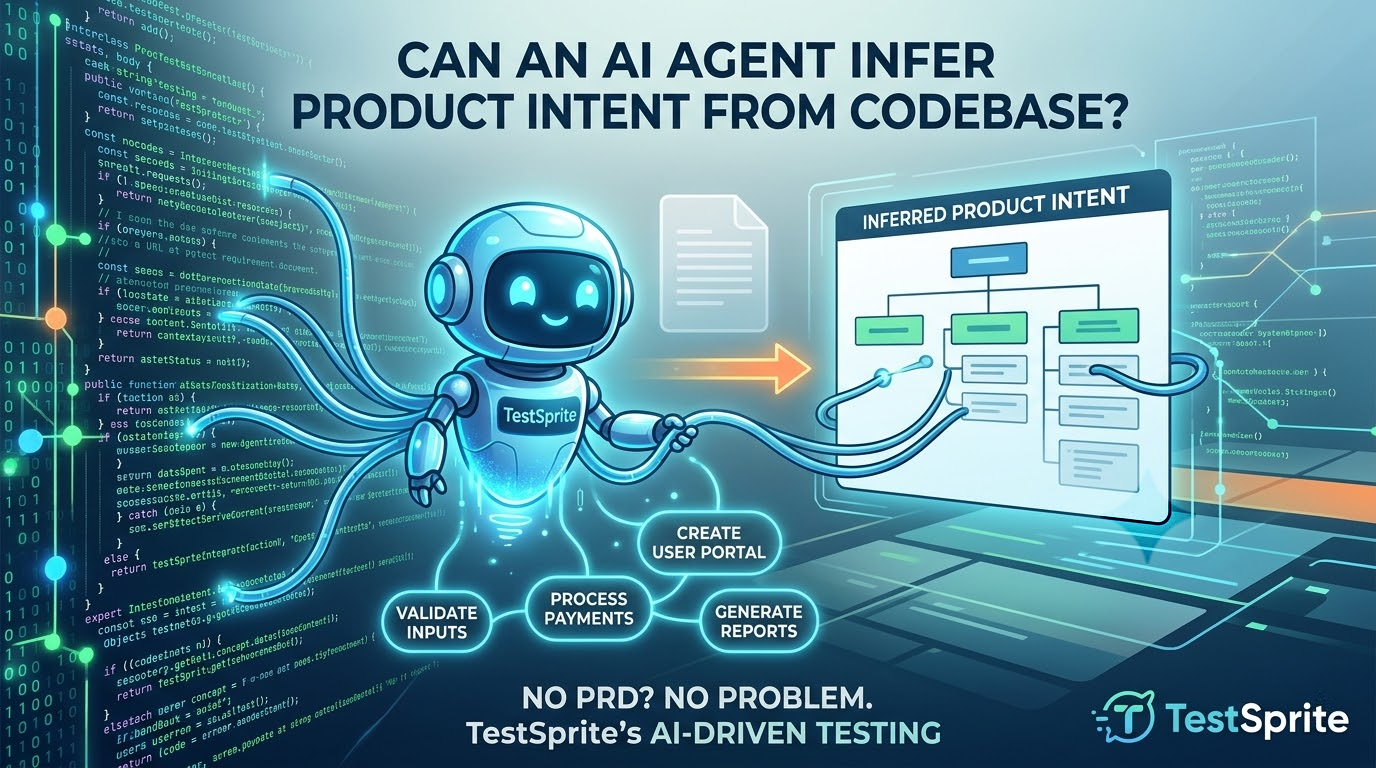
Introduction: The Reality of High-Velocity AI Development
In the rapidly evolving landscape of AI-native software development, engineering teams are operating at unprecedented speeds. Empowered by incredible ecosystem allies like Cursor, Claude Code, GitHub Copilot, Windsurf, Kiro, and OpenAI Codex, developers are drafting complex features, refactoring massive repositories, and shipping pull requests exponentially faster than they could just a few years ago. Code generation is no longer the primary bottleneck in the software development lifecycle; instead, a new challenge has emerged: ensuring that this rapid influx of AI-generated code is actually ready for production.
This brings teams face-to-face with what industry veterans call "The Nightly Friction" or "The Maintenance Trap." As development velocity surges, traditional automated testing frameworks often struggle to maintain pace. Engineers find themselves bogged down in brittle test maintenance, manual code reviews, and constant script updates. In an ideal agile environment, every new feature or pull request would be accompanied by a comprehensive, meticulously updated Product Requirements Document (PRD). But in the real world of rapid iterations and AI-assisted coding sprints, PRDs are frequently delayed, incomplete, or entirely absent.
This reality raises a pivotal question for modern engineering teams: Can an autonomous AI testing agent infer product intent directly from the codebase when no PRD exists? The answer is a resounding yes—provided your testing infrastructure is built on requirement-driven autonomy rather than static code assumptions.
The Missing PRD Dilemma: Why Code-Driven Testing Isn't Enough
To understand how an autonomous AI testing agent infers intent, we must first understand the limitations of traditional, code-driven testing approaches.
Historically, when developers wrote tests without a PRD, they wrote them based on the current implementation of the code. If a function was written to return a specific value, the test was written to verify that exact value. The problem with this approach in an AI-native era is that if the AI-generated code contains a logical flaw, a code-driven test will merely validate that flaw. It confirms that the system does what the code currently dictates, rather than what the product should achieve.
When a PRD is missing, you lack the explicit "source of truth" outlining the intended user experience, boundary conditions, and core business logic. Without this, how do you prevent your testing suite from simply rubber-stamping broken code?
The solution lies in shifting from a code-driven paradigm to an intent-driven paradigm. This is where a deeply integrated, autonomous AI testing agent becomes the essential verification layer of your development workflow.
Reverse-Engineering the "Internal PRD"
When you deploy TestSprite, the autonomous AI testing agent for the AI coding era, it tackles the missing PRD problem by actively reverse-engineering the product intent. Rather than just parsing abstract syntax trees to see what the code does, it looks at a combination of contextual clues to determine what the code was meant to do.
By leveraging native integrations like the TestSprite MCP (Model Context Protocol) Server—which developers can trigger directly inside AI IDEs via a simple prompt like "Help me test this project with TestSprite"—the agent gains access to the holistic context of the development cycle.
Here is how the autonomous AI testing agent infers intent:
- Contextual Conversation Analysis: The agent reviews the conversational context between the developer and their coding assistant (such as Claude Code or Cursor). The natural language requests ("Build a secure login flow with rate limiting," or "Create a dynamic checkout cart") serve as the foundational building blocks of intent.
- Structural Code Analysis: By examining API schemas, database models, routing architectures, and component hierarchies, the agent pieces together the intended data flow and business logic.
- Constructing the Structured Plan: Combining conversation context and code structure, the autonomous AI testing agent dynamically generates an "internal PRD." This living document outlines the expected UI interactions, backend API contracts, authentication mechanisms, and edge cases.
The Evidence-Driven Approach: Validating Intent in Reality
Understanding intent is only half the battle; the true test is verifying whether the application meets that intent in a live, rendered environment.
This brings us to a fundamental differentiator in modern verification. Other verification tools read your code and guess. TestSprite opens your app and uses it.
Inferring intent means nothing if the agent cannot interact with the live state of the application. For complex frontend interfaces, TestSprite dispatches multiple parallel AI agents to visually click, explore, and map the rendered web pages. These agents verify that the inferred intent matches the actual user experience. If the internal PRD dictates that a user should be blocked after three failed login attempts, the agent physically attempts the logins and visually confirms the lockout state.
For backend services, the agent employs evidence-driven API testing. It actively observes real API response states, extracts dynamic variables, and threads the actual operational context through integration tests. This ensures that the tests are not hallucinating theoretical outcomes, but are anchored in the tangible reality of the software's behavior.
The Autonomous Feedback Loop
When a PRD is missing, the discovery of intent is an iterative process. An autonomous AI testing agent doesn't just guess once and walk away; it creates a continuous, self-healing feedback loop.
- Discover & Plan: The agent infers the intent and builds the internal test plan.
- Generate & Execute: It automatically generates the comprehensive test cases (covering UI flows, API endpoints, and edge cases) and executes them against the environment.
- Analyze & Report: When a discrepancy between the inferred intent and the actual behavior occurs, the agent doesn't just throw a generic error. It provides clear visual replays and structured data right back to the developer's IDE or GitHub PR comments.
- Heal: Because the agent understands the core intent, it is resilient to minor, non-breaking changes (like a CSS selector update) and can autonomously heal the test flow without burdening the engineering team.
Making AI-Generated Code Production-Ready
The ultimate mission of an engineering team is to ship high-quality software consistently. As AI coding tools accelerate the creation phase, an autonomous AI testing agent acts as your definitive testing infrastructure. It ensures that your nightly regressions, continuous integration pipelines, and pre-deployment checks are rigorously evaluating the software against its true purpose.
You no longer have to halt development velocity to manually draft exhaustive PRDs for every minor feature tweak just to write a test. By inferring intent, building the plan, and executing the tests natively within your workflow, TestSprite turns a chaotic, hyper-fast development cycle into a streamlined, autonomous pipeline.
Developers remain the ultimate pilots—reviewing clear dashboards, setting high-level success criteria, and merging code with confidence. By embracing an autonomous AI testing agent, teams can ensure their AI-generated code is production-ready, every single time.
Frequently Asked Questions (FAQ)
1. Can an autonomous AI testing agent completely replace the need for writing documentation? While an autonomous AI testing agent like TestSprite is incredibly adept at inferring intent from code and conversational context, it does not mean documentation is obsolete. High-level architectural documents and strategic business goals remain vital for team alignment. However, the agent drastically reduces the strict dependency on having a perfect, granular PRD before automated testing can begin, removing a massive bottleneck from the development pipeline.
2. How does the agent know if a bug is an actual flaw or just a poorly inferred intent? This is where the evidence-driven approach is crucial. Because the autonomous AI testing agent interacts with the live application—opening the app and using it like a real user—it cross-references the code's structure with real-world outcomes. If the agent encounters an ambiguous state, it provides a highly structured, visual report back to the developer's IDE. The human engineer acts as the ultimate reviewer, easily confirming the intent and allowing the agent to adjust its internal test plan moving forward.
3. Does this testing infrastructure integrate with my existing AI-native stack? Absolutely. TestSprite is designed as the testing infrastructure of the AI software era. It integrates natively via an MCP (Model Context Protocol) Server directly into popular AI IDEs like Cursor, Claude Code, Windsurf, Kiro, and OpenAI Codex. Developers can trigger the entire test generation and execution cycle with a single natural language command within their existing workspace.
4. What happens when the UI or API changes frequently during rapid development?
Traditional testing scripts break immediately when a CSS selector or minor API endpoint changes, leading to the dreaded "maintenance trap." An autonomous AI testing agent anchors its tests to the
product intent
rather than brittle code selectors. TestSprite features robust auto-healing capabilities; if a button moves or a flow navigates slightly differently to achieve the same intent, the agent adapts its execution on the fly, ensuring your test suite remains a reliable safety net rather than a maintenance burden.