Can AI Test Auth Flows in a Web App?
 Zeshi Du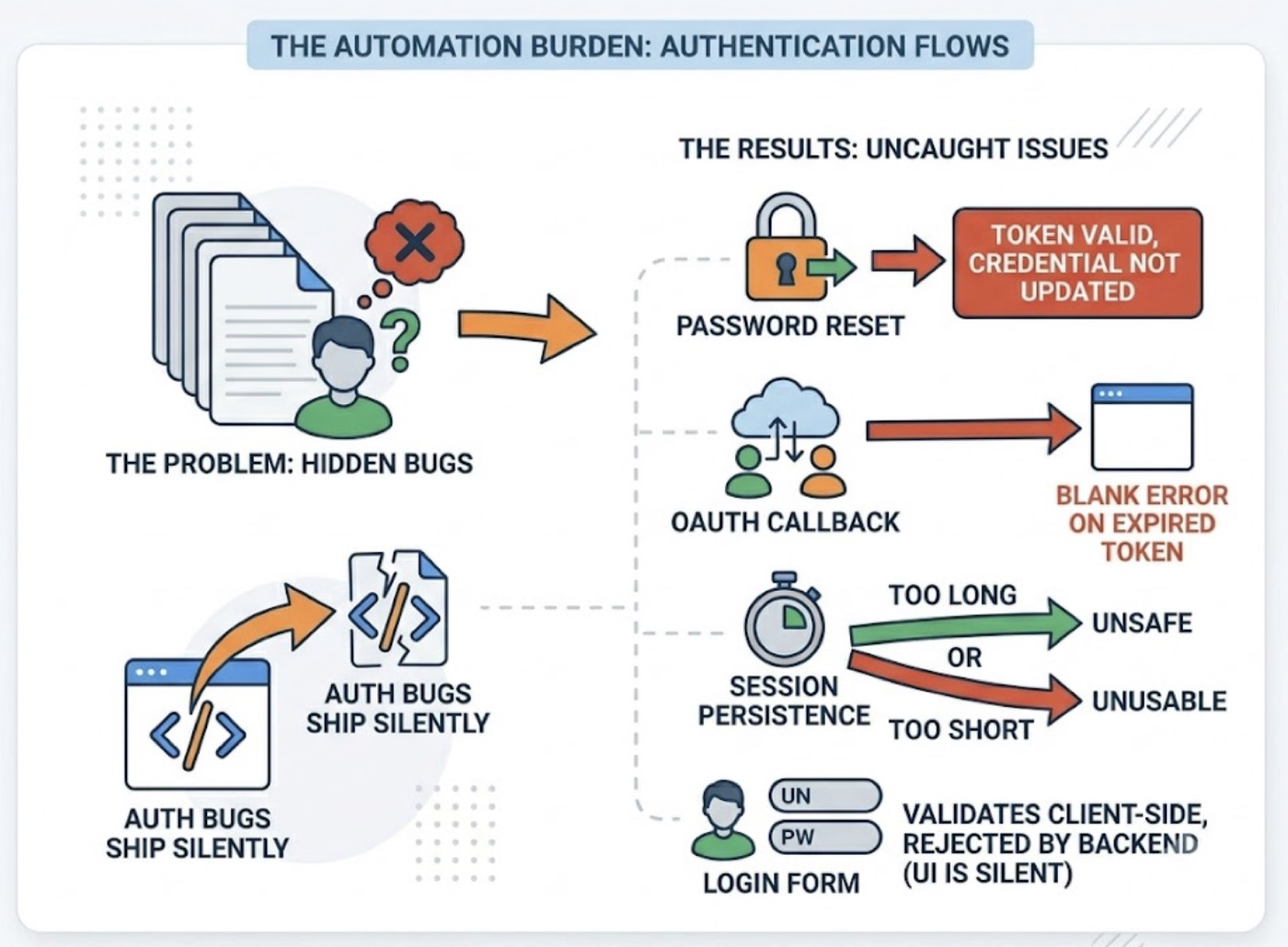
Authentication flows are among the most critical paths in any web application and among the most commonly undertested.
The reason is practical. Auth flows are hard to automate well. They involve credentials that expire, tokens that rotate, sessions that need to be established before anything else can run, and edge cases that only appear at the boundary between the frontend and the authentication provider. Most testing approaches either skip auth entirely, hardcode credentials that break on the next rotation, or test the auth logic in isolation without running the actual login sequence.
The result is a category of bugs that ships silently. A password reset flow that accepts the token but fails to update the credential. An OAuth callback that handles the happy path but produces a blank error screen on an expired token. A session that persists longer than it should, or not long enough. A login form that validates correctly on the client side but gets rejected by the backend for a reason the UI never surfaces to the user.
AI can test auth flows. But the approach matters significantly.
Why Auth Flows Break Automated Testing
Standard automated testing approaches struggle with auth flows for a structural reason. Authentication requires state, and state requires sequence.
A logged-in session doesn't exist until the login flow has run. A token doesn't exist until the authentication provider has issued it. A session doesn't expire until time passes or a specific event triggers the invalidation. Code-layer tools can mock these states, but mocking a session isn't the same as establishing one through the real login sequence.
Testing auth flows correctly means actually running them. Visiting the login page. Submitting real credentials. Following the redirect. Establishing a real session. Then using that session to access protected resources and verifying they respond correctly.
For OAuth flows, it means visiting the authorization URL, granting consent, following the callback, and verifying that the resulting token can be used correctly. For password reset flows, it means requesting the reset, following the reset link, submitting the new credential, and confirming that the old credential no longer works and the new one does.
Each of these is an interaction sequence, not a code check. Verifying it requires an agent that runs the sequence.
How TestSprite Tests Auth Flows
TestSprite tests auth flows by running them, the same way a real user or a thorough QA engineer would.
Other verification tools read your code and guess. TestSprite opens your app and uses it.
TestSprite's Auto-Auth capability handles the authentication layer automatically. It supports password endpoint authentication, OAuth refresh token flows, and AWS Cognito configurations. Before every test run, the agent runs the appropriate login sequence, establishes a real session, and arrives at the authenticated state through the actual auth flow, not through a shortcut that bypasses it.
This matters for two reasons. First, it means the auth flow itself gets tested on every run. If something in the auth sequence is broken, it surfaces immediately rather than being hidden behind a mocked session. Second, it means every test that runs after authentication is running with a real session, which catches the failures that only appear when authenticated state is genuine rather than simulated.
For teams with multiple user roles, the agent runs the auth flow for each relevant role. An Admin-role session and a Viewer-role session are established through separate, real login sequences. The downstream behavior for each role gets verified under the actual authentication context that role would have.
Testing the Edge Cases That Matter
The happy path of an auth flow is rarely where bugs live in production. The bugs live at the edges.
TestSprite's exploration agents navigate auth flows the way a real user with varied intentions would. They test the happy path, which they should. They also probe the edge cases that hand-crafted test suites routinely miss.
Expired tokens. What happens when a session token expires mid-flow? The agent operates across sessions and can simulate the experience of a user whose token expires while they're active. Does the application gracefully prompt re-authentication, or does it silently fail on the next protected request?
Invalid credentials. Submitting wrong credentials should produce a specific error message. The agent submits invalid credentials and verifies that the error appears correctly, that it's specific enough for the user to understand what went wrong, and that the form doesn't lock the account unnecessarily after a single failed attempt.
OAuth callback errors. OAuth flows can fail at the callback stage for reasons outside the developer's control. The agent tests what happens when the callback arrives with an error parameter rather than a code. Does the application handle it gracefully, or does the user see a blank screen?
Password reset lifecycle. The agent requests a password reset, follows the reset link, submits a new credential, and then verifies two things: the new credential grants access, and the old credential no longer does. Both halves of this verification matter. A reset flow that accepts the new credential but doesn't invalidate the old one is a security failure.
A Scenario: The OAuth Flow That Broke After a Backend Change
A startup uses Claude Code to refactor their OAuth integration after switching to a new authentication provider. The flow looks correct in the code. The happy path works in manual testing.
TestSprite's agents run the full OAuth sequence, including the edge cases. They navigate to the OAuth authorization URL, grant consent, and follow the callback. On this run, they specifically test the token refresh path: simulating a scenario where the access token has expired and the refresh token needs to be used to obtain a new one.
The agents find that the refresh token flow fails silently. The application attempts to use the expired access token, receives a 401 from the API, and returns the user to the login page without explaining why. The refresh token is present and valid, but the refactored code that should be exchanging it for a fresh access token has a bug in how it handles the response from the new provider.
A user whose session expires mid-task would experience an unexplained logout. The code-layer test confirmed the OAuth handler existed and ran. Only the agent that actually ran the refresh flow caught that it wasn't working correctly.
The failure returns to the Claude Code session in structured form. The coding agent receives the description: which flow was running, at which step the token exchange failed, what response came back from the provider, and what the application did instead of recovering. The fix lands in the same session.
Auth Coverage in CI, Without Credential Management Headaches
The practical challenge with auth testing in CI is credential management. Rotating passwords, expiring tokens, and provider-specific configurations make auth tests brittle in automated pipelines.
TestSprite's Auto-Auth removes this friction. Credentials are configured once. The agent handles the token rotation, session establishment, and re-authentication before every scheduled run. Nightly regression runs that cover protected flows don't fail because a JWT expired at midnight.
When an auth dependency is missing or an authentication flow is broken, TestSprite shows a Blocked status with a plain-English explanation rather than a misleading red failure. The team knows immediately whether a failure reflects a genuine auth bug or a configuration gap.
The GitHub Actions integration brings auth coverage into CI on every pull request. Changes to auth logic get tested against the real authentication flow before they merge. Through the TestSprite MCP Server inside Claude Code, Cursor, or Windsurf, auth coverage runs from a single instruction in the IDE.
Conclusion
AI can test auth flows in a web app, and done correctly, it tests them the same way a real user runs them: by actually completing the sequence, including the edge cases that hand-crafted suites skip.
The auth flows that matter most are the ones with state: login sequences that establish real sessions, OAuth callbacks that handle both success and error paths, password reset lifecycles that verify the full credential swap, and token refresh flows that keep long-running sessions valid. Testing all of these requires running them, not reading the code that implements them.
TestSprite runs them. Its Auto-Auth establishes real sessions through real login flows. Its exploration agents probe the edge cases at auth boundaries. Its structured failure descriptions return to the IDE in a form the coding agent can act on directly.
For teams where auth bugs are the failures users notice most, that's the coverage that matters.
Start testing your auth flows with TestSprite from inside your AI IDE today.