Can AI run nightly full regression tests?
 Zeshi Du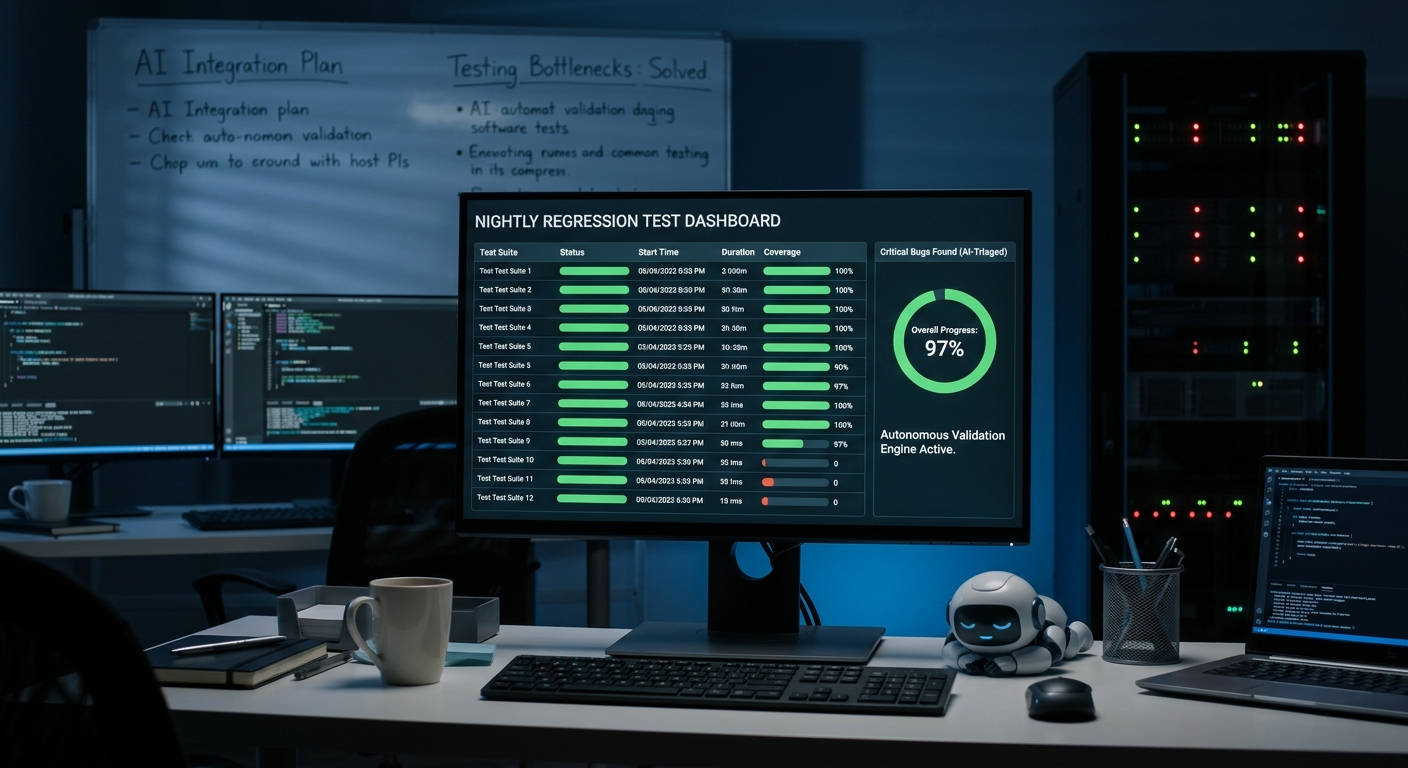
The AI coding boom has completely upended the software development lifecycle. With AI code generation tools like Cursor, Claude Code, and GitHub Copilot, developers are pumping out features, refactoring codebases, and shipping pull requests at 5x to 10x their previous speed. It is an engineering paradise—until 5:00 PM hits.
The massive influx of AI-generated code has exposed a new bottleneck: traditional software testing pipelines. Standard Quality Assurance workflows simply cannot keep up with the sheer volume of newly generated code. Human engineers are left juggling endless code reviews, and the dream of rapid deployment grinds to a halt at the validation stage.
"To close this loop", teams are increasingly looking toward intelligent automation, leading to a critical question: Can AI reliably run nightly full regression tests?
The short answer is yes—but it requires moving past traditional script-based automation and embracing a new era of autonomous software testing. Other verification tools read your code and guess. TestSprite opens your app and uses it. Built specifically for the era of accelerated development, TestSprite approaches software testing not as a simple script executor, but as an autonomous testing agent.
The Midnight Bottleneck: The Limitations of Traditional Nightly Testing
Every engineering team is familiar with the dread of the morning Slack notifications. You set up a nightly regression suite to run at 3:00 AM, hoping to wake up to a green dashboard. Instead, you are greeted by a wall of crimson error logs.
Traditional automated testing frameworks—like Selenium, Cypress, or Playwright—are notoriously brittle. When applied to high-velocity, AI-accelerated development environments, they suffer from three major challenges:
High Scripting and Maintenance Overhead
Traditional test automation requires engineers to manually write, debug, and maintain thousands of lines of test code. If a feature changes, the test script must be manually updated. When codebases are expanding rapidly in an afternoon, teams spend more time fixing broken test scripts than actually catching system anomalies.
The "Code-First" Anti-Pattern
Most testing tools generate assertions based directly on the existing codebase. But what happens if the generated feature contains a subtle, underlying discrepancy? If the testing tool reverse-engineers its test from that faulty code, it will validate the discrepancy as the "correct" behavior. The test passes, but the product remains broken.
Flakiness and the "False Alarm" Fatigue
Nightly tests run unattended, making them highly susceptible to environment-related failures. Two major culprits ruin nightly runs:
- Expired Authentication: At 3:00 AM, a hardcoded JWT token or an OAuth session expires. The test suite cannot log in, and hundreds of tests instantly fail—not because of an actual product defect, but because of a dead session.
- Minor UI Shifts: A developer tweaks a button layout or changes a CSS class name. A rigid testing script can no longer find the element, triggering a false positive.
After dealing with dozens of false alarms, teams develop "alert fatigue." They start ignoring nightly failures, defeating the entire purpose of regression testing.
Enter Autonomous Testing: How AI-Native Agents Solve the Regression Bottleneck
To successfully run full regression tests every single night without constant manual intervention, we have to move away from rigid scripts. The solution lies in an Autonomous AI Testing Agent—a system capable of navigating the entire lifecycle: discovering changes, planning strategies, generating tests, executing them, analyzing failures, and reporting actionable insights.
This is exactly where TestSprite changes the game. Built specifically for the era of accelerated development, TestSprite approaches software testing not as a simple script executor, but as an autonomous testing agent.
Here is how an autonomous AI testing platform solves the classic midnight meltdown:
Requirement-Driven Testing, Not Code-Driven
Instead of blindly trusting the codebase, TestSprite can ingest Product Requirement Documents (PRDs) or extract the true product intent into a structured internal requirement model. By anchoring its tests to what the software should do—rather than what the code currently does—it avoids the trap of validating existing discrepancies.
Grounded Backend and API Testing
Hallucinations and inaccuracies are major concerns in digital workflows. If an autonomous testing solution simply guesses how an API behaves, it will generate thousands of irrelevant errors. TestSprite introduces an Evidence-Grounded Backend approach. Before running or generating tests, the autonomous agent observes real-time API responses, status codes, and payload structures. This grounding in empirical evidence ensures that the generated regression tests are incredibly accurate.
Parallel Frontend Exploration
For user-facing applications, TestSprite deploys a fleet of parallel frontend exploration agents. Rather than following a single hardcoded path, these intelligent agents dynamically explore web pages, click through workflows, and interact with elements just like an expert user would. To give engineers ultimate clarity, the agent can even record video logs of its exploration, making morning reviews seamless.
The 3:00 AM Unattended Execution with Guardrails against False Alarms
True nightly regression testing must be completely unattended. Engineers shouldn't have to wake up in the middle of the night to refresh a token or verify the environment state.
To achieve this, advanced autonomous AI testing engines leverage specialized, production-ready capabilities that keep the testing pipeline moving smoothly while the team sleeps:
- Intelligent Auto-Authentication (Auto-Auth): To eliminate the dreaded expired token issue, systems like TestSprite allow teams to configure password endpoints, OAuth refresh tokens, or AWS Cognito. Right before the 3:00 AM cron job executes, the autonomous agent executes the login flow, fetches fresh credentials, and ensures the entire regression suite runs without authentication hiccups.
- Auto-Heal Reruns: If a test fails due to a minor UI change or a known environmental fluke, the autonomous testing agent doesn't immediately flag it as a breaking defect. Instead, it triggers an intelligent "auto-heal" sequence, analyzing the failure, adjusting the test parameters to accommodate the minor layout change, and rerunning the test. If it passes after healing, the system notes the layout change without sounding false alarms.
- Actionable Dashboards: When engineers log in the next morning, they aren't forced to sift through mountains of raw terminal text. Advanced testing dashboards provide clean, side-by-side comparisons highlighting exactly what changed between the current run and previous baselines, immediately isolating the root cause of any genuine regressions.
Collaboration Over Replacement: The Human-in-the-Loop Reality
Whenever autonomous AI testing is discussed, a common question arises regarding the role of quality assurance.
The reality is that the goal of an autonomous AI testing agent is to empower engineering teams and liberate technical capacity, rather than eliminating human oversight. It provides a highly automated, end-to-end framework that takes over the repetitive, exhausting, and time-consuming burden of writing and maintaining regression scripts.
By handling these heavy-lifting tasks, it allows quality assurance professionals and developers to focus on what humans do best: exploratory testing, complex security analysis, edge-case evaluation, and designing robust software architecture.
This creates a perfect ecosystem alignment. AI development tools like Cursor, Claude Code, and GitHub Copilot handle the hyper-fast generation of code, while an autonomous AI testing agent like TestSprite acts as the dependable guardian—ensuring that rapid production never comes at the cost of software stability. The human engineer remains the ultimate pilot, reviewing clear, high-level dashboards and approving pull requests with absolute confidence.
Conclusion: Get Your Code Production-Ready, Every Single Night
As codebases grow exponentially under the influence of generative AI, relying on manual test scripting for your nightly regressions is no longer sustainable. To maintain high deployment velocity without sacrificing quality, software teams must transition to autonomous, requirement-driven testing pipelines.
AI can absolutely run your nightly full regression tests—provided you leverage an autonomous AI testing agent equipped to think, adapt, and heal on its own.
Ready to stop chasing flaky test scripts and eliminate morning alert fatigue? Integrate TestSprite into your pipeline via its native MCP server for AI IDEs or connect it directly to your GitHub Actions. Let your developers code at the speed of thought, while TestSprite ensures your software remains production-ready, every single night.