Can AI Generate Negative Test Cases?
 Zeshi Du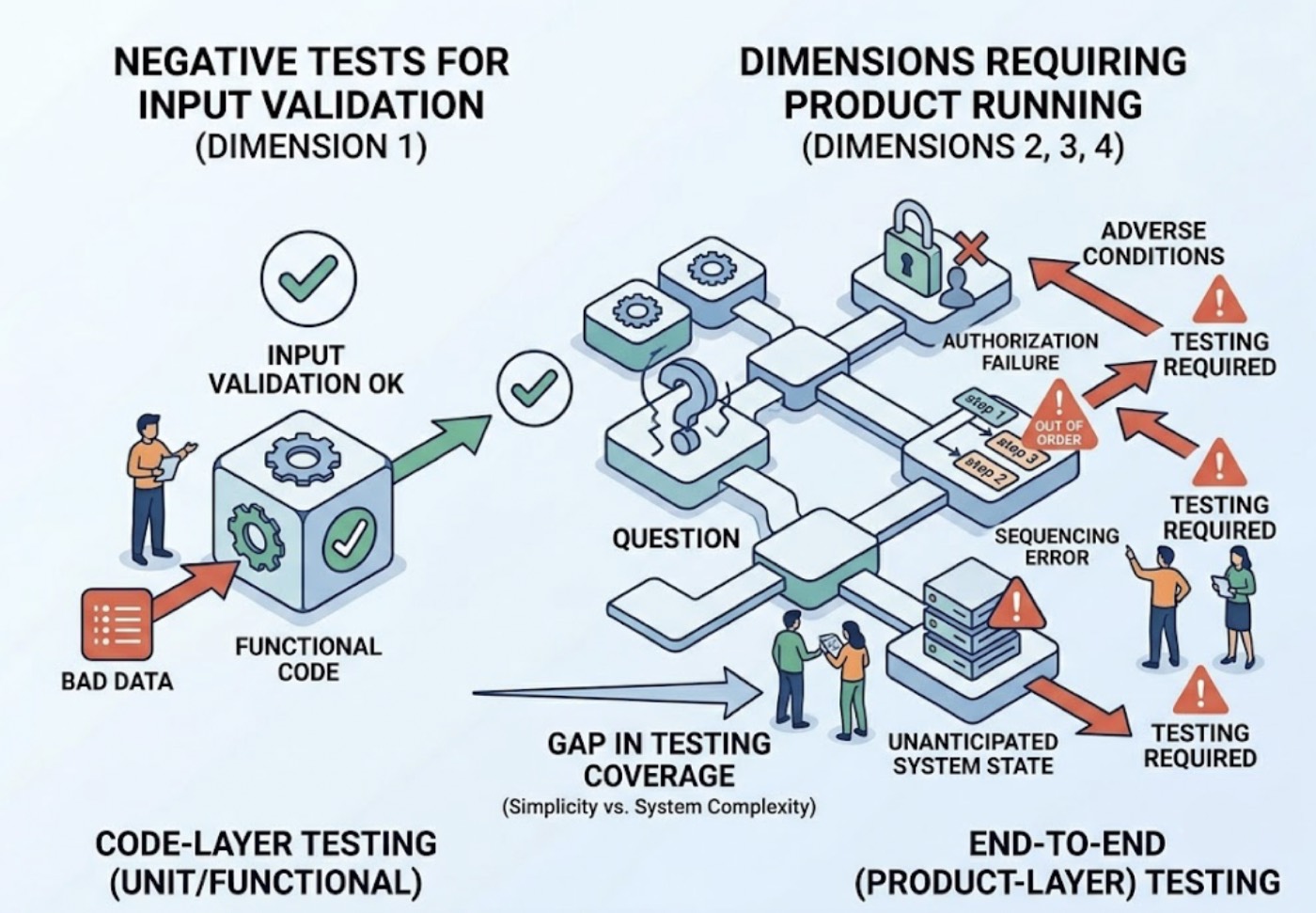
Yes. But the negative test cases worth having aren't the ones most AI tools generate.
The easiest version of AI-generated negative testing looks like this: read the code, identify the validation rules, and produce test cases that confirm each rule rejects the inputs it's supposed to reject. Fast, systematic, and narrow. It covers the happy path's mirror image. It doesn't cover the failure modes that actually reach users.
The negative test cases that matter are the ones that require doing what a real user does when things go wrong. Attempting an action you're not authorized to perform. Submitting a request with a dependency that no longer exists. Triggering a sequence that works correctly in isolation but fails when two layers disagree about what's valid. Pushing the product into a state the developer didn't anticipate and observing what happens.
Generating those test cases requires operating at the product layer, not the code layer.
What Negative Testing Is Actually For
Negative testing answers a specific question: what does the product do when something goes wrong?
That question has many dimensions. Some are about input validation: what happens when the data is wrong? Some are about authorization: what happens when the user doesn't have permission? Some are about sequencing: what happens when the user takes an action out of the expected order? Some are about state: what happens when the system is in a condition the developer didn't fully anticipate?
Code-layer negative testing handles the first dimension reasonably well. It can confirm that validation functions reject bad inputs. The other three dimensions require actually running the product under adverse conditions and observing the outcomes.
Authorization failures don't appear in validation logic. They appear when a user attempts an action against a real resource with real credentials that lack the required permission. Sequencing failures don't appear in individual function tests. They appear when a user completes step three before step two, or returns to step one after completing step four. State failures don't appear in unit tests. They appear when a user arrives at a screen under conditions the developer didn't fully model when writing the code.
Testing these requires an agent that navigates the product, creates the adverse conditions, and observes what happens.
How TestSprite Generates Real Negative Test Cases
TestSprite generates negative test cases by exploring the running application under adverse conditions the way a real user, or a methodical QA engineer, would.
Other verification tools read your code and guess. TestSprite opens your app and uses it.
Through the TestSprite MCP Server inside Claude Code, Cursor, Windsurf, or any MCP-compatible AI IDE, a single instruction launches the exploration. TestSprite's parallel agents navigate the live product and deliberately probe the boundaries: attempting actions that should be blocked, sending requests that should be rejected, navigating flows in sequences that aren't the expected path.
The negative test cases they generate aren't derived from reading the code's rejection logic. They're derived from what the agents observed when they tried the thing that should fail and watched what the product did in response.
Authorization as a Negative Test Domain
Authorization failures are one of the most important categories of negative testing, and one of the most commonly undertested.
A permission check that exists in the frontend but not in the backend. An admin action that a restricted user can reach by navigating directly to the URL. A resource that one user can access that belongs to another user. An API endpoint that accepts requests from any authenticated user when it should only accept requests from users with a specific role.
TestSprite's agents navigate the product under real authentication contexts for each relevant role. They attempt the actions each role should be blocked from performing, both at the UI layer and by calling the underlying API directly. When a restricted user can perform an action they shouldn't, that surfaces as a negative test failure with a precise description: which action was attempted, which role attempted it, what should have been blocked, and what actually happened.
This is negative testing that a code-inspection approach can't produce. Code inspection confirms that the permission logic exists. Product-layer testing confirms that the permission logic actually works under real conditions.
Sequence and State as Negative Test Domains
Negative test cases for sequencing and state require navigating flows in ways that real users sometimes actually follow, even if the developer didn't design for them.
What happens when a user submits a payment for an order that was already fulfilled? What happens when a user tries to accept an invitation after the invitation has expired? What happens when a user navigates back to a multi-step flow they abandoned halfway and tries to complete it from step three without re-entering step two?
TestSprite's agents probe these conditions by constructing the adverse sequences: creating resources and then attempting to interact with them in states they shouldn't be in, running flows out of order, revisiting completed processes, and observing what the product does.
The negative test cases that come out of this exploration aren't predefined. They're discovered. The agents find the states the product can be pushed into and test what happens when it gets there.
API Negative Testing: Beyond Validation Logic
At the API layer, negative test cases extend well beyond input validation.
What does an endpoint do when a required resource doesn't exist? When a request references an ID that belongs to a different user? When a request arrives with a valid token for a role that doesn't have permission to call that endpoint? When a multi-step operation is interrupted partway through and then retried?
TestSprite's Backend Testing 2.0 generates API negative test cases the same way it generates positive ones: by calling the endpoint and observing what actually happens. Before generating any test plan, the agent calls the endpoint with valid inputs to establish the baseline. Then it probes the boundaries: sending requests for resources that don't exist, sending requests with insufficient permissions, sending requests that violate the API's expected sequencing.
The resulting negative test cases are assertions grounded in observed API behavior under adverse conditions. When the API handles a 404 correctly and returns a specific error structure, the test verifies that structure. When the API should return 403 for an unauthorized request, the test confirms the actual response code rather than asserting against the code's rejection logic.
A Scenario: Negative Testing Discovers an Authorization Gap
A developer uses Cursor to build a document sharing feature. Documents can be shared with specific users at specific permission levels: view, comment, or edit. The implementation looks correct. The permission checks exist.
TestSprite's agents explore the feature with negative intent. They create a document as one user, share it with a second user at view-only permission, and then attempt every action as the view-only user: viewing the document (should succeed), commenting (should fail), editing (should fail), deleting (should fail), and changing the sharing settings (should fail).
The UI correctly blocks commenting, editing, deleting, and sharing changes for the view-only user. The agents then call the API endpoints directly with the view-only user's credentials.
The delete endpoint accepts the request and returns a 200. The view-only user can delete the document by calling the API directly, bypassing the UI restriction. The permission check exists in the frontend component. It was never implemented in the API route handler.
That's the negative test case that matters. Code inspection would have confirmed the frontend permission check exists. Product-layer negative testing found that the backend doesn't enforce the same rule.
The failure returns to the Cursor session in structured form. The fix lands in the same session.
Conclusion
AI can generate negative test cases. The ones worth having go beyond input validation to cover the failure modes that actually reach users: authorization boundaries that aren't enforced at every layer, sequences that break when users don't follow the expected path, states the product can be pushed into under adverse conditions, and API behavior under requests that should be rejected.
TestSprite generates negative test cases by navigating the live product under adverse conditions, the same way a methodical QA engineer or a curious user would probe a new feature. Its agents attempt the actions that should fail, observe what actually happens, and surface the gaps between intended and actual behavior.
The negative test cases that come out of this process aren't derived from reading the rejection logic in the code. They're derived from running the product and watching what it does when pushed.
Start generating real negative test cases with TestSprite from inside your AI IDE today.