Best Momentic Alternatives for Autonomous Full-Stack Testing
 Zeshi Du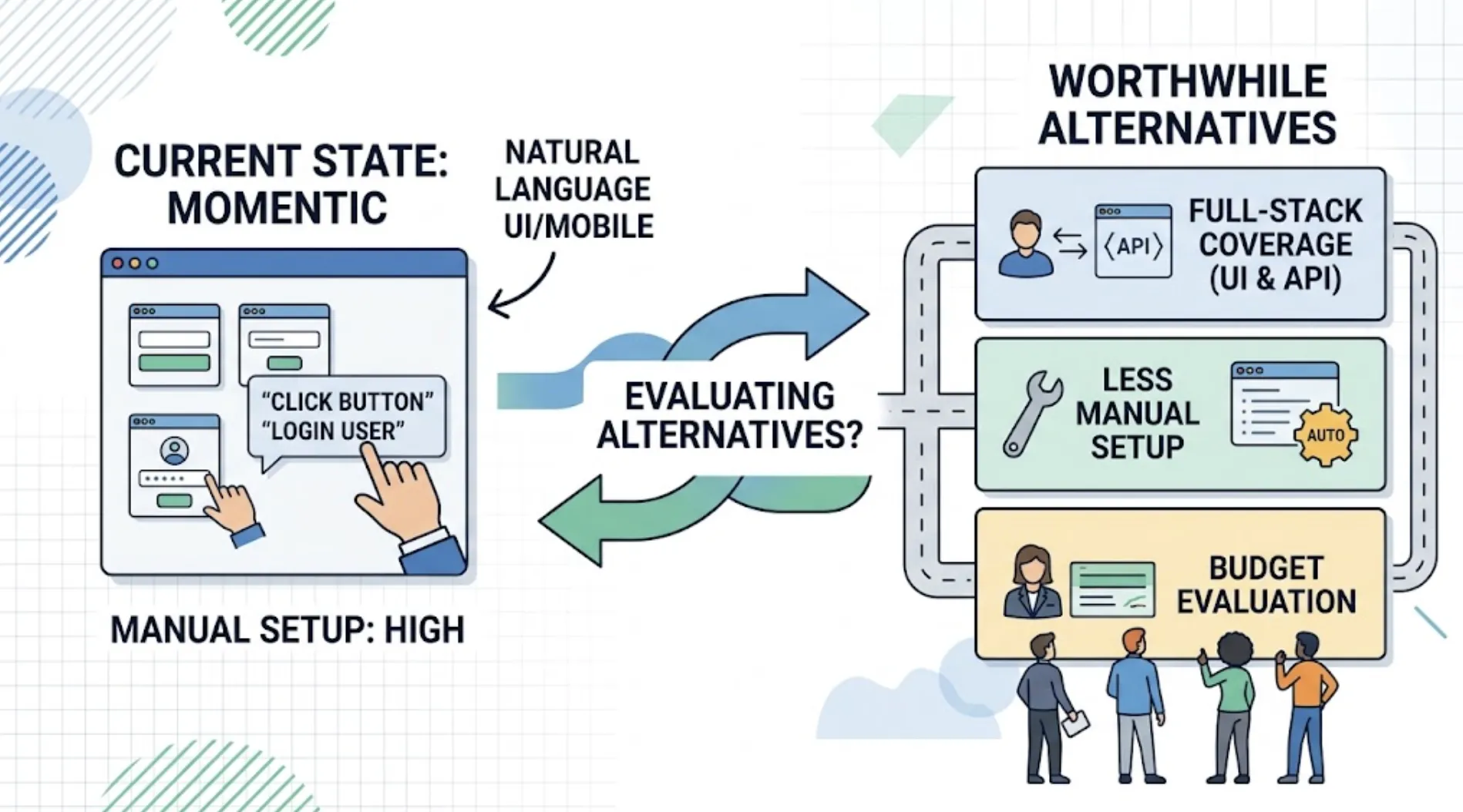
Momentic does natural-language UI and mobile testing well. If what you actually need is full-stack coverage, UI and API and backend, with less manual setup, it's worth knowing what else is out there before you commit a budget line. Here are the alternatives worth evaluating, and what each one is actually built for.
What "autonomous full-stack testing" should mean
Before comparing tools, it's worth being precise about the bar. Autonomous should mean the tool decides what to test and keeps that coverage current with minimal manual authoring, not just that it automates execution of tests you already wrote. Full-stack should mean UI and backend get comparable design attention, not one treated as primary and the other bolted on.
Momentic clears the autonomous bar well for UI. It's the full-stack part where alternatives start to differentiate.
TestSprite
TestSprite is built around a different starting point than most of the category: it's PRD-driven, not code-driven or UI-recording-driven. It parses your PRD when one exists, or reverse-engineers product intent from your codebase through its MCP Server when it doesn't, then generates end-to-end test cases across UI flows, backend APIs, authentication, error handling, performance boundaries, and accessibility.
The backend half of that isn't an afterthought. Backend Testing 2.0 observes real API responses before generating any assertion, so tests are grounded in what the API actually does rather than a guessed shape. Dynamic variables carry captured values (a created ID, a returned token) automatically into downstream tests, so CRUD lifecycles work end-to-end without manual wiring.
Other verification tools read your code and guess. TestSprite opens your app and uses it. It's MCP-native across Cursor, Claude Code, Windsurf, GitHub Copilot, Kiro, and OpenAI Codex, and closes the loop by packaging failures into a structured format your coding agent can act on directly.
Best for: AI-native teams generating code faster than they can manually verify it, and teams that need backend and API coverage treated as seriously as UI coverage.
mabl
mabl is one of the more established names in AI-driven test automation, with a mature low-code recording model and AI-based auto-healing. It covers web, mobile web, and API testing from a single console, with cross-browser execution across Chrome, Edge, Safari, and Firefox.
mabl doesn't publish a free tier, and third-party pricing estimates put its entry tier around $499/month with enterprise contracts reportedly starting well above $40,000/year, figures reported by third parties rather than published by mabl directly. It's a genuinely capable platform, built more for teams with an established QA function and budget than for early-stage or solo use.
Best for: mid-to-large teams that want a mature, low-code recording platform with strong enterprise support and are prepared for an annual, quote-based commitment.
testRigor
testRigor takes a different angle: plain-English test creation aimed specifically at making automation accessible to manual QA testers, not just developers. It covers web, native and hybrid mobile, desktop, and API testing, plus specialized support for platforms like Salesforce and compliance requirements like 21 CFR Part 11.
Its pricing isn't published; third-party estimates suggest its main paid tier runs somewhere in the $900 to $1,000/month range, though that figure comes from reverse-engineered estimates, not an official quote. testRigor has been in the market since 2015, which shows in its breadth of integrations but also means its design center predates the current wave of AI coding agents and MCP-based workflows.
Best for: teams with existing manual QA staff who want to convert manual test cases into automation without learning a framework.
Playwright, Cypress, or Selenium with a dedicated QA engineer
If your team has the headcount, hand-writing and maintaining a framework-based suite still works, and it gives you full control over every test. The tradeoff is the one this whole category exists to solve: someone has to write and maintain that suite by hand, and that person's time doesn't scale with how fast AI tools are now generating code.
Best for: teams with a dedicated QA function and no urgency to change an approach that's already working for them.
How to actually choose
The honest filter is: does your risk live mostly in the UI, or does your backend carry equal weight? Momentic and mabl are both strong UI-first choices. testRigor is strong if manual QA needs a path into automation without code. TestSprite is the option built specifically for teams where AI-generated code needs PRD-anchored verification across both frontend and backend, with a closed loop back to the coding agent that wrote it.
Conclusion
There's no single "best" alternative to Momentic, the right pick depends on whether your gap is UI coverage, backend depth, or getting manual testers into automation. If your team's actual problem is AI writing code faster than anyone can verify it, across the full stack, TestSprite is built specifically for that gap and is worth testing against your own project.