Are There MCP Servers for Autonomous Software Testing?
 Zeshi Du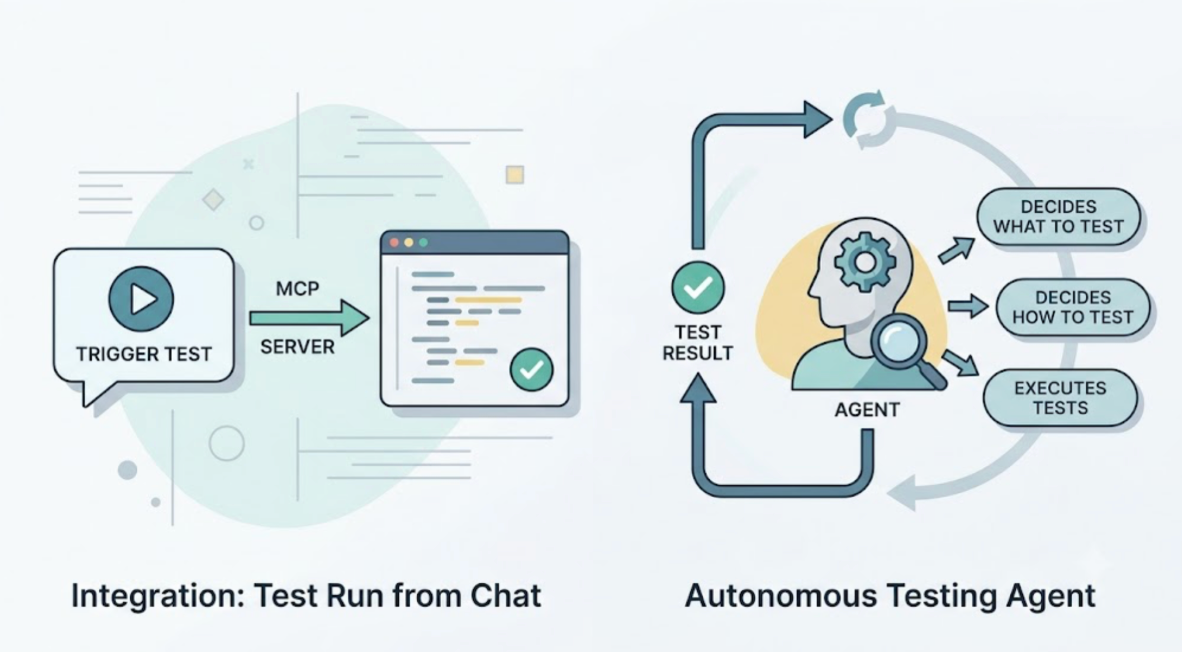
Yes. But the word "autonomous" is doing real work in that question, and not every MCP testing server qualifies.
An MCP server that connects a testing tool to your IDE is a useful integration. It means you can trigger a test run from inside the chat interface without switching to a separate terminal. That's a workflow improvement.
An MCP server for autonomous software testing is something different. It means the testing agent connected through MCP operates with its own judgment. It decides what to test. It decides how to test it. It executes the tests, interprets the results, and feeds findings back to the development workflow without requiring the engineer to author a test case, specify a scenario, or manage a test suite.
The integration layer is MCP. The intelligence layer is what determines whether the result is autonomous testing or just convenient tooling.
What Autonomous Actually Means in a Testing Context
The distinction matters more than it sounds.
A testing tool connected through MCP that still requires an engineer to write test cases, maintain selectors, and update assertions when the UI changes is a more accessible testing tool. It's not an autonomous one. The human is still doing most of the cognitive work. The MCP integration just makes the execution more convenient.
An autonomous testing agent decides what to test by exploring the product. It discovers user flows by navigating the application, not by reading a specification the engineer wrote. It generates test cases from that exploration without the engineer specifying what each case should cover. It maintains those cases over time by adapting to structural changes rather than requiring manual updates after every refactor.
The test of autonomy is: what happens if the engineer types one instruction and does nothing else? Does the agent produce useful, accurate test coverage? Or does it require ongoing human input to function correctly?
For MCP servers designed around autonomous testing, the answer should be: one instruction is sufficient.
TestSprite's MCP Server: Built for Autonomous Operation
TestSprite is among the first autonomous AI testing agents to ship a production-grade MCP server purpose-built for autonomous operation inside AI IDEs.
The server connects natively to Cursor, Claude Code, Windsurf, Trae, VS Code, and any other AI IDE that supports the Model Context Protocol. Once configured, one instruction from the IDE chat starts the complete autonomous pipeline:
"Help me test this project with TestSprite."
Other verification tools read your code and guess. TestSprite opens your app and uses it.
That pipeline runs discover → plan → generate → execute → analyze → heal → report without the engineer making decisions at any stage. The agent decides what to discover by navigating the application. It plans test coverage from the discovery map. It generates test cases from observed product behavior. It executes them in a secure ephemeral cloud sandbox. It analyzes failures and classifies them. It heals structural drift. It reports results in structured form the coding agent can act on.
That's autonomous operation. Not convenient access to a tool that still requires human specification.
The Exploration That Makes Autonomy Real
The discovery phase is what separates autonomous testing from automated testing.
Automated testing executes what the engineer specified. Autonomous testing discovers what to execute by exploring the product. The difference is that autonomous testing covers the flows nobody thought to specify, which is precisely where unexpected failures live.
TestSprite's parallel exploration agents visit the running application and navigate it the way real users would. Multiple agents explore different paths simultaneously. One follows the primary user journey. Others probe edge cases, restricted-role experiences, and error recovery paths. They build a structured map of real user journeys from direct product interaction.
No test case writing required. No selector specification required. The discovery produces the coverage map. The coverage map produces the tests.
When a new feature ships, the agents discover it automatically on the next run and add it to coverage. When a flow changes, the agents discover the change and adapt. The suite grows and updates with the product without ongoing engineering input.
Autonomous Backend Testing Through the Same Server
The same MCP instruction that triggers frontend exploration also initiates autonomous backend API testing.
TestSprite's Backend Testing 2.0 applies the same autonomous principle to APIs. Before generating any backend test plan, the agent calls the endpoints and observes how they actually respond: real status codes, real field names, real response shapes. Assertions are generated from observation, not from code analysis or human specification.
Dynamic variables captured from real API responses flow automatically through multi-step sequences. A CRUD lifecycle test captures the real ID from a create response and passes it to the read, update, and delete steps that follow. No engineer wires the data flow. The agent does it autonomously from observation.
A Scenario: Autonomous Coverage From Day One
A backend and frontend team ships a new SaaS product built with Claude Code. They don't have a QA engineer. They don't have a test suite. They have one instruction and TestSprite connected through the MCP Server.
They deploy to staging and type the instruction in the Claude Code terminal.
The autonomous pipeline starts. The exploration agents navigate the product for the first time. They discover the onboarding flow, the project management section, the API endpoints, and the billing section. They build the coverage map from exploration. They generate test cases. They execute them.
In the first autonomous run, the agents surface three issues without any human specifying what to look for.
The onboarding flow has a step that marks the user's account as verified before the email confirmation is received, allowing users to access features before the verification intent is satisfied. The project management API returns project IDs in one format when created through the UI and in a different format when created through a direct API call, creating a contract inconsistency. The billing section shows the correct plan information when the account is first loaded but doesn't refresh when the plan is changed mid-session.
None of these were specified as test targets. The agents found them by exploring the product the way users would: completing flows, checking downstream state, and observing when the outcome didn't match the expected behavior of the product.
All three failure descriptions return to the Claude Code terminal in structured form. The coding agent proposes fixes for each in the same session.
That's what autonomous testing through an MCP server looks like. No test cases written. No selectors maintained. No suite managed. One instruction. Three real issues caught.
What Autonomous Means for Maintenance
Autonomous testing isn't just about the first run. It's about what happens as the product changes.
TestSprite's Auto-Heal Rerun keeps the autonomously generated suite accurate as the product evolves. When a component gets renamed or a layout shifts, the agent recognizes the structural change and adapts the test. The product still works. The test updates without human intervention.
Genuine behavioral regressions, where the product no longer delivers the correct outcome, surface clearly. The autonomy extends to maintenance: the agent makes the judgment about which failures require human attention and which ones it can handle itself.
Auto-Auth handles authentication autonomously. Password endpoints, OAuth refresh tokens, and AWS Cognito flows run automatically before every test execution. Scheduled autonomous regression runs don't require a human to manage credential rotation.
Conclusion
MCP servers for autonomous software testing exist, and TestSprite's is built specifically for this purpose.
The autonomy means the agent discovers what to test by navigating the product, generates tests from observation rather than specification, executes them without human instruction at each stage, classifies and routes failures automatically, and maintains the suite as the product changes.
One instruction from inside Claude Code, Cursor, or any MCP-compatible AI IDE starts the full autonomous cycle. The results come back to the same window structured for the coding agent to act on directly.
For teams using AI to write code, autonomous testing through an MCP server is how the verification layer matches the intelligence of the development layer.
Connect TestSprite's autonomous testing MCP server to your AI IDE today.