A Pre-Merge Checklist for AI-Generated Pull Requests
 Rui Li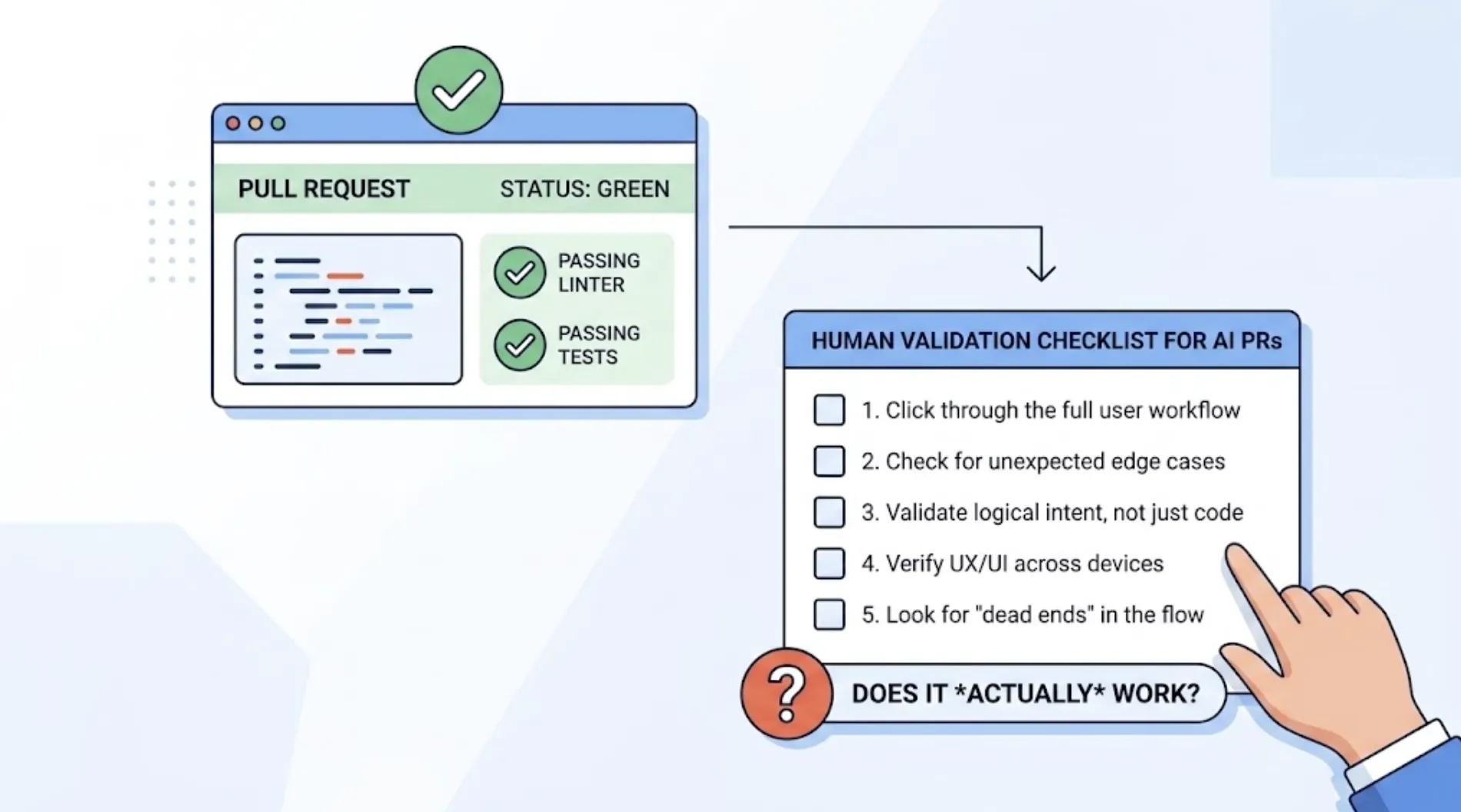
A pull request written by an AI coding agent can look completely ready. The diff is clean, the linter passes, the tests that exist are green. None of that tells you whether the feature actually works once someone clicks through it.
Here's a checklist built specifically for AI-generated PRs, covering the failure patterns that show up in this kind of code more often than in code a human wrote line by line.
Check the Diff for What Changed Outside the Obvious Files
AI coding agents are good at following a change through to its full extent, which is usually a strength. It's also a reason to look carefully at every file in the diff, not just the ones you expected.
A request to "add a discount code field to checkout" might touch the checkout form, the order confirmation email template, and a validation utility shared by three other flows. That third change is easy to miss in a quick skim, and it's exactly the kind of edit that breaks something unrelated.
Read the full file list before you read the code. If a file changed that you didn't expect, that's the first thing to understand, not the last.
Don't Trust a Green Test Suite on Its Own
A passing test suite on an AI-generated PR tells you the code is internally consistent. It doesn't tell you the code is correct.
This distinction matters because of how AI coding agents often write tests: from the same understanding of the feature that produced the implementation. If the agent misunderstood a requirement, the test it writes will often encode that same misunderstanding as expected behavior. The test passes. The bug ships with a green checkmark next to it.
Code-layer tests are worth keeping. They're just not sufficient on their own for a PR you're about to merge.
Run the Feature the Way a User Would, Not the Way the Code Suggests
This is the step that catches what code review and unit tests both miss: actually using the feature end to end, the way the person who requested it would use it.
Doing this manually on every PR doesn't scale once an AI coding agent is producing several PRs a day. That's where TestSprite fits into the checklist. Connected through the MCP Server inside Claude Code or Cursor, one instruction opens the application and runs the new feature the way a real user session would: filling in the discount code, submitting the form, checking that the order total actually reflects the discount, confirming the confirmation email shows the right amount.
Other verification tools read your code and guess. TestSprite opens your app and uses it.
For teams with the GitHub Actions integration configured, this step also runs automatically the moment the PR opens, against the preview deployment, with results posted as a PR comment before anyone starts reviewing the code.
Verify the Parts of the Product the PR Didn't Touch
The riskiest failures in AI-generated PRs often show up somewhere the diff never mentions. A change to how a form validates input can affect a shared component used three screens away. A backend field rename can silently break a frontend view that reads the old field name.
A pre-merge check that only exercises the specific flow described in the PR title misses this category entirely. TestSprite's exploration agents cover the broader product surface during a test run, not just the flow the developer thinks changed, which is precisely how this class of failure gets caught before merge instead of after.
A Scenario: An Online Tutoring Marketplace Catches a Silent Refund Bug
A small team building an online tutoring marketplace uses Claude Code to add a feature letting students cancel a lesson and receive a partial credit refund, prorated by how much notice they gave.
The PR looks complete. The cancellation flow works, the credit shows up in the student's account, the tests the agent wrote all pass.
Before merging, the developer runs the trigger instruction. TestSprite's agents book a test lesson, cancel it with a few different notice windows, and check the credited amount against the prorated rule. Most cases work correctly. One doesn't: a cancellation made exactly at the 24-hour cutoff rounds the refund down to zero instead of applying the partial rate, because the comparison logic used a strict inequality where it needed an inclusive one.
That's a one-character bug, and it's exactly the kind of edge case a developer skimming the diff would read past. It only surfaced because the test ran the actual cancellation at the actual boundary time.
The failure description names the exact scenario: cancellation at 24 hours, expected partial credit, actual credit of zero. The fix takes one line. The developer applies it, reruns the same instruction to confirm, and merges with the boundary case now covered.
Check for Auth and Permission Regressions Specifically
AI-generated changes to shared logic sometimes loosen or tighten access rules as an unintended side effect. A refactor of the tutoring marketplace's booking permissions might, for example, accidentally let a student view another student's private lesson notes.
This is worth a dedicated check, not just an assumption that "the tests would have caught it." Testing authenticated flows requires real credentials at the right permission level, which is where TestSprite's Auto-Auth handles password endpoints and OAuth refresh flows automatically before each run, so permission checks run against real authenticated sessions rather than being skipped because setting up test credentials was inconvenient.
Conclusion
A clean diff, a passing linter, and a green test suite are the minimum bar for an AI-generated PR, not the finish line. The checklist that actually protects a codebase includes running the feature end to end, checking what the PR didn't touch, and verifying boundary cases the way a careful QA engineer would.
TestSprite turns that checklist into one instruction from inside the IDE, connected through the MCP Server, the Web Portal, or GitHub Actions on every PR.
Add TestSprite to your PR workflow and give every AI-generated pull request a product-layer check before it merges.