Flaky Tests: What Causes Them and How to Fix Them for Good
Yunhao Jiao5 min read


Flaky tests are the silent tax on every automated testing program. They fail intermittently, pass on retry, and leave your engineering team with a choice: spend time investigating a failure that probably wasn't real, or ignore it and risk missing a failure that was.
Most teams end up doing both, and neither consistently. The result is a CI pipeline that engineers have learned to distrust — and a quality signal that's been degraded to near-uselessness by accumulated noise.
This guide covers what causes flaky tests, how to diagnose them systematically, and how modern AI testing approaches eliminate the root causes rather than just papering over the symptoms.
What Are Flaky Tests?
A flaky test is an automated test that produces inconsistent results — sometimes passing, sometimes failing — when run against the same code. The test failure is not caused by a real bug in the application, but by a problem in the test itself: timing issues, environmental dependencies, shared state, or non-determinism in the test execution.
Flaky tests are distinct from legitimately failing tests. A legitimate failure means the application has a bug. A flaky test failure means the test has a bug — or more commonly, the test makes assumptions about timing, state, or environment that aren't reliably true.
Why Flaky Tests Are More Damaging Than They Appear
The obvious cost of flaky tests is the time spent re-running CI pipelines and investigating false failures. This is real — teams can waste hours per week managing flaky test noise — but it's not the most serious problem.
The deeper problem is signal degradation. When a CI pipeline is red often enough, engineers stop treating red as meaningful. They learn to retry first, investigate later, and merge if the retry passes. A culture of "it's probably flaky" means real failures get ignored too. Regressions merge. Bugs ship.
Once a team has learned to distrust their test suite, restoring that trust takes significant work — far more than fixing the underlying flakiness would have.
The Seven Root Causes of Flaky Tests
1. Timing and Race Conditions
The most common cause of flaky tests. The test interacts with an element or API before it's ready — a button that hasn't finished rendering, an API response that hasn't returned, an animation that hasn't completed. Fixed waits (sleep(2000)) make things worse by being both unreliable and slow. The correct fix is adaptive waits that monitor real application state.
Signs: Tests pass on slower machines, fail on faster ones. Tests pass locally, fail in CI. Tests start failing after a performance optimization.
2. Shared State Between Tests
Test B depends on state created by test A. If tests run in a different order, or test A is skipped, test B fails for reasons unrelated to the code it's testing. Tests should be fully isolated — each test creates its own state and cleans up after itself.
Signs: Tests pass in isolation but fail when run as part of the full suite. Failures change based on which other tests run.
3. External Dependencies
Tests that make real network calls to third-party APIs, databases, or external services fail when those services are slow, rate-limited, or temporarily unavailable. These failures are environment failures, not application failures.
Signs: Tests fail more often at certain times of day. Failure messages reference network timeouts or 429 rate limit responses.
4. Environment Inconsistency
Tests pass in one environment and fail in another — different Node versions, different timezone settings, different database seeding, different environment variables. The test is making assumptions about the environment that aren't universally true.
Signs: Tests pass locally, fail in CI. Tests pass on one engineer's machine, fail on another's.
5. Brittle Locators
UI tests that use CSS selectors or XPath expressions fail when the DOM changes — even when the change is cosmetic and doesn't affect functionality. A developer renames a class, a framework update changes rendered HTML structure, a design system token changes a component's markup.
Signs: Tests break after UI refactors that don't change user-facing behavior. Failures cluster around the same components repeatedly.
6. Test Interdependency on Execution Order
Related to shared state but specifically about test ordering. Some test runners execute tests in different orders across runs, and tests written with implicit assumptions about order will flake when the order changes.
Signs: Test failures change between runs even when code hasn't changed. Certain tests always fail together.
7. Non-Deterministic Application Behavior
The application itself produces different outputs on the same input — random IDs, timestamps, probabilistic AI outputs, randomized sort orders. Tests that assert on these outputs will flake unless they test intent rather than exact values.
Signs: Tests assert on exact values that include timestamps, generated IDs, or other variable output.
How to Diagnose Flaky Tests
Step 1: Quarantine, don't ignore. Tag flaky tests separately — mark them as known-flaky and exclude them from blocking CI. This stops the signal degradation problem while you fix the root cause. Deleting them is wrong; they often cover real functionality.
Step 2: Run flaky tests in isolation repeatedly. Run the suspect test 20-50 times against a stable codebase. This confirms it's actually flaky and gives you failure rate data.
Step 3: Examine what changes between runs. Timing? Test order? Environment? The failure message usually contains clues. Network timeouts point to external dependency issues. Element not found points to timing or locator issues. State mismatch points to shared state.
Step 4: Fix the category, not just the instance. Fixing a single flaky test by adding a sleep is the wrong move. Fix the category of problem — use adaptive waits systematically, isolate state systematically, mock external dependencies systematically.
How AI Testing Tools Eliminate Flakiness at the Root
Traditional automated testing requires engineers to manually implement all the above fixes — writing adaptive waits, isolating state, mocking dependencies correctly. This is tedious and error-prone work.
Modern AI testing tools like TestSprite address flakiness architecturally:
Intent-based locators replace brittle CSS selectors. Instead of cy.get('.submit-btn-v3'), the AI matches "the primary form submission button" semantically at runtime. UI refactors don't break the test because the intent remains valid even when the markup changes.
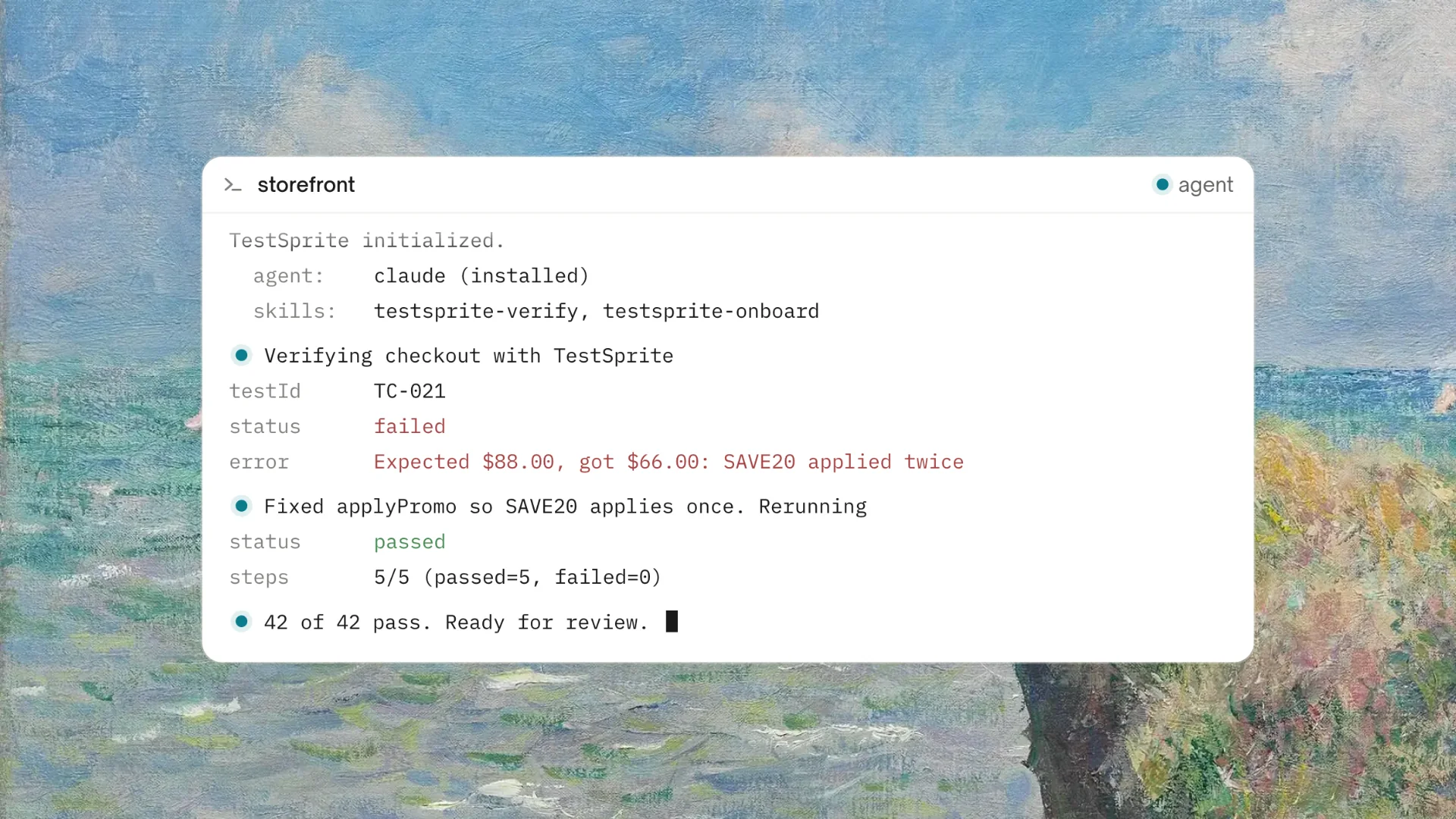
Intelligent failure classification distinguishes test fragility from real bugs automatically. When a test fails, TestSprite's engine determines whether the failure is a real application bug, a timing or locator issue, or an environment problem — and handles each appropriately. Real bugs surface as actionable reports; fragility is auto-healed.
Isolated cloud sandboxes eliminate environment inconsistency entirely. Every test run starts from a known, clean state. No shared databases, no leftover state from previous runs, no local environment differences.
Adaptive execution handles timing and race conditions without fixed waits. TestSprite monitors real page state — DOM stability, network idle, animation completion — before proceeding with each test step.
The practical result: teams using TestSprite report dramatically lower flakiness rates because the AI testing engine is designed to avoid the root causes of flakiness, not just detect and retry them.
Building a Flake-Free Culture
Beyond tooling, the most important thing teams can do about flaky tests is treat them as real bugs. A flaky test is a defect in your test suite, not an acceptable nuisance. It deserves the same attention as a production bug: triage, root cause analysis, and a permanent fix.
Teams that maintain this standard consistently have test suites engineers trust — and test suites engineers trust actually catch regressions.
Start building a flake-free test suite with TestSprite →